United Nations

Press Release: Group Cries Foul Over U.N. Anti-Drug Agency Meddling with State Laws in the U.S.

FOR IMMEDIATE RELEASE                                                                                                     

MARCH 9, 2010

Group Cries Foul Over U.N. Anti-Drug Agency Meddling with State Laws in the U.S.

International Narcotic Control Board says it is “deeply concerned” that states’ medical marijuana laws send “wrong message to other countries”

CONTACT: Aaron Houston, MPP director of government relations …… 202-905-2009 or [email protected]

WASHINGTON, D.C. — The Marijuana Policy Project today denounced efforts by the United Nations’ International Narcotic Control Board (INCB) — currently meeting in Vienna, Austria — to meddle in marijuana reform in the United States. In a recent report, the INCB said they were “deeply concerned” that the country’s 14 state medical marijuana laws are sending the “wrong message to other countries.”

         Additionally, the INCB is “concerned over the ongoing discussion in several states on legalizing and taxing the ‘recreational’ use of cannabis, which would be a serious contravention of the 1961 convention.” However, the Single Convention on Narcotics Drugs treaty explicitly grants exception for any country to make laws that agree with its constitutional and legal requirements; therefore, the U.S. is complying with the treaty.

         “The last thing the INCB should be doing is meddling in our states’ affairs,” stated Aaron Houston, MPP director of government relations. “We are a federalist society and our states are granted the right to decide their own policy—not the federal government, and certainly not the United Nations. Who is the U.N. to tell Texas, Mississippi, Ohio or any other state what to do?”

         The INCB has also criticized several Latin American countries (Mexico, Brazil, and Argentina) for decriminalizing possession of some narcotics, including marijuana.

         With more than 124,000 members and supporters nationwide, the Marijuana Policy Project is the largest marijuana policy reform organization in the United States. MPP believes that the best way to minimize the harm associated with marijuana is to regulate marijuana in a manner similar to alcohol. For more information, please visit www.mpp.org.

####

ALERT: #434 The International Narcotics Control Board On Cannabis

THE INTERNATIONAL NARCOTICS CONTROL BOARD ON CANNABIS ********************************************************************** DrugSense FOCUS Alert #434 - Thursday, 25 February 2010 Today major newspapers across Canada printed articles with headlines like 'Strengthen Medical Marijuana Laws, UN Drug Watchdog Warns' which appeared in the National Post: http://www.mapinc.org/drugnews/v10.n140.a11.html The key paragraph from the article states "The Vienna-based International Narcotics Control Board said Canada is operating outside international treaty rules aimed at minimizing the risk criminals will get hold of cannabis grown under the program." The Board has only the power to encourage governments to act in accordance with the United Nations Conventions on Narcotic Drugs. Governments are free to express their sovereignty as their laws allow. The media is more often than not clueless about this. Understanding this may help you to counter the issues raised in your letters to the editor and your other efforts in support of marijuana law reform. MAP's news clippings are updated a few times each day at http://www.drugnews.org/ Some may touch on this issue, but many will not. Most clippings are worthy of consideration for your letter to the editor writing efforts. ********************************************************************** The Board's report is at http://www.incb.org/incb/en/annual-report-2009.html and Chapter III, Americas is at http://mapinc.org/url/8FhqCC7M. The paragraph about the United States and cannabis is below. 400. While the consumption and cultivation of cannabis, except for scientific purposes, are illegal activities according to federal law in the United States, several states have enacted laws that provide for the "medical use" of cannabis.41 The control measures applied in those states for the cultivation of cannabis plants and the production, distribution and use of cannabis fall short of the control requirements laid down in the 1961 Convention. The Board is deeply concerned that those insufficient control provisions have contributed substantially to the increase in illicit cultivation and abuse of cannabis in the United States. In addition, that development sends a wrong message to other countries. The Board welcomes the reaffirmation by the Government of the United States that cannabis continues to be considered a dangerous drug. The Government has also underscored that it is the responsibility of the Food and Drug Administration to approve all medicines in the United States. The Board notes with appreciation that the Government, following new guidelines on prosecution, which stipulate that activities should not focus on individuals who comply with "medical" cannabis regulations in states, has confirmed that it has no intention to legalize cannabis. The Board is concerned over the ongoing discussion in several states on legalizing and taxing the "recreational" use of cannabis, which would be a serious contravention of the 1961 Convention. The Board emphasizes that it is the responsibility of the Government of the United States to fully implement the provisions of the 1961 Convention with respect to all narcotic drugs, including cannabis (see paragraphs 61-64 above). ********************************************************************** Suggestions for Writing LTEs Are at Our Media Activism Center http://www.mapinc.org/resource/#guides ********************************************************************** Prepared by: Richard Lake, Senior Editor www.mapinc.org === DrugSense provides many services at no charge, but they are not free to produce. Your contributions make DrugSense and its Media Awareness Project (MAP) happen. Please donate today. Our secure Web server at http://www.drugsense.org/donate.htm accepts credit cards and Paypal. Or, mail your check or money order to: DrugSense 14252 Culver Drive #328 Irvine, CA 92604-0326. (800) 266 5759 DrugSense is a 501c(3) non-profit organization dedicated to raising awareness about the expensive, ineffective, and destructive "War on Drugs." Donations are tax deductible to the extent provided by law.

Demand clarification from the "czar" on legalization

Help teach the world's drug czar that drug prohibition is the exact opposite of drug control.

Dear friends,
WATCH:
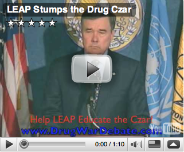
LEAP Media Director Tom Angell Puts the U.S. Drug Czar on the Spot

Forward this Message to a Friend!

On page 1 of the just-released World Drug Report 2009, the world's Drug Czar, Antonio Maria Costa, admits that the public is increasingly aware the "war on drugs" isn't working.

But outrageously, even while acknowledging the unintended consequences of the current policy, like the rise in international organized crime, the infiltration of our financial institutes and the waste of scarce resources, the report continues to defend prohibition, claiming that it is an effective drug "control" policy. After 100 years of international prohibition, starting with opium in 1909, "Czar" Costa is calling for more of the same. Page after page, the report struggles to find a measure of success for the greatest policy failure the world has ever known.

Clearly, Mr. Costa, head of the United Nations Office on Drugs and Crime, doesn't understand that prohibition is the opposite of drug control.  The preface - on page 1 - attempts to refute the arguments of Law Enforcement Against Prohibition (LEAP) and others who know that the solution is to legalize and regulate drugs.

Costa needs to know what legalization really means and we need your help to
educate him.

Please visit
http://www.DrugWarDebate.com to contact Mr. Costa.  A sample letter that you can edit (if you want) has been provided, so you can let the "czar" know that people calling for the legalization of drugs are endorsing more effective "control" over drugs than we have now, not less.

We can't do it without your help!

Sincerely,

Peter Christ
Vice-Director, Law Enforcement Against Prohibition
Retired Police Captain

P.S. The fact that our opponents are so prominently attacking us at the very beginning of their report is a real sign of how far our movement has come in such a short time, especially since last year's report didn't even mention legalization at all! 

P.P.S. If you'd like to help support this work, your generous donation is tax deductible and can be made at
http://www.CopsSayLegalizeDrugs.com/give


121 Mystic Ave. Suites 8&9
Medford, MA 01255
(781) 393-6985
[email protected]

Drug War Allies: Russia, Cuba, Pakistan… USA?

Tell our United Nations delegation to stop opposing harm reduction.

http://ssdp.org/unitednations/act

Friend,

President Obama recently announced that his administration would no longer allow ideology to trump science in policy-making decision. Yet, the very same week, the Obama administration publicly supported worn out Drug War ideology over harm reduction practices that have been proven to save and improve the lives of drug users.

I was back in Vienna, Austria last week to witness the United Nations' final deliberation over a new political declaration and action plan that will guide global drug policy for the next ten years.

Unfortunately, despite recommendations made by 300 Non-Governmental Organizations form around the world, including SSDP, the declaration included no mention of harm reduction.

(Harm reduction is like contraceptives, but for drugs. It's a scientifically proven set of policies and practices that keep drug users alive and healthy, without relying on abstinence-only messaging.)

After final approval of the declaration, 26 nations including Great Britain, Germany, and Australia, courageously spoke up to register their support for harm reduction in the official UN record, setting off a firestorm of debate on the floor of the United Nations.

While most countries chose to remain silent on the issue, a handful chose to speak up and denounce support for harm reduction.  These included Russia, Cuba, Pakistan… and the United States!

We must send a message to President Obama and Secretary of State Clinton that the American people will no longer stand idly by as they allow 20th century Drug War ideology to trump science and evidence!

Please
visit this action page to send a message to President Obama and Secretary of State Clinton, read the final approved U.N. declaration, and watch video of SSDP participating in a protest and press conference outside the United Nations.

Thank you for your support of SSDP's efforts to bring science and reason to national and global drug policies.

Sincerely,

Kris Krane
Executive Director

Students for Sensible Drug Policy

P.S. Like the work SSDP is doing to influence President Obama and the United Nations to change drug policy? If so, please let us know by making a donation today.
http://www.ssdp.org/donate

Stop the Global Drug War Demonstration in Vienna: Video and Pictures

Dear Friends, Here is video and photos of the demonstration organized by HCLU on March 11 at the entrance of the Vienna International Centre: Video: http://www.youtube.com/watch?v=xkXX8M0pUzA Photos: http://drogriporter.hu/en/demonstration Best, Peter Sarosi Drug Policy Program Director Hungarian Civil Liberties Union Tel.: +36 1 279 2236 www.drugreporter.net

ENCOD Appeal to the CND

Dear Friends, On http://www.encod.org/info/APPEAL-FOR-A-DRUG-POLICY.html or hereunder you can read the appeal for a moratorium on drug policy that the Encod delegation will present to the CND in Vienna the coming days. On Thursday 12 march we will organbise a FREEDOM TO FARM - Peace on Plants Picknick, open for all artists, performers, people and plants, in front of the UN Building in Vienna (see http://www.encod.org/info/ENCOD-DELEGATION-TO-UN-SUMMIT-IN.html). On Friday 13 March, we will host a press conference in cafe Landtmann in Vienna (see http://www.encod.org/info/CITIZENS-AFFECTED-BY-WORLD-DRUG.html). Best wishes, Joep ------------------------------- A Drug Policy Moratorium is needed, and a true Year of Reflection. Our call for a moratorium in UN drug policy is based on the following three reasons. 1. The Year of Reflection has not been used properly, and cannot be concluded in March 09. There has been no evaluation, nor reflection worthy of that name, at least not within UNODC, INCB, nor CND. As usual, CND only evaluates itself. And let us not forget that the Mexico’s call for an evaluation, shortly before UNGASS 1998, was refused by CND. In the past year, there has been no discussion on any independent evaluation within CND. The input from the global NGO-assembly “Beyond 2008” was all but ignored. The preparations for CND ‘09 concentrated on the Political Declaration that had to be produced in consensus for the “High Level segment” of CND, and are in an ideological stalemate on the subject of Harm Reduction. 2. The only independent evaluation that should have reached CND-members before and during their deliberations starting next week, was the one commissioned by the European Commission. This evaluation, by a commission chaired by Prof. Peter Reuter was ready in draft in December, but was held up for unclear reasons and will not be made public before the beginning of the CND. This means that there is no more chance of this evaluation to have any influence on the outcome of CND ‘09. However, on 4 March at a meeting in Brussels of the Civil Society Forum on drug policy of the European Union, a week before the start of CND, the core conclusion of the Reuter evaluation was disclosed: international drug policy has done more harm than good. 3. During the last weeks, it has become clear that the USA is on the verge of significant changes of position on drug policy. After the election of President Obama the American delegation continued for as long as possible to resist the acceptance of Harm Reduction and Human Rights principles, which are widely accepted throughout the United Nations. Only a few days ago the US representative at the CND announced a minor, but important shift in stance on Harm Reduction. It is clear that the Obama administration needs more time to devise its new policy. Of course, the UN cannot let its policies be determined by one country. On the other hand, the USA is the dominant global power, possibly even more in drug policy than in other areas. It makes little sense to adopt a global policy for a long period, knowing that the USA is in the process of changing its positions, which will probably influence a lot of other member states. Conclusion The need for a period of true reflection is greater than ever. Deciding on drug policy now, which means determining policy for many years, possibly again the next ten years, would be highly irresponsible. This year’s CND cannot be accepted to be the final chord of the “Year of Reflection”. The publication of the independent evaluation by the Reuter Commission can and should be the beginning of serious discussion and reflection. A Drug Policy Moratorium is needed, and a true Year of Reflection.

Press Advisory: Citizens Affected by World Drug Policies Question the UN

[Courtesy of ENCOD] From 11 to 13 March, the High Level Segment of the UN Commision on Narcotic Drugs will take place in Vienna, with the purpose of establishing new guidelines for international drug policies. The Summit will take place a year after the results of a ten year strategy adopted by the UN General Assembly Special Session (UNGASS) on Drugs in New York in 1998 should have been evaluated. The goal of that strategy was to eliminate or significantly reduce illicit drug supply and demand by 2008. The sad truth is that there has been no evaluation worthy of that name. The UN Office on Drug Control (UNODC) has written its own story, falsely claiming to have achieved control of the world drug problem. On the other hand, UNODC now acknowledges the serious harmful effects of drug prohibition. We welcome this important recognition, but we deplore the fact that it is immediately made worthless by unfounded predictions of less damaging results. A more serious evaluation does exist, however, which was ordered by the European Commission, and conducted by a respected group of experts with more distance to the UN and national drug policies. Until the moment this statement is written this report is not open for public scrutiny. It seems evident that, to have a meaningful impact on the deliberations and outcome of the CND, this "counterevaluation" should be made public before and not after the actual start of the CND. We condemn the way publication of this important advice has been held up. This will further reduce the relevance of the outcome of this year’s CND. Ten years have passed and the supply of cannabis, cocaine and heroin has increased. More people use illicit drugs than ever. The illegal environment in which drugs are produced, distributed and consumed has generated corruption, violent conflicts, criminal profits and dangers to public health. Independent analysts estimate the cost of drug prohibition in terms of expenses for police and justice operations at 70 billion euro year. There is no evidence whatsoever that these operations have had any positive impact on drugs-related crime. At the same time these policies have ruined the lives of hundreds of millions of people in the entire world, who have become a victim of executions, military repression, eradication of crops, environmental damage, incarceration and torture, violation of economic, social and cultural rights, marginalisation and stigmatization committed by authorities in the name of the war on drugs. Meanwhile, the UN drug control bureaucracy continues to reject any possible alternative to the policies of repression and prohibition. Also this year, the International Narcotics Control Board (consisting of 13 so-called drug experts in charge of monitoring the entire world drug situation) criticizes countries for applying non repressive harm reduction strategies such as needle exchange, decriminalization of cannabis use or even defending cultural traditions such as the use of the coca leaf in Bolivia, where this leaf has been a part of culture since thousands of years. How long will we have to see the UN dictating instructions to carry out policies that are deemed to fail? When will common sense take over the debate on drugs? This question is brought forward to the Ministerial Summit in Vienna by a coalition of citizens from the entire world. They will represent both producers of illicit plants, consumers of drugs and other citizens who are directly affected by drug policies. Among others they will maintain that the creation of legal markets for beneficial products that can be made of the coca leaf, cannabis and opium, for consumers in the entire world, could create opportunities for developing a sustainable future for populations in marginalised areas such as Afghanistan, Morocco or the Andean Region. They will maintain that non-repressive drug policies, such as cannabis policy in the Netherlands or heroin policy in Switzerland, have better results than repressive drug policies. The popularity of cannabis in the Netherlands, where it is legally available, is lower than in many other European countries or the United States, where it is totally prohibited. Mr. Costa has no idea how to explain this. He simply wants to continue the war on cannabis even when the evidence on cannabis use in the Netherlands falsifies the theory of prohibition. Representing citizens from all over the world they will insist that taking the drugs market out of the hands of criminal organisations will save and improve the lives of millions of people around the planet. Each day that the United Nations postpone this decision, they make themselves responsible for policies that do not benefit anyone, except the criminal organizations that dedicate themselves to drugs trafficking, as well as the bureaucracies working in the so-called drug control business, among others those who build prisons. It is time to initiate new strategies in international drug policy. Current strategies cause more problems than solutions. Non-repressive strategies are needed to deal with the drug issue, strategies that do not criminalise producers nor consumers, that are aimed at reducing risks related to drugs within a legal framework in which human rights are respected. We invite the representatives of the media to a press conference with the members of the delegation to the UN Summit on Friday 13 March, 11.00 hs onwards, in cafe Landtmann, Vienna. Speakers will be: If conditions allow: Chakib Alkhayari, president of the Human Rights Association for the people of the Rif (North Morocco). Representatives of coca producers from Bolivia. Jude Byrne and Matthew Southwell, members of INPUD, the International Network of People who Use Drugs. Fredrick Polak, European Coalition for Just and Effective Drug Policies (ENCOD) , who since one year is trying to start an open conversation with the UNODC Executive Director, Antonio Maria Costa on the evidence that drug prohibition has no impact on drug use levels. Adriana Rodriguez Salazar, independent researcher from Colombia, specialised in the impact of the war on drugs on society and environment in Colombia. Terry Nelson, of Law Enforcement Against Prohibition, United States, an association of mainly (ex-) policemen and judges opposed to the war on drugs.

DPA Statement: International Narcotics Control Board Releases 2008 Report

For Immediate Release: February 19, 2009

Contact: Tony Newman at (646) 335-5384 or Ethan Nadelmann at (646)335-2240                               

International Narcotics Control Board (INCB) Releases 2008 Report

Statement by Ethan Nadelmann, Executive Director of the Drug Policy Alliance

“The INCB Boldly Reaffirmed its Shameful Commitment to Politics over Science”

The International Narcotics Control Board (INCB), the independent and quasi-judicial control organ monitoring the implementation of the United Nations drug control conventions released its Annual Report 2008 today.

The following is a statement by Ethan Nadelmann, executive director of the Drug Policy Alliance:

“With the release of its annual report today, the International Narcotics Control Board boldly reaffirmed its shameful commitment to politics over science as well as its shocking indifference to the failures and harmful consequences of the global drug prohibition regime.

“The INCB is the last of the UN drug agencies to still prioritize abstinence-only ideology over evidence-based policies that have proven effective in reducing drug-related harms.  Its recommendations regarding substitution treatment, cannabis policy, and harm reduction measures to reduce death, disease, crime and suffering are all at odds with both scientific evidence and evolving policies in many parts of the world.

“Perhaps most stunning is the Board's failure to consider the crime, violence and corruption as well as over-incarceration and violations of human rights associated with the global drug prohibition regime. 

“Coming on the heels of the report released last week by the Latin American Commission on Drugs and Democracy, which came to very different conclusions with its call for a paradigm shift in global drug control policy, the INCB report seems sadly irrelevant to the most important issues in drug control today. 

“Now that the Obama administration shows signs of joining with other nations in emphasizing health and science over anti-drug rhetoric and ideology, the INCB may soon be faced with the choice of evolving or going out of business.

“Perhaps the only helpful feature of this year’s report was the focus on the tens of millions of people who suffer from untreated moderate-to-severe pain as a result of the underutilization of narcotic drugs.  But the international agency most engaged in trying to deal with this drug problem is the World Health Organization, while the INCB's historic obsession with restricting the availability of narcotic drugs has likely contributed to pervasive undertreatment of pain.

“It will soon be one hundred years since the International Opium Congress convened in Shanghai in 1909, thereby initiating the global drug control system.  An appropriate memorial would be the abolition of the INCB.”

###

Press Release: UN Drug Czar Embarrassed Again by Fredrick Polak

EMBARRASSMENT FOR UNITED NATIONS DRUG-CZAR COSTA Amsterdam – Antonio Maria Costa, the Italian Executive Director of the UN Office on Drugs and Crime, is seriously embarrassed because of a solo-action by Amsterdam psychiatrist Fredrick Polak. In an open letter published today, Polak demands an answer to a simple question. Despite earlier promises the global drug czar has been dodging the question for exactly one year. “How do you explain the low level of cannabis use in the Netherlands compared to surrounding countries, despite its free availability in coffeeshops?” On the internet two YouTube-videos show Costa avoiding the question time after time. To Polak the issue is of crucial importance as if falsifies the basic assumptions underlying drug prohibition. Therefore he continues to harass Costa with it. Polak, board-member of ENCOD (European Coalition for Just and Effective Drug Policies): “The primary objective of drug prohibition is reduction of consumption and addiction. However, the Dutch experience with coffeeshops of over thirty years has proved convincingly that without enforcement of this prohibition levels of use won’t skyrocket – which is what the drug warriors want us to believe. No wonder Costa is at a loss how to respond to the question.” Reprimand One year ago Polak first posed the question on a drug policy conference in New Orleans. Costa ignored it, but used the occasion to scold the Dutch government for “poisoning Europe” with amphetamines. That remark got Costa a reprimand from the Dutch government, at which he had to bite the dust and offer a letter of apology. Nonetheless, at a second occasion in March 2008 in Vienna, Costa again avoided the question. This time he claimed that more than 2000 coffeeshops had already been closed, and that the city of Amsterdam had decided to move all coffeeshops “from the red light district to the borders with France, Belgium and Germany”. Polak: “Apparently Mr. Costa thought Holland (or Amsterdam) borders on France. And that figure was totally unfounded.” Waste Shortly thereafter, Costa checked in with the authorities in Amsterdam and The Hague for a “study mission” including a visit to coffeeshop De Dampkring (The Atmosphere). At the next conference in Barcelona Polak asked him about his findings. Polak: “This time Costa really went too far, claiming that Amsterdam has three times more cannabis addicts than anywhere else in Europe.” Costa promised a discussion paper with the scientific basis for this claim, to be published on his website “very soon”. Until today Costa hasn’t lived up to this promise nor has he answered Polak’s initial question. Reason for Polak to draw media attention to the affair. Holland consistently scores low to average in Europe in drug consumption surveys. To Polak this justifies a call for the abolition of drug prohibition: “That will save us a lot of misery, and a huge waste of taxpayers’ money. What is the use of all the effort to enforce prohibition, when clearly it doesn’t diminish consumption?” Polak concludes his open letter on a positive note, suggesting Costa (67) not to wait until after his retirement to acknowledge the failure of drug prohibition. “Doing so now would earn him eternal fame.” + + + + + + + + + + + + + + + + + + + + + + + + + + + + + + + + + + + + + + + + + + + + + NOTICE to the EDITORS Enclosed is the Open Letter of 8 December 2008 to Antonio Maria Costa, Executive Director of the United Nations Office on Drugs and Crime in Vienna For more information you may contact the undersigned. The previous history to this open letter is shown in two short videos on the internet. Silenced NGO Partner: http:nl.youtube.comwatch?v=GjgzgRvHHwI Polaks’ Question Round 3 (with comments by dr. Alex Wodak, Sydney, Australia): http:nl.youtube.comwatch?v=xdOzi2ou2ZY Reactions from other NGOs: http:nl.youtube.comwatch?v=UaO7IvlUhro Yours sincerely, Fredrick Polak Stichting Drugsbeleid Netherlands Drug Policy Foundation /member of the board/ ENCOD (European Coalition for Just and Effective Drug Policies) /member of steering committee/ Vossiusstraat 31 1071 AG Amsterdam The Netherlands T +31 (0)20 6624 024 M +31 (0)6 3018 2408 E [email protected] __ Joep Oomen EUROPEAN COALITION FOR JUST AND EFFECTIVE DRUG POLICIES Lange Lozanastraat 14 – 2018 Antwerpen - Belgium Tel. + 32 (0)3 293 0886 – Mob. + 32 (0)495 122644 [email protected] www.encod.org EUROPEAN COALITION FOR JUST AND EFFECTIVE DRUG POLICIES Lange Lozanastraat 14 – 2018 Antwerpen - Belgium Tel. + 32 (0)3 293 0886 / Mob. + 32 (0)495 122644 / +31 (0)6 30210357 E-mail: [email protected] / www.encod.org

Video: An historic moment in global drug policy


SSDP is influencing United Nations drug policy and expanding internationally.

Watch videos of SSDP at the U.N.:

Then help us keep the momentum going!

http://www.ssdp.org/donate


Dear Friend,

The student movement to end the War on Drugs has truly gone global.

Two years ago, Canadian Students for Sensible Drug Policy appeared on the scene and immediately began influencing policy discussions in Ottawa. Late last year, SSDP chapters sprung up in Sierra Leone and Nigeria.
Earlier this year, United Kingdom Students for Sensible Drug Policy began forming a network of chapters in Europe. And last month, I attended a United Nations forum in Vienna, Austria representing one of only 25 U.S. organizations invited to join hundreds of other international Non-Governmental Organizations (NGOs) charged with recommending changes in global drug policy.

Believe it or not, despite the wide range of organizations present, all groups came to a consensus on recommendations that are forward thinking and grounded in reality, not dogma.

In addition to voicing SSDP's opposition to the failed War on Drugs, I made it a priority to ensure that youth concerns were included in the recommendations adopted by the global NGO community. Despite opposition by American prohibitionist groups like the Drug Free America Foundation and the Drug Free Schools Coalition, SSDP and a coalition of youth organizations succeeded in getting the NGO community to adopt the following language:

"Acknowledge that young people are disproportionately affected, both directly and indirectly, by illicit/harmful drug use and drug policy, and honouring the right of young people to be actively involved in the formation and evaluation of all facets of global drug policy"

In other words, the world is finally ready for young people to take a lead in the formation of drug policy. In fact, the chairman of the forum wrapped up the meeting with, "Its true what they say. Sometimes you have to look to the youth to lead."

But they weren't just looking for young people to lead the status quo. The recommendations submitted to the U.N. called for a drastic shift in the way that we deal with drugs and drug users:

- Acknowledging that drug policy should always be crafted and implemented with full respect for fundamental human rights and freedoms

- Recognizing that harm reduction plays an important role in mitigating many of the dangerous consequences of substance abuse, such as the spread of blood borne infections like HIV and Hepatitis

- Calling on the United Nations to treat demand reduction and harm reduction as equally or more important than supply reduction

- Calling on the United Nations to study the collateral consequences of a criminal justice approach to drug control, and to make recommendations to mitigate these harms


While the final declaration does not go as far as you and I would like, it represents a significant step forward in global drug policy.  If adopted by the United Nations, our recommendations may lead to public health based drug policies being adopted by governments around the world, which would be a welcome shift from treating drugs as primarily a criminal justice issue. And more importantly, youth will be welcomed to the forefront of this shift.

Now more than ever, Students for Sensible Drug Policy is ready to take on that challenge. By contributing to this groundbreaking work, you can take part in history in the making. http://www.ssdp.org/donate

Thank you for all of your support,

Kris Krane
SSDP Executive Director

P.S. To read the final declaration language or watch a few short video documentaries of the forum, visit http://www.ssdp.org/unitednations