Politics Outside US

Politics Outside US Subtopics:

Back from the Chapare

I'm now back from the coca producing region of the Chapare. Yesterday was a real grind: Get up very early, fly from La Paz to Cochabamba, take a taxi to the Andean Information Network office where I met up with AIN's Kathryn Ledebur and her husband, former Chapare human rights ombudsman ("defensor del pueblo) Gotofredo Reinecke, hopped in his jeep with him, stopped for gas and coca leaves (it's a tiring journey), then drove about two hours over an 11,000-foot mountain pass and down into the jungly Chapare.
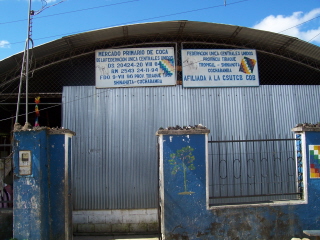
The coca leaf warehouse outside Shinahota. Here, local farmers bring their crops to be carefully weighed and sent on to legal markets within Bolivia. The entire process is controlled by the local growers' union.
But first, we had to traverse a major landslide on the highway caused by incessant rains. (We were extremely fortunate to have a mostly sunny day, a rarity this rainy season). At the landslide, buses and cargo trucks were backed up by the dozens, as they had been for days. The smell of rotting fruit in the trucks was pervasive. Bus passengers had to gather their bags and make a mile-long trek over a muddy path to get to buses waiting on the other side, but we left the jeep on the near side and walked right down the roadway itself—a shortcut—after Godofredo explained to the soldiers that I was a photojournalist shooting the "derrumbe." My sandals, socks, and jeans were covered with mud (which made quite an impression at the Cochabamba airport this morning). Once across the washed out area, it was onto the backs of small motorcycles for hire for another half-mile to where the buses and taxis were waiting for travelers trying to continue their journey, and then we hired a taxi for the tour of the Chapare. In the miserably hot and humid lowlands, we stopped for lunch, where Godofredo spotted veteran newspaper vendor and scene-observer Don Jaime Balderrama, with whom we had an interesting chat. Then it was on to the local military base for a talk with the comandante, which proved absolutely fruitless. He refused to say a word of substance, saying it all had to be cleared with the military high command. Sadly, this seems to be the attitude throughout the Morales government when it comes to coca matters, and as a result, I am not making much progress in getting interviews with government officials (although I still have some feelers out and some hopes, fading as they may be). The army fort, bought and paid for by US tax dollars was nicely constructed, and the colonel's office featured the only air conditioning I ran across on the whole trip. Sweet for him. Sweet for us, too. I didn’t want to leave, even though we were getting nothing from him.

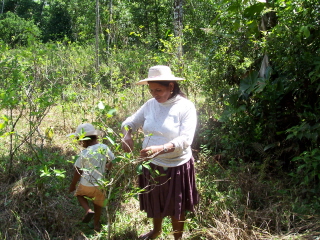
former cocalero leader Vitalia Merida with her daughter, in their coca field
Then it was on to visit Vitalia Merida, a former coca grower union leader (and current member), who has a coca field way out in the middle of nowhere. After her family suffered during the repression of the forced eradication years, she now reports that there is peace, if not prosperity. I'll be writing about what she had to say in a feature article this week. I have to say that is was an absolutely brutal hike in the mid-day sun to her coca patch. When I complained, Vitalia said, "You see how we suffer," although she sweated not a drop. Next was Shinahota, a small town that was the center of the Chapare cocaine economy during the Wild West days of the "cocaine coup" back in the early 1980s. Main street there features a bunch of two-story buildings erected at that time. Downstairs you bought cocaine, guns, and luxury items; upstairs you rented prostitutes. It's much quieter these days, and much less profitable. Just outside Shinahota, we stopped at a coca leaf warehouse operated by the local growers' union and had a nice chat with some Six Federation leaders who, sadly, were camera shy, and just a little bit suspicious of this wild-looking gringo. (I was indeed wild-looking by then: mud-splattered, sweat-drenched, my hair blown into knots as I hung my head out the window of the taxi seeking relief). We had an interesting conversation, though, and I will report on that in the Chronicle, too. Between Shinahota and Villa Tunari, we stopped briefly at a new coca leaf processing plant, which is being financed by Venezuelan President Hugo Chavez. He has promised to import coca products to Venezuela, which would violate the UN Single Convention, but as AIN's Kathy Ledebur noted, "Who's going to stop him?" No one there but construction workers, though. Shortly past the new coca plant, in Villa Tunari, is a municipal hospital staffed primarily by dozens of Cuban doctors and nurses. I couldn’t help but compare and contrast: The US builds forts and supplies the military, Venezuela helps Bolivia industrialize coca, and the Cubans heal the sick. So it goes. That's my report for today. I now have in essence a day and half left in Bolivia. I'm attempting to line up some last interviews, but I'm a little depressed by my lack of success with government functionaries, and just bad luck with some other people I hoped to talk to. But I still have 36 hours... More pictures will be posted here later today.
What a trip it's been, and it's only the end of week one!

Since last I blogged, I've gone by overnight bus from Lima to the Andean highlands city of Ayacucho, thence over the top of the Andes and down into the Amazonian selva (actually, the "ceja de selva," the eyebrow of the jungle) to the small towns of San Francisco, Ayacucho, and Kirimbiri, Cusco, on the other side of the rain-swollen Rio Apurimac deep in the heart of the coca growing region known as the VRAE (Valleys of the Apurimac and Ene Rivers), and then back to Ayacucho. It has been brutal—hours of travel on crappy, crappy dirt roads over mountains and across flooded out stretches of road through some of the poorest land in the country. Tomorrow (Saturday) morning, I get up a 5AM to catch a flight back to Lima and then on to Cusco, for a little rest and tourism at Machu Picchu. (Ayacucho is halfway between Lima and Cusco, but as they say, "you can’t get there from here." There are no city to city flights in Peru except to and from Lima. Go figure. An Aero Condor rep told me it's because they're a Fourth World country.) The travel to coca country was mind-bending: Huge mountains, endless switchbacks on dirt roads with no shoulder and a thousand-foot drop-off, indigenous people herding sheep and goats and burros and horses, the women wearing those funny Andean hats. (I hope Dave Borden will be good enough to post some more pictures here.) It is rainy season, so water is pouring down the mountains in spectacular cascades, but also ripping the road open and causing landslides that block the road. Local people come out to fix it, but put rocks in the road to collect a toll for their labors. From the crest of the Andes, somewhere at about 12,000 feet near Tambo, it was downhill all the way to the Apurimac River, a tributary of the Amazon. You go from jacket weather to dripping with sweat in the heat and humidity of the Amazon, pine trees turn to palm trees and tropical fronds. It was in some towns along the Apurimac that I hooked up with some local cocalero leaders and went out into the poverty-stricken countryside to view the fields myself. I've seen a lot of poverty in my day, but the conditions in which the coca farmers live are truly grim. They have to walk miles just to get to the nearest town, they have no running water or electricity, and even with four coca crops a year, they barely make enough money to feed and clothe their children. One of the highlights was one of the cocalero leaders pointing out the houses (more like shanties) of the cocaleros and demanding to know "Where are the narco mansions?" Well, certainly not around here. Every cocalero I've talked to has had the same refrain: This is our sacred plant, we have nothing to do with the drug trade, either leave us alone or provide real agricultural development assistance. And that refrain resonates: Of 70 municipalities in the VRAE, cocaleros hold power in all 70. This is also the home of the country's premier cocalero leader, Nelson Palomino of CONCPACCP, with whom I talked in Lima earlier this week. Will it be pretty much the same in Bolivia? I don't know. Check back later. Editor's Note: I certainly will post Phil's pictures, but it will be a little later this weekend. In the meanwhile, be sure to read Phil's Drug War Chronicle article from Peru, published earlier today -- three pictures, interviews with key people and lots of good info. -- Dave

Off to Ayacucho and the Valleys of the Apurimac and Ene Rivers

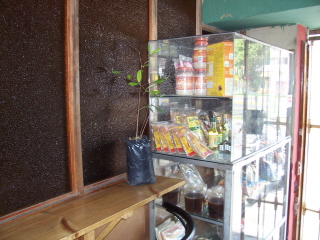
Oh, my situation is fluid. I was supposed to travel to Ayacucho today to visit cocalero leader Nelson Palomino and check out what is going on in the coca fields of the Valles de los rios Apurimac y Ene (VRAE), one of the most conflictive coca zones in the country. But last night, I got word that Palomino and his crew had come to Lima for meetings. I managed to hook up with them this morning, as well as visiting Mana Integral, a small company devoted to the nutrional uses of coca. It makes coca wheat, coca yoghurt, coca energy packets (they would look great at your local convenience store). And now, although Palomino is headed up to San Martin in the northeast for more meetings, one of his men is going to accompany me on an overnight bus ride, getting into Ayacucho at dawn, then another ride of four or five hours into the heart of the VRAE. It´ll be up and over the Andes and down into the selva at the edge of the Amazon basin. Should be very, very interesting in the VRAE. It takes so long to get there that we will stay there tomorrow night and return to Ayacucho Thursday afternoon. This has some implications for near-term blogging and for getting the Chronicle out in a timely manner this week. I don´t think I´m going to find high speed internet access in the VRAE, so you may not hear from me for a day or two. I also had very interesting and disturbing conversations with coca experts Baldomero Caceres and Ricardo Soberon yesterday. Look for some of that in one of the articles I do for the Chronicle this week. This working from the road in the Third World is really kind of a hassle. I have to rely on internet cafes, and often the people working them don´t have a clue about why my connection won´t work. Then, if I have to use their machines, I have problems with the strange keyboards. But I do my best.

With Baldomero Caceres in Miraflores

I´ve spent the last few hours with Baldomeo Caceres, the Peruvian psychologist and coca expert, walking around central Lima and talking about the politics of coca. Now, we´ve traveled to Baldo´s house in the upscale Lima suburb of Miraflores, where we´re going to have a nice Peruvian lunch, then I´ll pull out my laptop and do a formal interview with him. One of the points that Baldo hammered away on while we walked and talked was his frustration with the slow pace of efforts to get coca removed from the list of banned plants in the 1961 UN Single Convention on Narcotics. Evo Morales is supposedly ready to formally request coca´s removal from the list, but according to Baldo, he isn´t getting support from some of the quarters he should be in the world of the non-governmental organizations. We´ll see what Baldo is willing to say about that on the record. He was also pessimistic about the prospects for change at the UN General Assembly special session on drugs in Vienna next year. Again, we´ll see what he says about that on the record. I have just been called to lunch, so I will keep this short. After this, I go to interview Peruvian defense and drug policy analyst Ricardo Soberon, formerly an advisor to Congresswoman Nancy Obregon. I will have photos soon. I had to buy a cable for the camera so I can transfer the photos. I´ll try to post some this evening.

The Drug War Chronicle Andean Coca Tour 2007 is about to get underway

Friday night, I will be bedding down in Peru, after a day-long flight from Sioux Falls to Denver to Houston to Lima. That will be the first of 21 nights in Peru and Bolivia as the Drug War Chronicle explores the coca industry and its unsavory relative, the cocaine industry, in the Andes. While the process of making connections is ongoing and always a little shaky in developing countries, things are falling into place. While I will spend most of that first weekend resting and getting oriented, it looks like I'll have lunch Monday with Peruvian psychologist and coca expert Baldomero Caceres and Anthony Henman. Henman is a legendary name when it comes to coca. The British anthropologist (since gone native) is the man who, under a pseudonym, wrote "Mama Coca" back in the 1970s. That was the first serious ethnographic study of coca's history and use in the Andes for lay readers in English. I look forward to seeing what Henman has to say about the current state of affairs. Later that day, I will go to the upscale suburb of Miraflores for dinner with Ricardo Soberon, a leading Peruvian drugs and security expert. He was an advisor to coca grower leader turned congresswoman Nancy Obregon, but has since departed over unspecified political differences. I'll be sure to query him (and Nancy) about the nature of those differences. Speaking of Nancy, she is currently back home in northern Peru, so I won't be able to talk to her during that first week. But she will be back in Lima at the end of the month, and I will do an interview with her then. (I have to be out of Bolivia by February 28 because their visa requirements kick in on March 1.) I think I will fly from Lima to Ayacucho next Wednesday. That ancient city high in the Andes is the historic heartland of Sendero Luminoso, the Maoist guerrillas who led an uprising in the 1980s where tens of thousands were killed. The Senderistas are still around, though much weakened, and they try to gain the support of coca growers by killing policemen and anti-government drug workers. But Ayacucho is also the home of national coca growers' union leader Nelson Palomino, whom I will interview. Palomino and his crew have also promised to show me the coca fields and let me talk to farmers, so that should be enlightening. After that, I'll take a couple of days for the mandatory tourist visit to Machu Picchu outside Cusco, then I'll bus it from Cusco across the altiplano to Bolivia. At least that's the plan right now; there are reports of severe flooding right where I'll be crossing the border. I'm still trying to set things up with the American embassy in Lima and with the big Peruvian drug bureaucracies, ENACO (the coca monopoly) and DEVIDA (the drug enforcement bureaucracy). I've been talking with the US press officer in Lima about getting a meeting, but because I don't represent established media, I can't get official press status with the embassy, which means the press officer won't officially deal with me, but may manage to hook me up with some of the drug people in the embassy. Similar plans are in the works for Bolivia. Stay tuned.

Finally, Someone is Getting Serious About Marijuana

Why screw around arresting pot smokers when you can get to the root of the problem by simply eliminating marijuana? That is the latest plan from Indonesia's National Narcotics Agency, at least according to this report, which notes that the country should be pot-free by 2015:

South America trip back on again, and maybe a visit to the meth conference, too.

As readers of this blog know, I had to postpone my trip to Peru and Bolivia to report on coca doings because the Bolivian government announced on New Year's Day that US citizens would need visas to enter the country, even if coming as tourists. That announcement was followed by days of uncertainty, with the Bolivian consulate in Washington saying first one thing, then another about visa requirements. That's when we decided to postpone the trip.

Mexican Federal Police Take Tijuana By Storm -- Too Bad It Won't Work

A Reuters article this afternoon reported that Mexico's new president, Felipe Calderon, is sending over 3,000 troops to Tijuana in a crackdown aimed at stemming the ongoing violence that has wracked the border city in recent years. The first 500 arrived today and are investigating charges of corruption in the local police force:
As two helicopters circled overhead, dozens of troops with assault rifles and riot shields converged on a police headquarters to inspect weapons, a first step in probing alleged drug gang links and corruption inside the local force.
The move comes only three weeks since Calderon sent 7,000 troops to his own home state of Michoacan. 2,000 people were killed in drug trade violence in Mexico last year. One of the guests at DRCNet's 2003 conference in Mexico, "Out from the Shadows, Ending Drug Prohibition in the 21st Century" ("Saliendo de las Sombras: Terminando de le Prohibición de las Drogas en el Siglo XXI" en Español) was Gregorio Urias German, a Mexican congressman from Sinaloa, another part of the country that has suffered in the drug wars. Urias blames drug prohibition for this violence, but he fears that "If we can't even discuss the alternatives, if we can't even admit the drug war is a failure, then we will never solve the problem." He said that existing forums, such as the UN and the Organization of American States, are not fruitful places for discussion, "because only the repressive policies of the United States are discussed at these forums." While it is not the job of media outlets like Reuters to take a position favoring legalization in their news reporting, they will be doing a better job when they start to include leaders like Urias in their articles who hold that point of view. This Google News link will pull up a list of hundreds of appearances of this news story that are currently active in the mainstream media (many though not all the Reuters story or another by the AP). We encourage you to follow the links and submit some letters to the editor. Post them back here along with the letter-writing info for others.

I've Got Those Mean Old Bolivian Visa Blues

With my departure for South America set for 10 days from now, the Bolivian government has put a hitch in my plans. Bolivian President Evo Morales announced yesterday that as of now, American citizens will need a visa to visit Bolivia. As the Associated Press reported:
LA PAZ, Bolivia -- The government of President Evo Morales approved a decree Monday requiring U.S. citizens to obtain visas to enter Bolivia. Morales said the decree "a matter of reciprocity." The U.S. government requires Bolivians to obtain visas to enter the United States. "We are a small country but we have the same dignity as any other," Morales said. The decree, approved during a Cabinet meeting, applies to other countries, including Serbia and Montenegro and Cyprus. In February 2006, Leonilda Zurita, a congresswoman belonging to Morales' Movement Toward Socialism party, had her U.S. visa revoked. Zurita said Washington cited an alleged link between her and terrorist activities, which she denied. Morales also cited security concerns for the rule. An American man has been charged with setting off bombs in two La Paz hotels in March. Two Bolivians were killed and seven people were injured, including an American woman. U.S. ties to Bolivia have been tense partly due to Morales' friendship with Presidents Fidel Castro of Cuba and Hugo Chavez of Venezuela, as well as by Morales' background as the leader of coca growers fighting U.S. attempts to eradicate their crops.
What the AP did not make clear is that the visa requirement for Bolivians to enter the US is a recent, post-911 move by the US reversing years of visa-free travel for South Americans coming north. The Brazilian government has also imposed a visa requirement for Americans now in this game of diplomatic tit-for-tat. Thanks, Mr. Bush. What this means for my trip is unclear at this point. The Bolivian consulate in Washington wasn't answering the phone today. One of colleagues in the Washington office will run over there first thing tomorrow morning to try to find out what the new requirements are and how fast I can actually get a visa. I am going first to Peru, which hasn't imposed a visa requirement, and it may be possible to get a visa there, but I don't know that yet. I'll keep you all updated on the situation. (Read the comment I've posted to learn a little more about Leonilda Zurita. - DB)