
Politics Outside US

Politics Outside US Subtopics:

Monsters Retake Thailand's Government and Vow to Resume Mass Drug War Murders

We've reported here extensively on the thousands of extra-judicial killings by Thailand police of supposed drug offenders during the regime of now-deposed prime minister Thaksin Shinawatra. Following the coup which took Thaksin out of power, a government panel prompted by calls from human rights organizations determined that most of Thaksin's murder victims were not even involved with drugs. Recently the Thai government voted to bring the monsters back into power by electing Thaksin crony Samak Sundaravej as the new prime minister. He has already shown his stripes -- reporting from the Associated Press, via Drug WarRant:
New Thai Prime Minister Samak Sundaravej insisted Friday that he is not a puppet of deposed leader Thaksin Shinawatra, despite having boasted during campaigning that he was Thaksin's proxy. [...] Samak also said the new government will reintroduce Thaksin's controversial approach to combatting drug trafficking, defending the "drug war" conducted by Thaksin's government that led to the death of about 2,500 people in 2003-2004. [...] Interior Minister Chalerm Yoobamrung said Thursday that the ministry would launch a tough anti-drug campaign, particularly in border areas, that will yield results within 90 days.
How many drug war murders will Sundaravej commit? Have some Thai police officers already taken the encouragement to resume the rampage?

Heading Down Mexico Way

On Friday, once this week's Chronicle has been put to bed, I hop in the pick-up and head for Mexico for a month or so of on-the-scene reporting on the drug war south of the border. If all goes according to plan, I'll be spending a week in Nuevo Laredo, Reynosa, and Matamoros, the major Rio Grande Valley border towns on the Mexican side, where the Mexican government sent in the army a couple of weeks ago. After that, it's a week in Mexico City to talk to politicians, marijuana activists, academics, drug treatment workers, and others in the Mexican capital. Then, I'll head to the beaches of Oaxaca for a weekend, then up the Pacific Coast, stopping in the mountains above Acapulco to talk to poppy farmers, human rights observers, and whoever else I can find. A few hundred miles further north, in Sinaloa, I'll be trying to make contact with pot farmers, as well as seeing what the impact of the Sinaloa Cartel is on the ground in its home state. I will also, of course, be making a pilgrimage to the shrine of San Juan Malverde, patron saint of drug traffickers, on the outskirts of Culicacan. And then it's back toward Gringolandia, with a few days on the Tijuana side of the border, provided I have any money left by then. In the meantime, I'd like to share with you something that appeared last week but that got little attention. It's an analysis of drug situation in Mexico from Austin-based Strategic Forecasting, Inc, and it's pretty grim. Titled The Geopolitics of Dope, the analysis is a steadfastly realistic look at what drug warrior can hope to accomplish fighting the cartels. You should read the whole thing--it's very, very chewy--but here are the last few paragraphs:
The cartel’s supply chain is embedded in the huge legal bilateral trade between the United States and Mexico. Remember that Mexico exports $198 billion to the United States and — according to the Mexican Economy Ministry — $1.6 billion to Japan and $1.7 billion to China, its next biggest markets. Mexico is just behind Canada as a U.S. trading partner and is a huge market running both ways. Disrupting the drug trade cannot be done without disrupting this other trade. With that much trade going on, you are not going to find the drugs. It isn’t going to happen. Police action, or action within each country’s legal procedures and protections, will not succeed. The cartels’ ability to evade, corrupt and absorb the losses is simply too great. Another solution is to allow easy access to the drug market for other producers, flooding the market, reducing the cost and eliminating the economic incentive and technical advantage of the cartel. That would mean legalizing drugs. That is simply not going to happen in the United States. It is a political impossibility. This leaves the option of treating the issue as a military rather than police action. That would mean attacking the cartels as if they were a military force rather than a criminal group. It would mean that procedural rules would not be in place, and that the cartels would be treated as an enemy army. Leaving aside the complexities of U.S.-Mexican relations, cartels flourish by being hard to distinguish from the general population. This strategy not only would turn the cartels into a guerrilla force, it would treat northern Mexico as hostile occupied territory. Don’t even think of that possibility, absent a draft under which college-age Americans from upper-middle-class families would be sent to patrol Mexico — and be killed and wounded. The United States does not need a Gaza Strip on its southern border, so this won’t happen. The current efforts by the Mexican government might impede the various gangs, but they won’t break the cartel system. The supply chain along the border is simply too diffuse and too plastic. It shifts too easily under pressure. The border can’t be sealed, and the level of economic activity shields smuggling too well. Farmers in Mexico can’t be persuaded to stop growing illegal drugs for the same reason that Bolivians and Afghans can’t. Market demand is too high and alternatives too bleak. The Mexican supply chain is too robust — and too profitable — to break easily. The likely course is a multigenerational pattern of instability along the border. More important, there will be a substantial transfer of wealth from the United States to Mexico in return for an intrinsically low-cost consumable product — drugs. This will be one of the sources of capital that will build the Mexican economy, which today is 14th largest in the world. The accumulation of drug money is and will continue finding its way into the Mexican economy, creating a pool of investment capital. The children and grandchildren of the Zetas will be running banks, running for president, building art museums and telling amusing anecdotes about how grandpa made his money running blow into Nuevo Laredo. It will also destabilize the U.S. Southwest while grandpa makes his pile. As is frequently the case, it is a problem for which there are no good solutions, or for which the solution is one without real support.
This is the situation the Bush administration wants to throw $1.4 billion at in the next couple of years. Maybe it and Congress should be reading Strategic Forecasting analyses, too.

Goodbye To a Drug Warrior; Australian Prime Minister John Howard Set to Lose Power in Saturday's Elections

The Australian Labor Party and its leader, Kevin Rudd, appear poised to drive drug warrior Prime Minister John Howard and his Liberal/National Party coalition from office in elections coming this Saturday. Labor needs to pick up 16 seeks to take over, and according to recent polls, it should do so. Those same polls show Rudd and Labor defeating Howard and the coalitionby a margin of 54% to 46% in the popular vote. Howard could even lose his own district, something that hasn’t happened to a sitting Australian prime minister since 1929. It couldn’t happen to a nicer guy. Howard is a rigid foe of drug reform who in this most recent campaign has debased the discourse by reducing it to the level of "drugs are evil" and who over the weekend vowed to have the federal government take control of welfare payments for people who are drug offenders (look for a news brief on that on Friday). Although Howard was forced to accept the existence of the safe injection site at Kings Cross in Sydney, he is a fervent anti-harm reductionist. Here's just a short, and doubtless incomplete, catalog of his sins: He tried to narrow the drug policy debate by purging the federal drug advisory panel of harm reduction advocates, he opposed heroin prescription trials in Western Australia, the following year, he threatened to prosecute under federal law anyone using a safe injection site if any other states tried to open one, he tried to pressure states to roll back marijuana decriminalization laws, and last year, his government announced plans to ban bongs. Drug policy is not playing a major role in the campaign, although Howard has tried to make it one in recent days. If, as appears increasingly certain, he actually goes down to defeat on Saturday, it will be because of his support of the Iraq war, his disdain for environmental concerns, and, last but not least, because, after 11 years of Howard rule, Australians are ready for a new face. An added bonus in the election could be the rise of the Green Party to role of power broker in the Senate. Under Australia's system of proportional representation, the Greens could end up holding the balance of power in the Senate. While the Greens have retreated somewhat in their drug policy platform in the last couple of years, it is still light years ahead of either Labor or Howard's coalition.

A better mayor, on drug policy at least...

Vancouver's former mayor, Larry Campbell (now a member of Canada's Senate) has an editorial in the Winnipeg Free Press criticizing both the Liberals and Conservatives in Canada for the increase in marijuana convictions -- the former for not introducing the decrim bill soon enough -- the latter for being, well, just wrong (Sen. Nolin excepted, of course.) Campbell writes:
It's about time that we get over the stigma associated with many of the false assumptions that dominate this debate, and pragmatically move forward on eliminating pot prohibition. As someone who has both walked the streets as a member of the RCMP's drug squad and examined legislation for passage into law as a Senator, I have a sharp understanding of what constitutes a criminal. Those that use pot just don't fit the profile.
Campbell's rational call for change stands in stark contrast to the strong anti-marijuana stance of another former mayor, New York City's Rudy Giuliani, who radically increased marijuana arrests and even opposes medical marijuana use. Campbell's actually for legalization across the board -- according to our 2003 interview with him, though not optimistic of it. Keep up with Canada drug policy news through our topics page here (or the RSS feed for it here). Or just read our newsletter...

Christiania is in trouble again (video)

The marijuana friendly, Danish counter-culture enclave of Christiania is in trouble, according to an article in the UK newspaper The Independent, "On the barricades: Trouble in a hippie paradise." The intro to the article, authored by Cahal Milmo, reads:
[Christiania] was set up in the heart of Copenhagen as an antidote to the selfish society. But Europe's most famous commune is under threat from a right-wing government determined to 'normalise' this relic of the 1970s.
The Legalise Cannabis Alliance (UK) has video footage of what looks like a pretty serious police raid posted to YouTube -- there are links to more video there too.
We published a Chronicle news feature in January 2004 when hash sellers on Pusherstrasse burned their own stands in protest of a looming government crackdown, and again two months later when the trouble hit. Reason's Kerry Howley provides some "fun facts" about Christiania here. Why not just leave the hippies alone, conservative Danish government (and US government)?

Let's Celebrate UN Anti-Drug Day...By Killing People

Yesterday was the UN Office on Drugs and Crime (UNODC) annual International Day Against Drug Abuse and Illicit Trafficking. Most countries that actually observe the day (mainly in the Middle East, Africa, and Asia), generally celebrate it by burning piles of drugs and holding propagandistic anti-drug events. But China really knows how to put on an anti-drug day show. Every year, it executes drug offenders on anti-drug day. This year was little different, as this headline indicates: China Approves Death Penalty for Seven Drug Traffickers:
BEIJING, June 25 (Xinhua) -- The Supreme People's Court (SPC) on Monday announced its approval of the death penalty for seven drug traffickers, a day before the International Day Against Drug Abuse and Illicit Trafficking. Gao Guijun, presiding judge of the Fifth Criminal Court under the Supreme People's Court, said that since the SPC took back the power of review over the death penalty on Jan. 1, the SPC had strictly examined death penalty cases involving drug trafficking. "Our approval of the death penalty regarding drug trafficking could stand the test of history," said Gao. Ni Shouming, the SPC's spokesman, reiterated the court's resolute stance on fighting drug trafficking, saying the court would show no leniency in handing down heavy penalties to the kingpins of drug trafficking gangs and those who participate in cross-border drug crimes.
No word yet on whether China actually executed any drug offenders yesterday, but stay tuned--I will be writing a feature article on this annual exercise for this week's Chronicle. In the meantime, happy UN anti-drug day, y'all.

Is another drug war bloodbath just around the corner?

Update: response from former ONDCP official who worked on the US-China agreement
Death sentence is passed against a
woman who was immediately executed
with three other people on drugs charges.
(UN International Anti-Drugs Day, 6/26/03)
www.sina.com.cn via AI web site)
One of the sick annual rituals in the global drug war has been China's annual round of executions of supposed drug offenders marking the occasion of the UN's "International Day against Drug Abuse and Illicit Trafficking," held June 26th of every year. We wrote about this last year and in most previous years. I wrote an editorial about it in 2000, which went over some of the highly troubling information Amnesty International has published about China's drug death penalties, and in which I criticized then-drug czar Barry McCaffrey for putting in place an arrangement with China for cooperation in drug enforcement between our two countries, and the UN for holding this international event year after year even though they obviously are aware that it continues to prompt such carnage. I believe that handing over criminal defendants to totalitarian regimes with limited due process rights and draconian death sentences for nonviolent offenses is immoral, and makes us complicit in the human rights abuses that those nations may commit against people we wind up sending into their clutches. But the UN's annual Day doesn't even have a law enforcement justification. We have a statement from UN Secretary General Ban Ki-Moon about the upcoming Day online here. I'm posting a few examples from Amnesty that illustrate why I really feel this is an important human rights issue that we as taxpayers should not be indirectly supporting, even if that puts some obstacles in the way of global policing efforts or puts a crimp in the UN's promotion of prevention and treatment programs: The Death Penalty in China: Breaking Records, Breaking Rules, August 1997 AI report:
In a case that is illustrative of many more, a young woman, returning to Guangzhou province from her honeymoon in Kunming in January 1996, agreed to take a package for an acquaintance in return for some money. Acting as a courier in this manner is common practice in China. It was reported that during the train journey she became suspicious about the contents of the package and tried to open it. When she found she couldn’t open it she began to realize it was drugs. She then allegedly became so nervous and agitated that the ticket checker on train became suspicious and discovered the package. She was sentenced to death on 26 June 1996 by Guangxi High People’s Court.
AI 1998 Annual Report on China:
Ji Xiaowei, a Hong Kong citizen sentenced to death in southern China for alleged drug-trafficking, claimed on appeal that he had confessed under torture during police interrogation. The appeal court ignored his claim and confirmed the death sentence. He was executed on 18 July.
AI Report 2005:
Ma Weihua, a woman facing the death penalty on drugs charges, was reportedly forced to undergo an abortion in police custody in February, apparently so that she could be put to death "legally" as Chinese law prevents the execution of pregnant women. She had been detained in January in possession of 1.6kg of heroin. Her trial, which began in July, was suspended after her lawyer provided details of the forced abortion. She was eventually sentenced to life imprisonment in November.
There has been some talk in China recently of making the use of the death penalty more transparent and reducing its use, and that is welcome. Reportedly there has been about a 10% drop. But China is still the world leader in this. So is anyone interested in an international campaign to get the UN to cancel International Anti-Drugs Day and to subject global law enforcement cooperation to human rights standards? China is by no means the only country executing people for drug offenses. Write me through the site or send me an email. I'd appreciate any links you have to especially important articles or web sites dealing with this topic. Lastly, we have a topical archive on the site for the Death Penalty, here and also available via RSS.

Mexico's President is Half Right

Mexican President Felipe Calderon told Deutsche Press-Agentur this weekend that America's drug habit is the cause of Mexico's drug prohibition-related violence. In Mexican President Blames US for Drugs War, Calderon said:
"Our problem is the demand for narcotics in the US market, which significantly affects Mexico," the Mexican president said. Calderon stressed that no strategy from the Mexican government against drug cartels will be sufficient unless demand is reduced. "It is evident that as long as there is a market, as long as there is drug consumption in the United States, this problem will persist in Mexico," he said.
Calderon is, of course, absolutely correct on that score. I've often noted that the prohibition-related violence plaguing our southern neighbor--there have been 1,046 killed in Mexico's drug wars so far this year--is Mexico paying the price for our war on the drugs we love to consume. Where he is wrong is his implicit assumption that the US government can meaningfully reduce demand and that the war on drugs could somehow succeed if--gosh darnit!--we Americans only tried harder. We spend about $40 billion and arrest nearly 2 million people a year in the drug war, and the drug use numbers fluctuate at the margins. The US drug market will never go away. If Calderon wants to see an end to the prohibition-related violence in Mexico, he would be much better off calling for the regulation and normalization of the illicit drug business than waiting for Americans to quit using drugs. The only thing less likely than the US government ending drug prohibition is that Americans are going to change their ways.

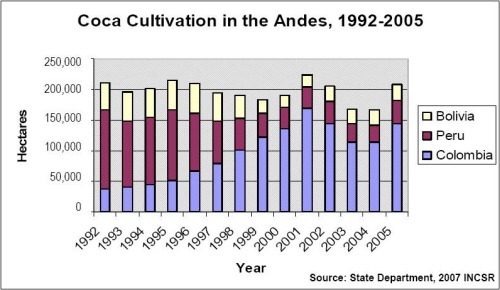
Ponder This Graph for a Moment, Please

graph from WOLA and AIN (graph from WOLA/AIN memo, link below)
This graph shows what about $10 billion in US taxpayer dollars has accomplished. Note that while coca production has shifted within the region, the 1992 levels and the 2005 levels are essentially identical. Why is our coca eradication policy not subjected to cost-benefit analysis? Is there anyone who will argue that it is working? If so, I'd like to hear it. To be fair, that $10 billion has accomplished some things. It has engendered massive social conflict in all three countries, it has led to tens of thousands of peasant farmers being arrested as drug traffickers, it has led to thousands of deaths (especially in Colombia, where the eradication policy is part of the US's broader military intervention in that country's festering civil war). Your tax dollars at work. $10 billion is a lot of money. Heck, we could finance the Iraq war for a few weeks with it! Or we could give $100,000 college scholarships to 10,000 students. Or build $100,000 homes for 10,000 families. Or numerous other programs that, unlike the coca eradication program, might actually accomplish something. By the way, I came across the graph above in a memo from the Andean Information Network and the Washington Office on Latin America. That memo was occasioned by the US government's release of coca cultivation estimates for Bolivia. The US government has for months been complaining that Bolivian President Evo Morales' pro-coca policies were going to lead to a boom in production there. Surprise! It didn't. Read the memo for some juicy analysis.

More Reefer Madness Yellow Journalism in Australia

More Australian Reefer Madness Journalism Yesterday, we published a newsbrief about the Australian media frenzy over "super dope", but the yellow journalism about marijuana coming from Down Under just keeps coming. Early in the week, it was the "super dope" scare, where the Aussies whipped themselves into a frenzy over kind bud. By late in the week, there was a new wave of hysterical marijuana reporting, this time centering on people who have both indoor marijuana grow operations and children. "Children in Drug Den Danger!" screamed the Daily Telegraph in an article about raids on two Sydney homes where parents were growing pot:
SIX children aged as young as five have been forced to live and sleep within metres of toxic chemicals and cancer-causing cannabis plants - all because their parents wanted a quick dollar.
Whoa! "Cancer-causing cannabis plants"!?!?!? This is just simply absurd. As far as I know, no one, not even Harry Anslinger, has ever claimed that a growing marijuana plant is carcinogenic. I suspect this is merely bad reporting; as the Australian AP reported in its account of the raids, the equally silly Kids Allegedly Forced to Sleep Near Mum's Toxic Pot:
South West Metropolitan Region Commander, Acting Assistant Commissioner Frank Mennilli, said the raids followed tip-offs from the public. "Hydro houses pose significant risk and it appalls me that anyone would have such a disregard for safety that they would jeopardise the lives of children," Mr Mennilli said. "We've gone into some of these homes where young children – one even on a ventilator – are sleeping only metres away from these plants and carcinogenic contaminants. "In all these homes the electricity supplies have been illegally and dangerously diverted, posing a huge risk of fire – endangering the lives of those inside and people living in neighbouring homes."
Ah, it's not the plants that are carcinogenic; it's those darned "contaminants." It appears the "contaminants" referred to here are nothing more than the chemical fertilizers used to make the plants grow faster. As Mennilli put it in the Daily Telegraph story, "So not only do you have the odour from the plants but also you have the chemicals used in relation to the growth of these plants. The "highly toxic" chemical fertilizers are so dangerous they are sold in nurseries and greenhouses and Walmarts and K-Marts across the land. They are so dangerous, they are used by millions of little old gardeners without a second thought. Now, you probably don't want your kid drinking the stuff or making Kool-Aid out of powdered fertilizer, but fertilizer is fertilizer. It's no more dangerous when used to grow marijuana than it is when used to grow tomatoes. The Australian media should be ashamed of itself. It not only uncritically accepts police statements at face value; it then runs with them to the point of simply making shit up. "Cancer-causing cannabis plants," indeed! "Toxic chemicals," oh my! I will give Mennilli and the media accounts props for mentioning the risk of fire from improperly wired, illegally obtained electricity. You can start a fire trying to do that. But even the fire hazard is a function of prohibition, not marijuana. People steal electricity not because it's cheaper, but because they wish to avoid being busted by cops monitoring their electrical use.