Race

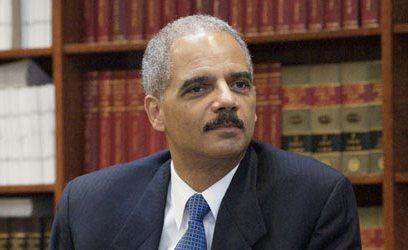
Attorney General Holder says yes to retroactivity only for some federal crack prisoners. (Image courtesy DOJ)

AG Holder Backs Early Release for Crack Cocaine Prisoners

The Fair Sentencing Act, which reduced disparities between crack and powder cocaine sentences, could be about to get even fairer. The US Sentencing Commission is pondering making it retroactive, and Attorney General Holder agrees.

Fixing the Fiasco of the NYPD's Marijuana Arrests

Two New York State legislators have proposed a simple, effective legislative fix to New York City's 15-year marijuana arrest craze. Senator Mark Grisanti, a white Republican from Buffalo, and Assemblyman Hakeem Jeffries, a black Democrat from Brooklyn, have together offered legislation that would strike from the law the misdemeanor for simple marijuana possession of less than an ounce. The NYPD made 50,000 of these marijuana possession arrests in 2010 and 500,000 arrests since 1997.

New York Bill Would Reduce Charge for Marijuana Possession

In a rare show of bipartisanship and upstate-downstate agreement, freshman state Sen. Mark Grisanti is co-sponsoring a bill with Democratic Assemblyman Hakeem Jeffries to reduce from a misdemeanor to a violation public possession of small amounts of marijuana. The co-sponsors say many people, especially minorities in New York City, end up getting arrested for small amounts if they are stopped by a police officer and told to empty their pockets -- at which point the possession becomes public.

More Black Men in Prison Today Than Enslaved in 1850, Drug Laws the Reason

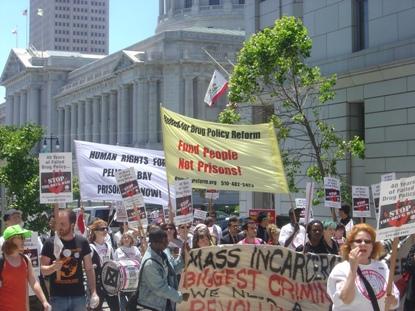
Michelle Alexander, author of The New Jim Crow: Mass Incarceration in the Age of Colorblindness, told an audience at the Pasadena Branch of the American Civil Liberties Union, "More African-American men are in prison or jail, on probation or parole than were enslaved in 1850, before the Civil War began." Why have rates of incarcerated black men skyrocketed over the past 30 years? Alexander says it's the war on drugs which focuses primarily on minority communities even though multiple studies have proved that whites use and sell illegal drugs at rates equal to or higher than blacks. Despite this data, four of five black youths in some inner-city communities can expect to be incarcerated in their lifetimes.

New Directions New Jersey: A Public Safety and Health Approach to Drug Policy

The New Directions New Jersey conference will examine the decades-old ramifications of President Nixon’s declaration of the “war on drugs” in urban communities like Newark.

Drug policy experts from across the country and around the globe will discuss topics including: reducing crime and incarceration, effectively addressing addiction, treating drug use as a health issue, communities of color and the war on drugs, and drug policy lessons and models from abroad.

When asked about the war on drugs on the campaign trail, President Barack Obama said, “I believe in shifting the paradigm, shifting the model, so that we focus more on a public health approach [to drugs].” Polls show the American people agree. President Obama’s drug czar, Gil Kerlikowske, told the Wall Street Journal last year that he doesn’t like the term “war on drugs” because “[w]e’re not at war with people in this country.” Yet for the tens of millions of Americans who have been arrested and incarcerated for a drug offense, U.S. drug policy is a war on them—and their families. What exactly is a public health approach to drugs? What might truly ending the war on drugs look like?  This conference will serve as a model for those looking for new directions and strategies for ending the war on drugs.

“We see the impact of the ‘drug war’ first hand, where so many people are incarcerated for being economically disadvantaged by the disappearance of work,” says Bethany Baptist Church pastor, Reverend William Howard.  “Afterwards, they are virtually permanently barred from the legal workforce for the rest of their lives. We must take our stand against the destructive scourge of drug abuse and trafficking by developing new, sensible strategies that solve more problems than they create.”

The conference will be guided by four principles:

  • The war on drugs has failed and it is time for a new approach to drug policy.
  • Effective drug policy balances prevention, harm reduction, treatment and public safety.
  • Alcohol and other drug use is fundamentally a health issue and must be addressed as such.
  • Drug policies must be based on science, compassion, health and human rights.

Panel members and conference speakers include:

·         Rev. Dr. M. William Howard, Jr., pastor, Bethany Baptist Church

·         Ethan Nadelmann,executive director, Drug Policy Alliance

·         Paula T. Dow, New Jersey Attorney General

·         Garry F. McCarthy, police director, City of Newark

·         Michelle Alexander, Esq., associate professor, Ohio State University’s Moritz College of Law and the Kirwan Institute for the Study of Race and Ethnicity; Author, The New Jim Crow: Mass Incarceration in the Age of Colorblindness

·         Beny Primm, MD, executive director, Addiction, Research and Treatment Corporation, Brooklyn, New York

·         Todd Clear, dean, School of Criminal Justice, Rutgers University

·         Donald MacPherson, former drug policy coordinator, City of Vancouver

·         Alex Stevens, professor of Criminal Justice, School of Social Policy, Sociology and Social Research, University of Kent, Chatham, UK

·         Stephanie Bush-Baskette, Esq., Author and Director of the Joseph C. Cornwall Center for Metropolitan Studies at Rutgers University

·         Deborah Peterson Small, Founder and Executive Director, Break the Chains: Communities of Color & the War on Drugs

For a full list of panel members, go to: http://www.drugpolicy.org/docUploads/DPA_New_Directions_NJ_final_prog_REFERENCE.pdf

Please RSVP to: [email protected]
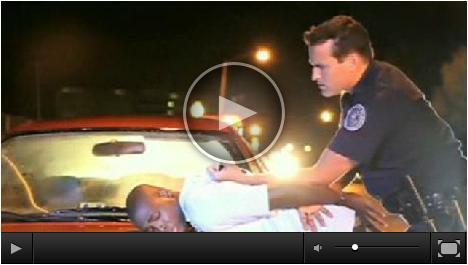
drug arrest scene, "10 Rules for Dealing with Police," flexyourrights.org

Mass Marijuana Arrest Policy Costs NYC Big Bucks

New York City has earned the dubious distinction of being the world's marijuana arrest capital. But such (dis)honors come at a price. A big price.

Make Nonviolent Marijuana Offenses the Lowest Police Priority (Action Alert)

Dear Friends,

On March 15, a new report was released on the steps of New York City Hall documenting the crushing costs of the 50,383 marijuana possession arrests that occurred in 2010 in that city alone, costing New York City $75 million. Released by the Drug Policy Alliance and co-authored by Queens College sociology professor Dr. Harry Levine, the report reveals the police, judicial, and human costs of New York City’s marijuana arrest crusade.

Every single day, 140 people are arrested for marijuana offenses in New York City, making it the leading cause of arrest. A full 87% of those arrested are Black or Latino, a particularly outrageous number since people of color do not use marijuana at higher rates than the rest of the population. Incredibly, the NYPD has quietly made marijuana infractions their top law enforcement priority without even a pretense of public input or debate.

Although New York decriminalized possession of under 25 grams of marijuana, possession that is "open to public view" remains a crime.  Police officers have learned to ask vulnerable people they believe to be in possession to empty their pockets so they can then make an arrest.

The “suspects” do not have to be using, buying, or selling marijuana, nor do they have to be acting out in any way at all. They simply have to be “suspects.”

This flagrant abuse of state power is a tightly held secret. Please help us expose it. Stand with LEAP in supporting a more rational plan for drug policy. Our speakers are law enforcement professionals who know firsthand that the “war on drugs” is a waste of police resources. They speak out against our current drug policy in order to put police priorities back where they belong. 

Help us send the message to NYC Mayor Michael Bloomberg, that using already strained police and judicial resources in this way is not acceptable and that the overwhelming racial disparity of these arrests is appalling. Please sign our petition, and please make a contribution today to support LEAP as the voice of law enforcement in drug policy reform.

Thank you,

Major Neill Franklin (Ret.)
Executive Director
Law Enforcement Against Prohibition


Your donation puts LEAP speakers in front of audiences. To support LEAP's work by making a contribution, please click here.


121 Mystic Ave. Suites 7-9
Medford, MA 02155
(781) 393-6985 [email protected]

We need help growing our all-encompassing movement of citizens who want to end the failed "war on drugs," so please invite your family and friends to learn about LEAP.


Democrats Responsible for Drug War on Black and Latino Men, Ruining Countless Lives (Opinion)

It’s a bit shocking to grasp the role that the Democratic Party, Bill Clinton and Barack Obama, have played in undermining the lives of hundreds of thousands of young minority men. In a very hard-hitting op-ed on October 24th, “Smoke and Horrors” New York Times Saturday columnist Charles Blow, citing the work of City University Professor Harry Levine, makes four truly mind-jolting points.