Coca

many pictures from the Chapare...

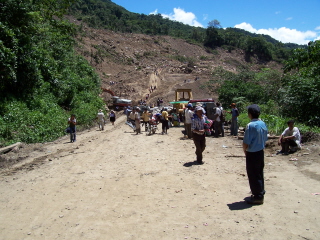
US-funded FELCN (Special Force for the Struggle Against Narcotics) checkpoint between Cochabamba and Chapare, search being conducted for cocaine and precursors Site of major landslide produced by massive rainstorms. Buses and trucks by the dozens were backed up here. We had to leave the jeep on the near side, walk across the landslide, hire motorcyclists to carry us about a mile to where taxis were waiting, then hire a taxi for the afternoon in the Chapare. Click the "read full post" link or here for 20 more pictures chronicling Phil's visit to the Chapare coca-growing region.

Back from the Chapare

I'm now back from the coca producing region of the Chapare. Yesterday was a real grind: Get up very early, fly from La Paz to Cochabamba, take a taxi to the Andean Information Network office where I met up with AIN's Kathryn Ledebur and her husband, former Chapare human rights ombudsman ("defensor del pueblo) Gotofredo Reinecke, hopped in his jeep with him, stopped for gas and coca leaves (it's a tiring journey), then drove about two hours over an 11,000-foot mountain pass and down into the jungly Chapare.
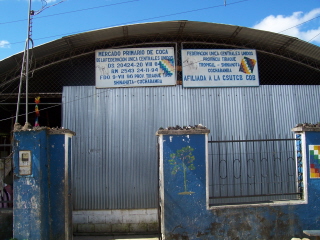
The coca leaf warehouse outside Shinahota. Here, local farmers bring their crops to be carefully weighed and sent on to legal markets within Bolivia. The entire process is controlled by the local growers' union.
But first, we had to traverse a major landslide on the highway caused by incessant rains. (We were extremely fortunate to have a mostly sunny day, a rarity this rainy season). At the landslide, buses and cargo trucks were backed up by the dozens, as they had been for days. The smell of rotting fruit in the trucks was pervasive. Bus passengers had to gather their bags and make a mile-long trek over a muddy path to get to buses waiting on the other side, but we left the jeep on the near side and walked right down the roadway itself—a shortcut—after Godofredo explained to the soldiers that I was a photojournalist shooting the "derrumbe." My sandals, socks, and jeans were covered with mud (which made quite an impression at the Cochabamba airport this morning). Once across the washed out area, it was onto the backs of small motorcycles for hire for another half-mile to where the buses and taxis were waiting for travelers trying to continue their journey, and then we hired a taxi for the tour of the Chapare. In the miserably hot and humid lowlands, we stopped for lunch, where Godofredo spotted veteran newspaper vendor and scene-observer Don Jaime Balderrama, with whom we had an interesting chat. Then it was on to the local military base for a talk with the comandante, which proved absolutely fruitless. He refused to say a word of substance, saying it all had to be cleared with the military high command. Sadly, this seems to be the attitude throughout the Morales government when it comes to coca matters, and as a result, I am not making much progress in getting interviews with government officials (although I still have some feelers out and some hopes, fading as they may be). The army fort, bought and paid for by US tax dollars was nicely constructed, and the colonel's office featured the only air conditioning I ran across on the whole trip. Sweet for him. Sweet for us, too. I didn’t want to leave, even though we were getting nothing from him.

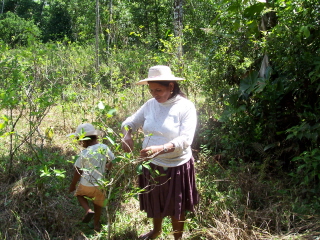
former cocalero leader Vitalia Merida with her daughter, in their coca field
Then it was on to visit Vitalia Merida, a former coca grower union leader (and current member), who has a coca field way out in the middle of nowhere. After her family suffered during the repression of the forced eradication years, she now reports that there is peace, if not prosperity. I'll be writing about what she had to say in a feature article this week. I have to say that is was an absolutely brutal hike in the mid-day sun to her coca patch. When I complained, Vitalia said, "You see how we suffer," although she sweated not a drop. Next was Shinahota, a small town that was the center of the Chapare cocaine economy during the Wild West days of the "cocaine coup" back in the early 1980s. Main street there features a bunch of two-story buildings erected at that time. Downstairs you bought cocaine, guns, and luxury items; upstairs you rented prostitutes. It's much quieter these days, and much less profitable. Just outside Shinahota, we stopped at a coca leaf warehouse operated by the local growers' union and had a nice chat with some Six Federation leaders who, sadly, were camera shy, and just a little bit suspicious of this wild-looking gringo. (I was indeed wild-looking by then: mud-splattered, sweat-drenched, my hair blown into knots as I hung my head out the window of the taxi seeking relief). We had an interesting conversation, though, and I will report on that in the Chronicle, too. Between Shinahota and Villa Tunari, we stopped briefly at a new coca leaf processing plant, which is being financed by Venezuelan President Hugo Chavez. He has promised to import coca products to Venezuela, which would violate the UN Single Convention, but as AIN's Kathy Ledebur noted, "Who's going to stop him?" No one there but construction workers, though. Shortly past the new coca plant, in Villa Tunari, is a municipal hospital staffed primarily by dozens of Cuban doctors and nurses. I couldn’t help but compare and contrast: The US builds forts and supplies the military, Venezuela helps Bolivia industrialize coca, and the Cubans heal the sick. So it goes. That's my report for today. I now have in essence a day and half left in Bolivia. I'm attempting to line up some last interviews, but I'm a little depressed by my lack of success with government functionaries, and just bad luck with some other people I hoped to talk to. But I still have 36 hours... More pictures will be posted here later today.

Phil is on the way to the Chapare...

Phil wrote me this morning that he was heading out to the Bolivian city of Cochabamba and the Chapare region of which it is part. The Chapare is one of the major coca-growing regions in the country. It is unclear whether he will be able to post to the blog today -- Phil will be out in the fields -- or if that will have to wait until he returns to La Paz. The Andean Information Network is an organization that monitors and reports on developments in Bolivia in general and the Chapare in particular, and they are helping Phil with this leg of his trip. I have met current and past AIN staff during their not-infrequent visits to Washington. The AIN web site is a great resource for people wanting to learn more about the relevant issues as well as keep up with the latest developments. Among other things, I just noticed that they have published a curriculum to help schoolteachers deal with US and Andean drug control issues in their courses. Of course the site discusses the state of the coca issue in the administration of Bolivian cocalero leader turned president Evo Morales.

This way to the Coca Museum...

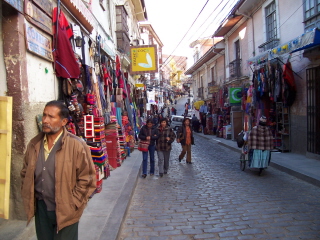
pictures from La Paz, Bolivia: Calle Linares pedestrian mall, with Coca Museum sign (Click the "read full post" link or the title link for more pictures if you don't already seen them.)

As Promised, More Pictures from Phil

Phil took a day off from his reporting to visit the famous Inca ruins of Machu Picchu, but coca seems to be everywhere... stunted coca plant in garden, Machu Picchu (click this post's title link or the "read full post" link for more pictures -- not coca or drug policy, but breathtaking)

Coca at Machu Picchu--Who Knew?

Yesterday, I visited the world class Inca ruins at Machu Picchu. Despite it being a cloudy, foggy, rainy day (it is that season, after all), it was a very impressive experience, one I cannot recommend too highly. Located atop a mountain peak several thousand feet above the raging Rio Urubamba (to enter its waters at this time of year is certain death), Machu Picchu was the primary center for scientific and philosophical research for the Inca empire and a place of retreat for the Inca nobility. Its stonework is amazingly well-hewn, and the complex is huge. About a thousand people lived there full-time, with others coming for special occasions along the Inca trail from Cusco, the capital of the empire. If you ever get to Peru, seeing Machu Picchu is an absolute must. I’m sure I haven’t done it justice with these brief comments. I benefited from traveling with a small group that had a very well-informed tour guide, and it was from him that I learned that coca was part of the Inca diet. In addition to using it for its hunger-suppressing and energy-providing qualities, the Incas used it to keep their teeth strong! The coca leaf is heavy in calcium, and because the Inca lacked cows and llamas provided only enough milk for their young, the coca leaf was their primary source of calcium. Our guide was quite proud of the fact that Inca skeletons always showed strong, healthy teeth, a fact he attributed to chewing the coca leaf. Among the ruins at Machu Picchu, there is a garden packed with plants used by the Inca. Among them is coca, even though it is ill-suited to grow well at such elevations. In fact, the coca plant in the garden there was stunted and scraggly, growing only about 18 inches high, or about one-half to one-fourth of the size obtained by coca plants at elevations to which it is more suited. Still, they grew it at Machu Picchu, for the reasons mentioned above. Today, I’m trying to catch up on emails and news and all that good stuff before heading for Bolivia tomorrow. One thing I will do today, though, is visit the Buen Pastor shop, that place I mentioned a blog post or two ago, where they sell coca products here in Cusco. Look for something about that later today or Wednesday, since tomorrow will be a long day of bus travel across the 12,000-foot altiplano past Lake Titicaca and up to La Paz. I think I will be heading on to Cochabamba the next day, where my friends from the Andean Information Network await me. The coca leaf is ubiquitous around here. My hotel provides some with breakfast every day. All the restaurants offer mate de coca (coca tea). Little indigenous women near Machu Picchu offer it to travelers getting ready to trek around the heights. And the US government wants to eradicate it all. Now, I'm off to visit the coca shops of Cusco. Stay tuned. Note: Dave Borden will be posting some Machu Picchu photos I sent him later today. Come back and check 'em out!

On the Gringo Trail, Getting Whispered Solicitations, and Sipping Mate de Coca

I'm not sitting in Cusco, the old Inca capital, where the Spanish invaders built their churches and houses on the ruins of the Inca city. There is still that fine Inca rock work all over the place; in fact, the place I'm staying in, the Posada de Loreto, has exterior walls that are made of Inca stone, and the whole Callejon de Loreto is one of the streets most noted for its Inca stone work. In Ayachucho, mine was a rare white face; in the rural countryside of the high Andes and the Amazonian selva, mine was the only white face; one that men and women stared at and little child hid from. That's not the case here in Cusco, the gringo capital of Latin America. This city of about 400,000, with its incredible Inca cachet and closeness to the ruins of Machu Picchu, attracts droves of tourists, from tour groups of old people to the international youth backpacker set to the Andean hippies (you know the type, long haired, wearing indigenous ponchos and caps and playing flutes and beating on drums and getting quite messed up on local substances, could be American or German or Australian or even Peruvian). And where there are lots of gringo tourists, there are people wanting to sell them things, including drugs. I don't know what it is about me—is there a neon sign above my head?—but once again it didn’t take more than a few minutes from the time I ventured into the main square this afternoon to be offered cocaine, marijuana, and women. My worry-wart boss will be happen to know I passed on all them, although I feel remiss in not having inquired about prices. Maybe tomorrow. Cusco is high, some 11,000 feet, so I figured this was the time for me to try mate de coca (coca tea) for the first time. I've chewed the leaves before, several times in the last week, as a matter of fact, but I had never had the tea. It was basically a glass of hot water with coca leaves steeping in it. According to my waiter, I was supposed to chew the leaves as I sipped the tea. I did, and I got a nice coca jolt within seconds. Did it help me cope with the altitude? Well, it seems likely; I certainly felt more energetic. I also discovered that there is a store here in Cusco that sells various coca products, along with other hip, "socially conscious" stuff. It's name is the Buen Pastor (Good Shepherd), but they were closed by the time I tracked them down this evening. Since I'll spend the day at Machu Picchu tomorrow, I'll track them down on Monday and see what the deal is. And since I'll be gone all day—up at 5am to catch the train up the Sacred Valley, getting to Machu Picchu about 10am, spending the day at the site, and returning to Cusco about 8pm—you won't be hearing anything more from me for awhile. But there should be some pictures posted. I'm going back to my hotel right now to get the camera, so I can upload them and Borden can download them. On Tuesday, it's on to Bolivia…

More Pictures from Coca Country -- Ayacucho and Cusco

Pictures from Phil, Ayacucho province and Cusco -- more of them (and good writing) can be found in Phil's Drug War Chronicle scene article here. Many more to come... cocalero Percy Ore in his fields, near the town of San Francisco, Ayacucho province coca waiting by the side of the road to go to market (Click the "read full post" link if you're not seeing the rest of the pictures.)

What a trip it's been, and it's only the end of week one!

Since last I blogged, I've gone by overnight bus from Lima to the Andean highlands city of Ayacucho, thence over the top of the Andes and down into the Amazonian selva (actually, the "ceja de selva," the eyebrow of the jungle) to the small towns of San Francisco, Ayacucho, and Kirimbiri, Cusco, on the other side of the rain-swollen Rio Apurimac deep in the heart of the coca growing region known as the VRAE (Valleys of the Apurimac and Ene Rivers), and then back to Ayacucho. It has been brutal—hours of travel on crappy, crappy dirt roads over mountains and across flooded out stretches of road through some of the poorest land in the country. Tomorrow (Saturday) morning, I get up a 5AM to catch a flight back to Lima and then on to Cusco, for a little rest and tourism at Machu Picchu. (Ayacucho is halfway between Lima and Cusco, but as they say, "you can’t get there from here." There are no city to city flights in Peru except to and from Lima. Go figure. An Aero Condor rep told me it's because they're a Fourth World country.) The travel to coca country was mind-bending: Huge mountains, endless switchbacks on dirt roads with no shoulder and a thousand-foot drop-off, indigenous people herding sheep and goats and burros and horses, the women wearing those funny Andean hats. (I hope Dave Borden will be good enough to post some more pictures here.) It is rainy season, so water is pouring down the mountains in spectacular cascades, but also ripping the road open and causing landslides that block the road. Local people come out to fix it, but put rocks in the road to collect a toll for their labors. From the crest of the Andes, somewhere at about 12,000 feet near Tambo, it was downhill all the way to the Apurimac River, a tributary of the Amazon. You go from jacket weather to dripping with sweat in the heat and humidity of the Amazon, pine trees turn to palm trees and tropical fronds. It was in some towns along the Apurimac that I hooked up with some local cocalero leaders and went out into the poverty-stricken countryside to view the fields myself. I've seen a lot of poverty in my day, but the conditions in which the coca farmers live are truly grim. They have to walk miles just to get to the nearest town, they have no running water or electricity, and even with four coca crops a year, they barely make enough money to feed and clothe their children. One of the highlights was one of the cocalero leaders pointing out the houses (more like shanties) of the cocaleros and demanding to know "Where are the narco mansions?" Well, certainly not around here. Every cocalero I've talked to has had the same refrain: This is our sacred plant, we have nothing to do with the drug trade, either leave us alone or provide real agricultural development assistance. And that refrain resonates: Of 70 municipalities in the VRAE, cocaleros hold power in all 70. This is also the home of the country's premier cocalero leader, Nelson Palomino of CONCPACCP, with whom I talked in Lima earlier this week. Will it be pretty much the same in Bolivia? I don't know. Check back later. Editor's Note: I certainly will post Phil's pictures, but it will be a little later this weekend. In the meanwhile, be sure to read Phil's Drug War Chronicle article from Peru, published earlier today -- three pictures, interviews with key people and lots of good info. -- Dave

Phil is Back in Ayacucho -- Report and Pictures Coming Tomorrow AM...

Phil called me this afternoon from a small town called San Francisco, off in the wilds of the Peruvian state Ayacucho -- the heart of coca country. He promised a bunch of pictures, including some of coca fields, when he got back tonight to the city of Ayacucho itself -- all three Internet cafes in San Francisco were offline, so he couldn't send them or post to the blog from there. Among other things, Phil told me that the roads are really bad there, and together with it being a real mountain region he can see why it is difficult to transport most crops out of there to larger markets. Phil was expecting to get back to Ayacucho around 7:00pm, but debris left by a landslide had to be cleared off of the road, and they were delayed for three hours. The hotel doesn't have Internet or even phone lines in the rooms to try a dial-up, and he was left with a little over an hour with which to post some Chronicle articles for me to proof, and with much of the Chronicle writing job in front of him. So no blogging from Phil tonight, unfortunately. But check back tomorrow morning, when Phil will recount the tale of his trip over the top of the Andes and down into the edge of the Amazonian jungle to visit with coca growers...