
The Drug Debate

European Alternatives on Drug Policy -- The Road to Vienna 2008

On 6 and 7 November, in the European Parliament in Brussels, a Conference will be organised on European Alternatives on Drug Policy - the road to Vienna 2008. This Conference is organised by the European Coalition for Just and Effective Drug Policies (ENCOD), in collaboration with two political fractions in the European Parliament (GUE and Greens).

Dynamics of American Drug Culture

September 18, 12 PM, Rivers Auditorium, Laramie County Community College, Cheyenne, WY, "Dynamics of American Drug Culture," lecture by Sheldon Norberg. Visit http://www.SheldonNorberg.com for further

Dynamics of American Drug Culture

September 13, 7 PM, Rivers Auditorium, Western New England College, Springfield, MA, "Dynamics of American Drug Culture," lecture by Sheldon Norberg. Visit http://www.SheldonNorberg.com for further in

Confessions of a Dope Dealer

August 30 & 31, 9 PM, in Entheon Village, Black Rock City, NV, Confessions of a Dope Dealer, Sheldon Norberg's acclaimed solo-performance, hits the playa at Burning Man. Visit http://www.ADopeDealer.c

Cocktail Reception with Judge James P. Gray

Please join us for a private reception with Judge James P. Gray Why Our Drug Laws Have Failed Friday, July 14, 2006 Please join us for a cocktail and hors d'oeuvres reception for James P. Gray, author of Why Our Drug Laws Have Failed and What We Can Do About It: A Judicial Indictment of the War on Drugs (Temple University Press, 2001).

Ecstasy found to Help Alleviate PTSD among Military Veterans

Researchers are gaining ground in the combat against posttraumatic stress disorder (PTSD) in an unlikely way.  Touted as “the party drug,” ecstasy, or MDMA, may just be the saving grace for hundreds of thousands of veterans suffering from PTSD.

According to a study by the Rand Corporation, in 2008 one in five soldiers returning home from Afghanistan or Iraq showed symptoms of PTSD. All in all, nearly 300,000 returning soldiers were affected. Letting individuals with PTSD go untreated is detrimental to both the individual and to society as a whole, as it has been linked to higher incidences of depression, health issues, violence, marital problems, drug use, unemployment, homelessness and suicide among veterans. And although each active military service member is provided with $400,000 in military life insurance coverage, that provides little comfort to families of a PTSD-afflicted veterans.

In US First, California Assembly Committee Approves Marijuana Legalization Bill

A bill to legalize the adult use, sale, and production of marijuana was approved Tuesday by a 4-3 vote in the California Assembly Public Safety Committee. While the vote was historic—it marked the first time a state legislative committee anywhere had voted for a marijuana legalization bill—a Friday legislative deadline means the bill is likely to die before it reaches the Assembly floor.
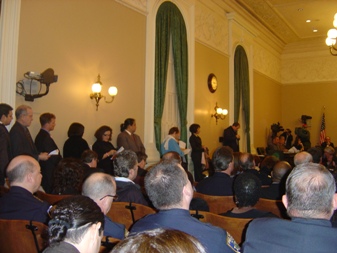
hearing room audience
Still, supporters pronounced themselves well pleased. "The conversation is definitely gaining traction in Sacramento," bill sponsor Assemblyman Tom Ammiano (D-SF) told a press conference at the capitol after the vote. "This is a significant vote because it legitimizes the quest for debate. There was a time when the m-word would never have been brought up in Sacramento." “This historic vote marks the formal beginning of the end of marijuana prohibition in the United States,” said Stephen Gutwillig, California state director of the Drug Policy Alliance, who testified before the committee both Tuesday and in an earlier hearing. “Making marijuana legal has now entered the public dialogue in a credible way. Decades of wasteful, punitive, racist marijuana policy have taken quite a toll in this country. The Public Safety Committee has demonstrated that serious people take ending marijuana prohibition seriously.” "The mere fact that there was a vote in the Assembly to regulate and control the sale and distribution of marijuana would have been unthinkable even one year ago," said former Orange County Judge Jim Gray, a member of Law Enforcement Against Prohibition, who also testified before the committee last fall. "And if the bill isn't fully enacted into law this year, it will be soon. Or, the bill will be irrelevant because the voters will have passed the measure to regulate and tax marijuana that will be on the ballot this November," Gray pointedly added. The bill, AB 390, the Marijuana Control, Regulation, and Education Act would impose a $50 an ounce tax on marijuana sales and would task the California Department of Alcoholic Beverage Control to regulate them. It was amended slightly from the original by Ammiano. In one example, the bill strikes "legalize" and replaces it with "regulate." It also strikes out language saying the bill would go into effect after federal law changes. And it adds language to clarify that medical marijuana does not come under its purview. Tuesday's Public Safety Committee opened to a hearing room packed with legalization supporters, but also by more than a dozen uniformed police chiefs and high-ranking police officers from around the state. Law enforcement was out in force to make its displeasure known.
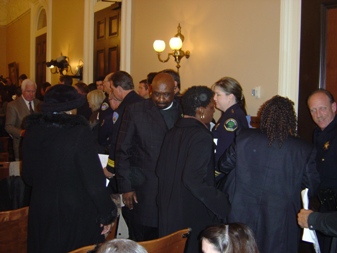
police and preacher present to oppose the Ammiano bill
But first came Ammiano himself, recusing himself from his position as committee chair to testify in favor of his bill. "This is landmark legislation to legalize and regulate marijuana," Ammiano told his colleagues. "It would generate nearly a billion dollars annually in revenues, according to the Board of Equalization, and would leave law enforcement to focus on serious crimes, violent crimes, and hard drugs. The drug wars have failed," the San Francisco solon said emphatically. "Prohibition has fostered anarchy. Legalization allows regulations, and regulation allows order." Since the primary hearing on the bill took place last fall, Tuesday's hearing was limited to 30 minutes (it was closer to 45), and witnesses either said their pieces succinctly or were gently chided by committee Vice-Chair Curt Hagman (R-Chino Hills). The Drug Policy Alliance's Gutwillig recapped testimony he gave last fall, as did the Marijuana Policy Project California state director Aaron Smith. "AB 390 is a historic reversal of failed marijuana policies," said Gutwillig. "It would begin to control a substance that is already commonly available and consumed, but unregulated. Prohibition has created enormous social costs and jeopardized public safety instead of enhancing it." "This legislation would finally put California on track for a sensible marijuana policy in line with the views of most California voters," said Smith. Also endorsing the bill was Matt Gray of Taxpayers for Improving Public Safety, a California group lobbying for more progressive criminal justice policies. "We support the bill," said Gray. "Marijuana is the state's largest cash crop, and this bill will remove a revenue stream from organized crime and decrease availability for youth." The opposition, led by law enforcement, church and community anti-drug groups, and a former deputy drug czar, threw everything short of the kitchen sink at the committee in a bid to sink the bill. Hoary old chestnuts reminiscent of "Reefer Madness" were revived, as well as new talking points designed to discourage members from voting for legalization.
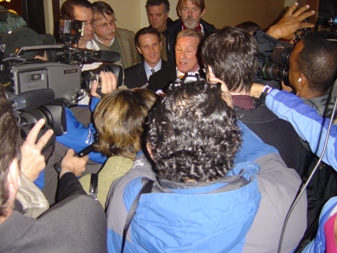
bill sponsor Assemblyman Tom Ammiano, with Dale Gieringer,
Stephen Gutwillig and Aaron Smith in background
"I traveled here with a heavy heart," said former deputy director for demand reduction for the Office of National Drug Control Policy Andrea Barthwell, the big hitter leading off for the opposition. "The eyes of America are upon you," she told the committee. "We don't want you to set a course that worsens the health of Americans for years to come. This is a scheme that will benefit drug cartel kingpins and corner drug dealers and create chaos in our public health system," she warned. "People all over the country are afraid California will have this leverage in the same way the medical marijuana initiative was leveraged to create a sense that these are reasonable policies," Barthwell continued. "We've reduced drinking and smoking through public health, and prohibition is working for our young people to keep them drug free," she added. "Legalization of marijuana will only increase the challenges facing us," said San Mateo Police Chief Susan Manheimer. "What good can come from making powerful addictive drugs more cheaply available? Don't we have enough trouble with the two legal drugs? Adding an additional intoxicant will lead to increase drugged driving and teen sex," she told the committee. "Marijuana of today is not the dope your parent's smoked," she added for good measure. After mentioning that in the Netherlands cannabis cafes have "run rampant," asserting that "drug cartels will become legal cultivators," and that legalization would bring about "quantum increases" in the availability of marijuana, Manheimer swung for the fence. "To balance the budget on the back of the harm caused by illegal intoxicants is mind-boggling—I would call it blood money," she said. Worse, "the addictive qualities of these drugs will cause more crimes as people struggle to find money to buy marijuana. We are very concerned about marijuana-related violence." Then it was the turn of Claude Cook, regional director of the National Narcotics Officers Associations Coalition. "This is dangerous work we do," Cook said by way of introduction. "We are strongly opposed to AB 390, we see no benefit for our communities. Marijuana is also carcinogenic. If we want to raise revenue, maybe it would be safer to just bring back cigarette vending machines. This is human misery for tax dollars." And by the way, "Drug offenders who are in prison have earned their way there by past criminal conduct," he added. Cook predicted downright disaster were the bill to pass. "Use by juveniles will increase. Organized crime will flourish. California will become a source nation for marijuana for the rest of the country. The cartels will thrive. Highway fatalities will rise," he said without explaining just how he arrived at those dire conclusions.
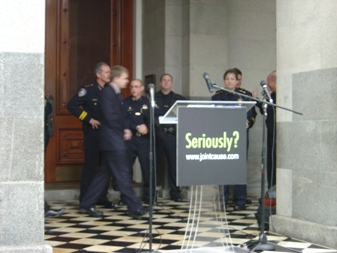
police waiting to speak at anti-drug rally after committee vote
"I see the devastation of marijuana and drugs in my community," thundered Bishop Ron Allen, "CEO and president" of the International Faith-based Coalition, and a self-described former crack addict who started with marijuana. "If marijuana is legalized and we have to deal with it in our liquor stores and communities, you have never seen a devastation like you're going to see. It's going to lose us a generation. You don't want this blood on your hands." "I'm going to discount the ad hominems and alarmist attacks," Ammiano replied after the testimony. "Some of the arguments today reminded me of Reefer Madness," he said Before moving to a vote, committee members briefly discussed their positions. Assemblywoman Nancy Skinner (D-Berkeley) noted that because of the state's medical marijuana law, "We have created a class difference, where a certain class of our population can utilize dispensaries for their own reasons to use marijuana, and on the other hand, we have the street activity around marijuana that is not under semi-legal status." Skinner voted for the bill, while saying she was not sure she would support it on the Assembly floor. "I'm not supporting marijuana, but the question is who we regulate it and is it time to have a serious debate." In the end, four of five Democratic committee members—all from the Bay area—supported the bill, while one Democrat joined the two Republicans on the committee in opposing it." The bill would normally head next to the Assembly Health Committee, but given the time constraints on the legislature, no further action is likely to be taken this session. Still, Tuesday was a historic day in Sacramento and in the annals of the American marijuana reform movement.

British Science vs. Politics Battle Explodes As Top Drug Advisor Fired for Heresy

The British Labor government has created a firestorm of controversy with its firing of Professor David Nutt, head of the Advisory Committee on the Misuse of Drugs (ACMD) last Friday. Nutt was canned by Home Secretary Alan Johnson after the psychopharmacologist again went public with his criticism of the government for refusing to follow a science- and evidence-based drug policy. As of today, after a weekend of furious back and forth in dozens of newspaper articles, two more members of the ACMD have resigned in protest over the firing, and a mass resignation of the 31-member body may come after a meeting next Monday. Johnson told parliament Monday that he had agreed to a request from the ACMD for an urgent meeting, but he also told parliament he had ordered a review of the ACMD to satisfy ministers that the panel is "discharging its functions" and that it still represents a value to the public. The ACMD's charge is to "make recommendations to government on the control of dangerous or otherwise harmful drugs, including classification and scheduling under the Misuse of Drugs Act 1971 and its regulations," its web page explains. "It considers any substance which is being or appears to be misused and of which is having or appears to be capable of having harmful effects sufficient to cause a social problem. It also carries out in-depth inquiries into aspects of drug use that are causing particular concern in the UK, with the aim of producing considered reports that will be helpful to policy makers and practitioners." Tensions between the ACMD and the Labor government began rising after the government up-scheduled marijuana from a Class C drug (least harmful) back to Class B, where it had been prior to being down-scheduled in 2004. The Labor government ignored the ACMD's recommendation that marijuana remain Class C. Things only got worse when the ACMD recommended that Ecstasy be down-scheduled from Class A (most harmful) to Class B, and the government promptly ignored that advice. At that point, Nutt went public with his criticisms of then Home Secretary Jacqui Smith. He also famously compared the dangers of Ecstasy to those of horse-riding, deeply offending both the horsey set and the Labor government. Smith told Nutt to shut up, and he managed to do so until last week. Last week, in a lecture and briefing paper at the Center for Crime and Justice Studies at King's College London, Nutt accused Smith of "distorting and devaluing" scientific evidence when she decided to reclassify marijuana. He also said that Ecstasy and LSD are less dangerous than alcohol and tobacco. "We have to accept young people like to experiment – with drugs and other potentially harmful activities – and what we should be doing in all of this is to protect them from harm at this stage of their lives," he said. "We therefore have to provide more accurate and credible information. If you think that scaring kids will stop them using, you are probably wrong.” Nutt's briefing paper included a ranking of various licit and illicit drugs by comparative harm. Heroin and cocaine were ranked the most harmful in Nutt's scheme, with alcohol fifth, marijuana ninth, LSD fourteenth, and Ecstasy eighteenth. "We need a full and open discussion of the evidence and a mature debate about what the drug laws are for — and whether they are doing their job," Nutt said. That was too much for Home Minister Alan Johnson. He told parliament Monday that Smith had warned Nutt not to publicly disagree with ministry decisions again. "Well, it has happened again," said Johnson. "On Thursday October 29 Professor Nutt chose, without prior notification to my department, to initiate a debate on drug policy in the national media, returning to the February decisions, and accusing my predecessor or distorting and devaluing scientific research. As a result, I have lost confidence in Professor Nutt's ability to be my principal adviser on drugs." Prime Minister Gordon Brown is standing behind Johnson. An official spokesman said the firing was based on the "important principle" that advisers should present advice to ministers but not speak out against their policy decisions. "It would be regrettable if there were other resignations, but this is an important point of principle," the spokesman added. "The government is absolutely committed to the importance of having independent advice and evidence presented by advisory bodies." Nutt defended himself and attacked the government in a London Sunday times opinion piece. "My sacking has cast a huge shadow over the relationship of science to policy," he wrote. "Several of the science experts from the Advisory Council on the Misuse of Drugs (ACMD) have resigned in protest and it seems likely that many others will follow suit. This means the Home Office no longer has a functioning advisory group, which is very unfortunate given the ever-increasing problems of drugs and the emergence of new ones. Also it seems unlikely that any 'true' scientist — one who can only speak the truth — will be able to work for this, or future, Home Secretaries. One of the ACMD members who resigned, chemist Les King, said ministers were putting inappropriate pressure on scientists to make drug policy decisions based on political—not scientific—reasons. "It's being asked to rubber stamp a predetermined position," he said, warning that others could leave the council over the brouhaha. "If sufficient members do resign, the committee will no longer be able to operate," King said. Scientist and Labor MP Robert Winston said Nutt had a "very reasonable" point about the relative dangers of legal and illegal drugs, and that he was disappointed by the firing. "I think that if governments appoint expert advice they shouldn't dismiss it so lightly," he said. "I think it shows a rather poor understanding of the value of science." Reuters reported Saturday that the firing is causing consternation in scientific circles. Scientists told the news agency the decision could undermine the integrity of science in policy-making, including critical areas like health, the environment, education, and defense. "Scientific data and their independent interpretation underpin evidence-based policy making -- and nobody rational could possibly want a government based on any other type of policy making," said Chris Higgins, chair of an advisory committee on spongiform encephalopathy, or "mad cow" disease. Maurice Elphick, a professor of animal physiology and neuroscience at Queen Mary, University of London, said politicians should look elsewhere if they wanted data to back social policies and allow science to maintain objectivity. "If, however, politicians really do want to have an objective assessment of the relative risks to health of different recreational drugs, then they should listen to what the medical scientist has to say, not sack him." he said. The Labor government has picked a fight with science. It's unclear how this will all play out, but Labor doesn't seem to be doing itself any favors so far.

Room for Debate on Mexico's Drug Decriminalization Law

The New York Times "Room for Debate" blog has a series of comments on Mexico's new decriminalization law. Will it reduce violence, or police corruption? Will increase drug use? Is it really a decriminalization law? Former foreign minister of Mexico Jorge Castaneda is among the participants. Check it out . Also of interest today, Mary O'Grady in the Wall Street Journal on "Mexico's Hopeless Drug War." O'Grady points out that "[p]rohibition and demand make otherwise worthless weeds valuable," arguing that neither the decrim law nor Calderon's ongoing drug war will reduce the violence. Via Tony Newman...