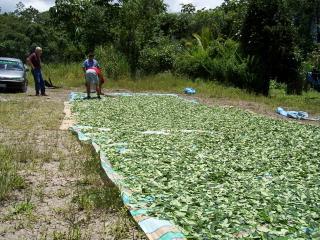
Bolivian President Evo Morales is a former coca growers' union leader, but that doesn't mean everything is swell between Evo and the cocaleros. This week is a case in point.
Drug prohibition isn't stopping Mexican drug trafficking organizations (DTOs). The Australian Crime Commission says highly sophisticated Mexican DTOs are having a significant impact on the Australian cocaine market. The surge is linked to one of the most powerful and brutal syndicates involved in the drug war in Mexico, the Sinaloa organization.
Looking Backwards: Portland Police Chief James Craig
According to federal Health Department data, across the U.S., cocaine and marijuana use have been static since 2002. But New York is a hot-bed for drugs, and Manhattanites are particularly heavy users. A review of drug-test data compiled by drug testing firm Sterling Infosystems shows that cocaine is losing its favor among investment professionals, and is being replaced by marijuana.
Are your stimulus dollars really being wasted on an Obama administration plot to get monkeys high on crack and cocaine as select Republicans and conservatives have been saying recently? No. The money is actually being spent on research into how to treat drug addiction in humans.
the scales of justice tip slightly closer to sanity
The House of Representatives Wednesday approved a bill that would reduce, but not eliminate, the sentencing disparity for federal crack and powder cocaine offenses. The measure had already passed the Senate, and it has the support of the White House, which means the bill will soon be a law.
After nearly a quarter-century of federal crack cocaine laws that disproportionately affected black Americans with far harsher sentences than for powder cocaine, the US Senate has passed a bill that would take a step toward eliminating that disparity. Advocates aren't sure whether to be pleased by the progress or disappointed by the ways in which it falls short.
The drug prohibition tactic of interdiction on sea vessels fails to stop cocaine from being trafficked -- somewhere between 10 and 20 percent is seized, but the traffickers simply send more to make up for what is confiscated. In Honduras -- and many other places across the globe -- locals help traffickers recover cocaine thrown overboard to avoid detection. These Honduran locals call the tightly sealed packages of cocaine "square grouper", and they hope to find all they can.
On 27 April 2007, the US Sentencing Commission (USSC) voted to approve an amendment of the crack cocaine guidelines to lower applicable sentence ranges. In its press release (http://www.ussc.gov/PRESS/rel0407.htm), the USSC announced that a forthcoming report "will set forth current data and information that continue to support the Commission's consistently held position that the 100-to-1 crack-powder drug quantity ratio significantly undermines various congressional objectives set forth in the Sentencing Reform Act and elsewhere." The report has not been published as of this date. FedCURE will post the report as soon as it becomes available. You can check the USSC site at: http://www.ussc.gov.
[Courtesy of WOLA]
Washington, DC April 7-- In the last 15 days, fighting between the Colombian military and the Revolutionary Armed Forces of Colombia (FARC) and the activities of new illegal armed groups vying for control of drug routes is reportedly generating the internal displacement of an estimated 7,000 people. The Colombian Department of Nariño is experiencing one of the worst protection and humanitarian assistance crisis since Colombian President Alvaro Uribe began his second term in office. The U.S. financed aerial herbicide spray program (fumigations) compounds and exacerbates the myriad of hardships that Afro-Colombian communities are already facing: racism, disadvantaged access to state programs, food insecurity due to the internal armed conflict, internal displacement and vulnerability to human rights violations by the armed groups.