The director of the Las Americas Immigrant Advocacy Center in El Paso, Louie Gilot, said cases of Mexicans fleeing drug prohibition violence have risen significantly over the past two years and that the asylum seekers include former police officers, rights activists, journalists, business leaders and even government officials. Carlos Spector, an attorney, said the U.S. government is reluctant to grant political asylum to Mexican applicants because doing so means recognizing that aid from Washington is financing military abuses against the Mexican civilian population.
The Obama administration has been sending drones deep into Mexican territory to gather intelligence. The American assistance has been kept secret because of legal restrictions in Mexico and the heated political sensitivities there about sovereignty.
We've heard for some time now that drug prohibition violence from Ciudad Juárez is spilling over into El Paso. An indictment just released against Barrio Azteca gang members confirms it. So why are some law enforcement agencies and local leaders so reluctant to admit it?
And the spillover continues: The bloody prohibition war that has claimed tens of thousands of lives has spread to the Lone Star state's agriculture, where drug traffickers are targeting farmers' livelihoods. Texas farmers and ranchers say confrontations with Mexican drug trafficking organizations are quietly adding up. Several growers and ranchers say their jobs started becoming more dangerous about two years ago.
Mexico has made an official request for more information about a secret U.S. government operation to allow smugglers to take nearly 1,800 guns into Mexico in an effort to track them to drug trafficking organizations. The operation, code-named "Fast and Furious," was run by the Bureau of Alcohol, Tobacco, and Firearms (ATF), in spite of objections from its own agents. Assault weapons and high-powered sniper rifles were among the guns smuggled in to Mexico over a period of 15 months. Some of the 1,765 weapons have since been linked to crime -- including the murder of a U.S. border patrol agent in December. Fewer than 800 of the guns have been recovered.
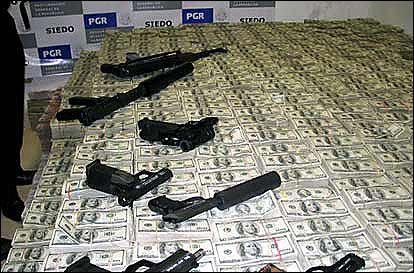
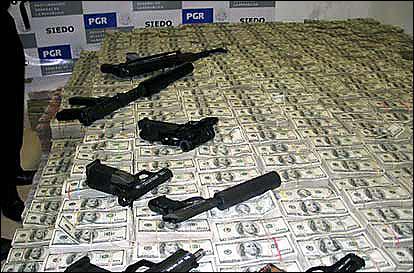
Prohibition creates an endless supply of hot guns and cold cash. (Image via Wikimedia)
A former Mexican governor admitted that the previous PRI government negotiated deals with drug cartels to keep the peace. Was that a better strategy than what Calderon is doing now?
Cash generated by drug prohibition buys lots of guns in Mexico (Image via Wikimedia)
Because the update was late last week, it's two weeks worth of Mexican mayhem this week. And yet another grim landmark as the death toll passes 36,000.
Belizeâs Ambassador to Guatemala, H. E. Alfredo Martinez, said there is already evidence that Guatemalaâs drug prohibition war problems are trickling over the border. Not only is Belizeâs western border with Guatemala infamously porousâGuatemala disputes its very existence, particularly the portion to the South of the Sibun, where anti-narcotics efforts are supposed to be concentrated.
A U.S. immigration agent who was killed in a part of central Mexico increasingly under the influence of drug traffickers has been identified as Jaime J. Zapata. Zapata was shot to death and another special agent was wounded when they were apparently ambushed by gunmen at a fake roadblock.