Arrests

Giuliani's Cocaine Connection

This post is a little more sympathetic than the title might seem to suggest. One of the big news stories today was the indictment of Rudy Giuliani's now-former South Carolina campaign chairman Thomas Ravenel, the state's now-suspended Treasurer, on federal cocaine distribution charges. Drug policy academic Mark Kleiman points out that Ravenel does not appear to have been a drug dealer:
The other guy indicted in the case seems to be the dealer. Ravenel seems to have been one of his customers, who bought cocaine in quantity to share with friends. Under federal law, there's no crime of selling drugs; the crime is "distribution," which includes giving the stuff away.
(Talking Points Memo, linking to Kleiman, observes that Ravenel would have been buying for "what was probably going to be a pretty big bash".) Ravenel should be considered innocent until proven guilty, of course, and Kleiman points out what I think is a pretty good reason why:
The most likely scenario here: The state cops nailed the dealer (he was already in custody on state charges when the indictment was handed up yesterday), and the dealer gave them a prominent customer in order to buy himself some consideration at sentencing time.
As a legalizer, I have to have some sympathy for anyone caught up in the drug war's headlights. Still, Ravenel was a political official at the highest levels in a state that has some real "tough on drugs" policies in place. Unless he was actively involved in working for serious drug policy reform -- and I'm not aware that he was -- and assuming the accusations made against him are accurate, there's a hypocrisy angle here. Furthermore, the candidate he was involved in trying to elect as president, Rudy Giuliani, is a drug warrior who increased arrests in New York when he was mayor, who tried to shut down methadone maintenance in the city, and who opposes needle exchange and medical marijuana. It's especially hypocritical for a drug user to chair a state campaign for a drug warrior trying to be president, who would presumably continue to be a drug warrior if elected president. Then again, maybe Ravenel intended to quietly lobby Giuliani to shift his views/policies on drugs. I tend to doubt it, but I don't know the guy so I can't say for sure. As for Giuliani, did he have no idea about his friend's (alleged) drug proclivities, or no one who could inform him about them? I've heard from a knowledgeable source that when Giuliani was the US Attorney in New York, the safest place to sell drugs was in front of City Hall. Bottom line: If you're a top-level state official, it's probably not a good idea to organize all-out (all night?) cocaine fests. But if you are in the habit of organizing cocaine fests, speak out against the war on drugs too, so at least people won't think you're a hypocrite if you get caught. Actually, speak out against the drug war in any case.

Latest Entry in the Annals of Excess Department

This is not directly drug war related, but this is such an asinine abuse of both police and prosecutorial power that I thought I needed to share it. Alright, here's the tale in a nutshell: Kid riding in pick-up that gets pulled over, kid videotapes cop during encounter (just as cop-car camera videotapes the pick-up), cops seizes camera, arrests kid, cop consults with prosecutor, then charges kid with felony wiretapping, punishable by up to seven years in prison. To stupidly repressive to be true? Here it is: Video Recording Leads to Felony Charge:
Brian D. Kelly didn't think he was doing anything illegal when he used his videocamera to record a Carlisle police officer during a traffic stop. Making movies is one of his hobbies, he said, and the stop was just another interesting event to film. Now he's worried about going to prison or being burdened with a criminal record. Kelly, 18, of Carlisle, was arrested on a felony wiretapping charge, with a penalty of up to 7 years in state prison. His camera and film were seized by police during the May 24 stop, he said, and he spent 26 hours in Cumberland County Prison until his mother posted her house as security for his $2,500 bail. Kelly is charged under a state law that bars the intentional interception or recording of anyone's oral conversation without their consent. The criminal case relates to the sound, not the pictures, that his camera picked up.
Yes, that's right. Apparently, operating a video camera is a crime in Pennsylvania. Who knew? I'm not aware of mass busts of video camera operators at weddings, in parks, at concerts, at family reunions, or any of the thousand and one other places they are commonly used. I haven't seen the Pennsyvlania cops rounding up media camera operators, either, come to think of it. Oh, and the police have an exemption. They can videotape you, but you can't videotape them. Funny how that works.

More Border Blues--Canadian Mom Searching for Missing Daughter Denied Entry

Just two weeks ago, in an article titled Border Blues, we wrote about how both the Canadian and the US governments can and do deny entry to people who admit to past drug use or have a drug conviction. Last week, a particularly egregious example of the abuse of this provision occurred. In a sad tale first picked up by the Vancouver daily the Province, "Mother's Hunt for Missing Daughter Blocked at Border", Kamloops, BC, mother Glendene Grant related how she was turned away from the US as she headed for Las Vegas to search for her young adult daughter, Jessie Foster, who went missing a little more than a year ago. Although Grant had made several previous trips to Las Vegas in an effort to find her daughter and even though she was scheduled to meet local law enforcement and appear at a Crimestoppers event about Jessie's disappearance, she was turned away a week ago today. Why? The 49-year-old mother was arrested in 1986 on marijuana and cocaine possession charges. We are looking into this. Right now, I have emailed Ms. Grant to set up an interview, and I have calls in to US Customs and Border Protection and an anti-human trafficking unit in the Las Vegas Police Department. There is apparently some suspicion that Jessie Foster was the victim of sex slavers. But who cares about that, right? Customs and Border Protection appears more interested in protecting us from a harmless woman who got busted on penny ante drug possession charges more than two decades ago than helping her spur an investigation with possible international implications. My understanding that the decision to deny entry to people with old drug convictions is not mandatory (I'll be checking with CBP on this) but discretionary. In the case of Glendene Grant, the denial of entry looks to be an abuse of discretion, not to mention just downright mean, inhumane, and cold-hearted. Is there more to the story? Stay tuned.

What the heck is going on in Licking County, Ohio?

There's something funny going on in Licking County, Ohio. According to the local newspaper's courthouse roundup, a bunch of people were charged with drug trafficking, but the charges don't seem to match the facts. Let me show you what I mean:
• Ti C. Warner, 27, last known address 381 N. Executive Drive, Newark, was charged with aggravated trafficking in drugs, a second-degree felony. The charge also carries a specification of selling drugs near a school. Between March 29 and 30, Warner allegedly was observed by Central Ohio Drug Enforcement Task Force buying a total of about seven grams of methamphetamine on two occasions, according to court reports. Both purchases were allegedly made in the vicinity of a Newark City school, according to court reports. Branstool set Warner’s bond at $40,000. • Sherry L. Runyon, 46, last known address 16328 Pleasant Hills, Newark, was charged with trafficking in crack cocaine, a fifth degree felony. On April 11, she allegedly was observed by Central Ohio Drug Enforcement Task Force buying less than one gram of crack cocaine, according to court reports. Branstool set Runyon’s bond at $10,000. • Kevin L. Barker, 29, last known address 9215 Lancaster Road, Hebron, was charged with aggravated trafficking in drugs, a fourth-degree felony. On March 26, he allegedly was observed by Central Ohio Drug Enforcement Task Force buying 1.64 grams of methamphetamine, according to court reports. Branstool set Barker’s bond at $10,000.
Do you see what I mean? These are people who were apparently caught buying drugs. And they are charged with drug trafficking? I don't know who is responsible for these charging decisions—either the Central Ohio Drug Enforcement Task Force or local prosecutors—but they don't seem to be supported by the facts. And here's one more bizarre charging example from Licking County:
• Kelly L. Mihelarakis, 32, last known address 633 Mount Vernon Road, Newark, was charged with permitting drug abuse, a fifth-degree felony. Between March 29 and 30, Mihelarakis allegedly allowed an associate to buy about seven grams of methamphetamine on two occasions. Both alleged purchases were made in the vicinity of a Newark City school, according to court reports. Branstool set Mihelarakis’ bond at $5,000.
Excuse me!? "Permitting drug abuse"? This person is charging with not stopping someone else from buying speed? This is a crime? You have got to be kidding. Well, my hat is off to the Central Ohio Drug Enforcement Task Force and the Licking County criminal justice system. With their apparently unjustified charging decisions, they are certainly doing their part to ensure that Ohio's chronic prison overcrowding crisis continues.

Video Showing Field Drug Test False Positives for Many Different Soaps

In the aftermath of the infamous "soap bust" of drummer Don Bolles of "The Germs" fame, Dr. Bronner's has released a video showing the NarcoPouch field drug test coming up with false positives for a range of natural soap products. Curiously "fake" soaps that are actually detergent-based are coming up negative. Read the full press release here. Watch the video (which also includes TV news footage about the incident) via YouTube below:

Marijuana Activists Brutalized by Moscow Police During Annual Demonstration

Eugene Kazachenko distributed the following disconcerting report from Moscow yesterday:
Dear sisters and brothers! My name is Eugene Kazachenko. I'm from Moscow, Russia. Today, some hours ago my friends from Marijuana march were arrested. They tried to stretch the banner with calling to legalize marijuana. The goal of this march was legalization marijuana for medical use. Now there are about 20 people arrested. The police was very cruel with marijuana activists. With fear for life of our brothers and sisters my friends and I are receiving periodical news of Radio station Ekcho Moskvy ("The Echo of Moscow"). This is the only free radio channel, which real informs of social and political life in Russia. It informs that Police has placed people by faces on the ground. Police has dragged girls upon the ground and has beaten young men. Policemen have banged young men by their faces about parked cars. In the police department some young activist was beaten so cruel that this has caused coming an ambulance. The representatives of The Federal service of drug control have accused all delaying activists in biased attitude to narcotics. Without any reason they have accused participants of Marijuana March in propaganda of narcotics. At the police department some policemen are trying to plant the drugs to activists. However attorney was not passed to his clients for legal defense. On entrance with the sub-machine-gun in hands the policeman did not let to attorney to come into the door of the police department. Marijuana March was organized by Cannabis Legalization League. At this moment all of delaying marijuana activists are in Presnentsky administrative (misdemeanor) court of Moscow (phone number of this court: +7 495 254-53-59). They are accusing for undertaking unsanctioned meetings. This position of government disagrees with 31 articles of The Constitutions of Russian Federation and Public International law. Though many religious confessions concern with a rehabilitation and spiritual counseling for drug abusers, however they never call any attention in regard to the realistic position of medical cannabis. Regrettably Christians and other religious circles of Russia do not raise a voice in rights protection of drugs consumers from unjustified state repression. Because of unchangeable and increased repressive policy of Russia in attitude to consumers of drugs the religious figures are positioning itself apart of to questions of government drugs policy. Hypocritically the majority of them tacitly agrees with official drug policy or on the pattern of flattering politicians they loudly convicts all people, which voice opinion for legalization hemp as a medicine. With respect, Eugene Kazachenko MDiv of Moscow Theological Seminary

Coordinated Drug War Raids as Taxpayer-Funded Lobbying

Peter Guither at the Drug WarRant blog has pointed out what he calls a "blatant and pathetic effort" by the State of Kentucky to secure drug war funding from Congress:
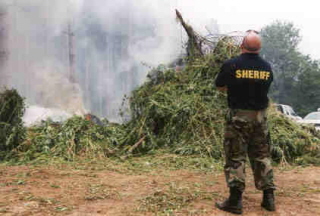
State police, local law enforcement, sheriff's offices, HIDTA and multi-jurisdictional drug task forces throughout the nation collectively conducted undercover investigations, search warrants, consent searches, marijuana eradication efforts, drug interdiction and arrest warrants for a period of one week. This collective effort, Operation Byrne Drugs II, was conducted from April 23-29 to highlight the need and effectiveness of the Byrne grant funding and the impact cuts to this funding could have on local and statewide drug enforcement.
Actually it is the media efforts that seem to be coordinated, in addition to the drug enforcement. I noticed a suspiciously similar press release distributed by the California Dept. of Justice last July about a suspiciously similar incident:
BNE task forces, comprised of state, local and federal law enforcement agencies, throughout the state served 16 search warrants, seized three firearms, confiscated 53 pounds of methamphetamine, 91 pounds of marijuana, and 37,747 marijuana plants. State drug enforcement agencies across the U.S. on July 27, 2006 participated in a "national day of drug enforcement." Organized by the National Alliance of State Drug Enforcement Agencies, "Operation Byrne Drugs" promoted the continued funding of the Byrne Justice Assistance Grant program that supports local and statewide drug enforcement. The federally funded program has suffered deep cuts over the last few years, directly affecting BNE. In fiscal year 2001-02, BNE received more than $11.5 million for personnel and operating costs. In fiscal year 2006-07, BNE received less than $6 million, nearly a 50% decline over five years.
your tax dollars at work to get more of your tax dollars
Now I run an advocacy group, and I can tell you with confidence that this is exactly what groups who want to achieve a legislative objective will do -- organize media-worthy events in order to get the attention of the policymakers you need to influence, in this case Congress. The main differences between what we do and what the narcs are doing are that: 1) They are using taxpayer funds to carry out their media/lobbying campaign to secure taxpayer funds; and 2) They are using the authority the government has given them to wield state power including guns in order to arrest and incarcerate people, as a component of their media-lobbying campaign. We will generally just hold a press conference or a rally, or issue a report. I suspect that in strict legal terms they have not violated the law. But make no mistake -- this is lobbying of Congress by state agencies to get our money, and they are destroying numerous lives in order to do it. I don't agree with drug enforcement at all (as readers know), but even for those who do, clearly enforcement decisions about when and whom to raid should be based on law enforcement/public safety needs, NOT politics. Unfortunately, it is not only drug money that corrupts our law enforcement; it is drug war money too.

Racial Profiling: Another DOJ Cover-up?

A new report from the Justice Department's Bureau of Justice Statistics (BJS) shows that black and Hispanic drivers are significantly more likely to be searched, arrested and subjected to the use of force than whites.

It was initially encouraging to see the DOJ release this year's report without any shenanigans considering what happened last time:
The Justice Department intervened, insisting that BJS not publicize that nasty part about minority drivers being more likely to be searched, arrested, handcuffed, beaten, maced, or bitten by dogs.

A conflict emerged in the course of which BJS Director Lawrence A. Greenfeld was removed from his post. His attempt to provide the media with an unbiased summary of his agency’s findings was apparently too much for his superiors at the DOJ. Ultimately, no press release was sent out, and the study was unceremoniously posted in the bowels of the BJS website.
Perhaps it's a sign of progress and lessons learned that DOJ declined to bury this year's equally shocking findings. After all, covering up racial profiling is one way – however shameful and undignified – of admitting that it exists.

Yet, upon closer inspection, we find that this year's BJS report omits the single most important piece of information contained in the previous report: hit-rate data showing whether minorities were more likely to be hiding contraband.
Likelihood of search finding criminal evidence

Searches of black drivers or their vehicles were less likely to find criminal evidence (3.3%) than searches of white drivers (14.5%), and somewhat less likely than searches of Hispanic drivers
(13%).
This revealing fact fundamentally undermines the sole premise from which police agencies and others have sought to defend ongoing racial disparities such as those revealed this week. Consider the following hypothetical (but really quite typical) debate with a racial profiling apologist:
RPA: There's no such thing as racial profiling. Cops don't even know the race of the driver until after they've made the stop.

Me: Who gets pulled over is only one part of the equation. The data show that minority drivers are more likely to be searched, arrested, and subjected to the use of force after being stopped…

RPA: Well, if that's true it's because those people committed more crimes.

Me: Actually, the data show that searches of white people are more likely to produce evidence of a crime.

RPA: Wow, you must have gotten straight A's at the Al Sharpton Academy of Social Science.

Me: This data comes from the Department of Justice.

RPA: Hang on, I'm getting a call. Oh yeah, gotta take this. Good talk.
DOJ was able to provide a racial breakdown of hit-rates in its previous report (the one it buried) thus the omission of such information from this week's report is highly conspicuous. And of course, DOJ's previous attempts to cover up racial profiling data attest to the agency's lack of candor and credibility on this issue.

The larger question then is why the Department of Justice seeks to downplay racial profiling in the first place. BJS reports primarily reflect the behavior of local law-enforcement agencies, not the feds. The only real embarrassment here for DOJ is its ongoing failure to provide adequate monitoring of police practices at the state level. An activist such as myself may be keenly aware of DOJ's abdication of this responsibility, but I suspect that most people are not.

In any case, we'd be hard pressed to generate any further controversy surrounding cover-ups at the Department of Justice this season. Instead, let's do our best to make sure everyone knows how to handle police encounters. No matter how thorough, a traffic stop report from the federal Bureau of Justice Statistics won't save your ass on the New Jersey turnpike anyway.

Punk Rocker Jailed -- Over Soap!

FOR IMMEDIATE RELEASE CONTACT: Adam Eidinger April 9, 2007

"Germ" Wrongly Jailed Over Soap

Absurd GHB Drug Charges for Don Bolles, Drummer of the "The Germs", Stem From a Bottle of Dr. Bronner's Peppermint Soap Found in Van During Police Stop ESCONDIDO, CA – The Bronner family, makers of the popular organic Dr. Bronner's Magic Soaps are shocked and disturbed by musician Don Bolles' April 4th arrest for felony drug possession after police alleged an 8oz bottle of peppermint Dr. Bronner's Magic Soap tested positive for the illicit drug GHB (Gamma Hydroxy Butyrate). The notion that anyone would put GHB in a rinse-off liquid soap product is beyond belief, and the police field test used must have been flawed or tampered with. GHB, which produces euphoria and is an alleged aphrodisiac when ingested, of course has absolutely no effect in a soap product that is rinsed off the hands and body. Mr. Bolles, drummer of the legendary punk band The Germs, was arrested following a police traffic stop and spent three and half days in various jails in Orange County before being released early Easter morning. During a consented search of Mr. Bolles vintage 1968 A-108 van, Newport Beach police found a bottle of peppermint Dr. Bronner's soap which is made with organic coconut, olive, hemp, peppermint and jojoba oils. Felony drug possession could mean 20 years in prison if convicted. A pretrial hearing is scheduled for Friday, April 13, 2007 at the Harbor Justice Center, 4601 Jamboree Road Newport Beach, CA at 8:30am. "I've used only Dr. Bronner's soap for 35 years," says Mr. Bolles. "I use it for everything - bathing, washing my hair, washing my clothes - it goes everywhere I go. I'm scheduled to go to Europe to tour with The Germs this summer, but these felony charges could keep me from traveling out of the country. This whole thing could be really devastating to a 50 year old guy just trying to make a living. I told the officer 'its soap, it smells like peppermint soap,' but he seemed intent on arresting me." "It is totally outrageous that the police could be this malicious and idiotic," says Michael Bronner, Vice-President of Dr. Bronner's Magic Soaps. "This clearly is a case of profiling by the Newport Beach police of a person who doesn't look like the people who live in that town. We are paying the cost of Mr. Bolle's lawyer, and we demand the charges be dropped or proof from the police forensics lab of GHB contamination be immediately provided to us," said Bronner. Adds brother David Bronner, President: "We cannot imagine anyone putting GHB, or any other drug for that matter, into a rinse-off soap product that is lathered and rinsed off the body immediately. The Newport Beach police should see how much of a buzz putting beer in their shampoo gives them, and get a grip and apologize on their hands and knees to Mr. Bolles." At the time of the arrest Mr. Bowles was driving his girlfriend, and fellow musician Cat Scandal to an Alcoholics Anonymous meeting in Newport Beach. "I had heard of GHB but the police had to tell me what it was," said Bolles. "I'm going to fight these charges." To arrange an interview with Don Bolles, Michael Bronner or David Bronner please contact Adam Eidinger at [email protected].
###

Former DEA Agent: We'll Win If We Just Arrest Every Drug User

Most people who notice that the drug war has failed eventually come to understand that we must stop wasting billions of dollars harming people who've used drugs.

But a select few propose escalation, and their ideas range from crazy to…well, crazier.

Expert: War on drugs should shift focus from the Press & Sun-Bulletin in Binghamton, NY gives a voice to former DEA agent Michael Levine, who I don't think will be joining LEAP anytime soon. He's written a book called Fight Back that doesn't sound very good.

According to Levine, the reason the drug war is failing is because we've been wasting our time chasing the dealers when we should be trying to arrest all the users. He's serious:

It is the druggie who is victimizing us. It is he -- not the drug dealer, the smuggler, the Medellin Cartel, or all the Manuel Noriegas of this world -- who is responsible for the spread of drug abuse.

He thinks we should turn to China and Japan for guidance:

They succeeded in getting the situation under control because they targeted the users, forcing them into rehabilitation. They realized "that they did not have a drug epidemic; they had an epidemic of druggies."

For starters, we must begin teaching children the truth about drugs:

Levine says druggies should be depicted "convulsing and vomiting on themselves in detoxification wards; or staring vacant eyed on the benches of intake centers and emergency wards. That is what being a druggie is really all about, and that is what we should want our kids to see and understand."

Of course, no such rant would be complete without this:

Give me one community -- the worse the better -- where the citizens, the media and the police are willing to work together in following the step-by-step plan of Fight Back and I guarantee the end of the drug problem within one year."

I think the first step towards solving our drug problem is to be more selective in our use of the term "expert."