Arrests

Students for Sensible Drug Policy Responds to the Arrests at San Diego State

Just watch the finesse with which SDSU's chapter of Students for Sensible Drug Policy responded to the arrest of 75 of their classmates:


SDSU-SSDP President Randy Hencken's superb performance shows how effectively one can reframe the issue by choosing smart and appropriate talking points. There are many interesting, and truthful, drug policy reform arguments that would nonetheless have been poorly applied here. As the video shows, a disciplined and mature reaction from reformers resulted in positive press coverage.

There is another lesson here, however, that should not go unnoticed: the reform argument came off strong because we had people on the ground at San Diego State well before the DEA showed up to haul students away in handcuffs. SSDP is a growing presence on campuses throughout the nation and beyond. Each new chapter increases our chances of being organized and prepared when the next such opportunity presents itself.

If you're in school and you don’t have a chapter, go here now. Whether you're looking to organize events or just stay informed and make some friends, you'll find what you’re looking for. This is where the next generation of reformers is coming from.

Don't Use Text Messages to Advertise Your Cocaine Prices

When I heard today that 75 students at San Diego State University were arrested on drug charges, something didn't sound right. That's just a hell of a lot of people, and in light of the drug war's typically flimsy evidentiary standards, I leaned towards the assumption that more than half of them probably didn’t do a damned thing.

That may still be true, but after learning how reckless and cavalier these guys were, I'm less shocked by the outcome:

"Undercover agents purchased cocaine from fraternity members and confirmed that a hierarchy existed for the purpose of selling drugs for money," the DEA said.
…

A member of Theta Chi sent out a mass text message to his "faithful customers" stating that he and his "associates" would be unable to sell cocaine while they were in Las Vegas over one weekend, according to the DEA. The text promoted a cocaine "sale" and listed the reduced prices. [AP]

Um, had you ever heard of the drug war, you idiot? Why not advertise on Craigslist while you're at it.

Many will say they had it coming, but I sympathize nevertheless. The lure of the black market sucks these guys in like a whirlpool. It is precisely the sort of people who would behave this way that are drawn forcefully towards such activity, empowered by it, and ultimately destroyed by the state at tremendous expense to the taxpayer.

If someone responsible and accountable to the public were charged with distributing these substances to those determined to consume them, we wouldn't have conspicuous drug monopolies creating disorder on college campuses across America. We wouldn't have to pay for young people to be investigated and convicted, then sent away to a horrible place where taxpayers must buy their food and clothing and medical care and even fund their reintegration into society.

Look no further than the fact that college students are getting hauled out of college 75 at a time for drug violations to know that our drug policy isn't working at all.

NYPD's Mindless Response to Accusations of Overzealous Marijuana Enforcement

Let's revisit once again this week's excellent NYCLU study of marijuana arrests in New York City. It illuminates several embarrassing facts, which the architects of this disgusting policy would prefer to keep concealed. Among them:

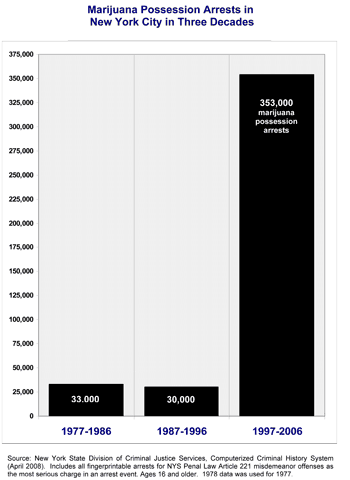
*A shocking increase in arrests from 45,300 between 1988 and 1997 up to 374,000 between 1998 and 2007
*A sustained violation of the spirit of New York's marijuana laws, which hold that citizens should not be arrested for small amounts of concealed marijuana
*Stark and unexplainable racial disparities. 83% of arrestees were black or Latino even though whites are more likely to use marijuana
*Similarly disturbing gender disparities. 90% of arrestees were male, even though women and men use marijuana at similar rates
*The appalling hypocrisy of NY mayor Michael Bloomberg who presides over these arrests despite his admission that he's enjoyed marijuana in the past
*A profit motive behind the arrests wherein police deliberately make marijuana collars at the end of their shift so that they can collect overtime pay while processing the offender

Now that these ugly revelations have been exposed, what does NYPD have to say in its defense? Exactly what one might expect:
In an official comment on the study, the Police Department was critical of the role played by the New York Civil Liberties Union in publicizing the report and noted that the research had been backed, in part, by the Marijuana Policy Project, which supports legalization. [NY Times]
Um, pardon me, but what the hell does that have to do with anything? The report is accurate. Complaining that it was publicized by its authors and that it was funded by supporters of marijuana policy reform is irrelevant. Of course police are angry that this went public. It's embarrassing. And of course it was funded by critics of marijuana laws. Who else would fund it? The Heritage Foundation? I don’t think so.

So the Marijuana Policy Project is biased, they say, but NYPD sees no conflict of interest when defending the same laws that its officers are paid overtime to enforce? The arrogance of this couldn’t possibly be overstated, but I guess there wasn't much else to say. If everything in the report is true, all you can really do is call the author a jerk.

So in order to avoid ridiculously dumb drug policy debate tactics in the future, let's just get one thing straight once and for all: if people who oppose marijuana laws aren't allowed to criticize marijuana enforcement, then people who support marijuana laws shouldn't be allowed to defend it. Does that sound fair?

New York City's Marijuana Arrest Rate is Wildly Out of Control

Two of my colleagues, Deborah Small and Prof. Harry Levine, have analyzed New York City's marijuana policy in a major report released Wednesday the New York Civil Liberties Union. The chart appearing above pretty makes the central point, but check out Jacob Sullum's piece in Reason for a good general discussion of the report's findings and implications. Also, Scott wrote here last night about an important side angle, why it's a bad idea to take out your marijuana to give it to police. Yesterday's is a must-read too. The report itself, and the authors' summary, are online here

Don't Give Your Marijuana to the Police

This remarkable New York Times piece exposes New York City's out of control marijuana policy, which has produced 374,900 misdemeanor marijuana arrests since 1998, despite a decrim law that's been in effect for 30 years. This is a rare example of professional-quality drug war coverage from the mainstream media and should be read in its entirety, as it raises several interesting issues.

I found this passage, which describes one particular arrest, quite revealing:

"I came out of the building, and this unmarked car, no light, no indication it was police, was right on me," said the man, a Latino who asked that his name not be used because he was concerned about his job. "Right on my tail. An officer got out, he said, 'I saw you walking from that building, I know you bought weed, give me the weed.' He made it an option: 'Give me the weed now and I will give you a summons, or we can search your vehicle and can take you in.' "

He opened the console and handed them his marijuana — making it "open to public view."

"I was duped," he said. But the deception was legal, and his pot wasn’t.

The officers escorted him in handcuffs to the unmarked car.

Amazingly, police must actually trick citizens into displaying their marijuana in order to make an arrest, since the decrim law requires plain view discovery. NYPD officers have become quite adept at initiating this through the typical threats and coercion that have long been the hallmark of petty drug war police practices.

Fortunately, the most obvious and effective antidote to New York's overzealous marijuana policing is really pretty simple: don't give them your marijuana. Don't admit having marijuana. Don't give them consent to search you or your vehicle. Ask if you're free to go.

Ending this obscene spectacle, which violates the spirit of New York's marijuana laws and wastes precious law-enforcement resources, is vitally important. But until that happens, citizens can protect themselves by not idiotically turning over their illegal drugs to the police. Seriously, stop giving them your drugs.

How many drug dealers does it take to supply a 10,000-person community? Or, is Twiggs County, Georgia, the latest Tulia?

Pete Guither over at Drug WarRant has spotted a report on what looks to be a suspiciously large number of drug busts -- 17, with 11 more warrants pending, all following a six-month undercover investigation -- in the sparsely populated Twiggs County in Georgia. Twiggs has 10,184 residents, at latest count -- the largest city, Jeffersonville, boasts a mere 1,028 residents. The county is so small, in terms of its population, that there is exactly one auto repair shop. Which raises the question, can a county that small really support 28 drug dealers? The same question came up in the Tulia scandal, where about 46 people, almost all of them black, were convicted and imprisoned for drug dealing based on the testimony of a rogue cop, who as it turns out had made it all up. Many of the names listed in the indictment have an African American sound to them. Comments from local officials also raise questions about the operation's timing. In issue #520 of the Chronicle, we reported that Congress had substantially cut funding for the federal grant programs that support these kinds of task forces and that law enforcement organizations were engaged in a massive lobbying/media campaign to try to get the funding back. Twiggs police clearly had that situation in mind when they spoke with the press:
Officials, however, are concerned about the future of such major operations. Special agent Martin Zon of the GBI's state drug task force said federal funding for the task force has been cut by nearly 70 percent in the newest budget. Once it takes effect in July, the budget cuts could hamper law enforcement efforts in the drug war. "We've been a recipient of these funds for many years, and in December we learned that these grants would be cut drastically," Zon said. "Our budget was cut by 70 percent, which cuts our ability to fulfill requests from places like Twiggs." Mitchum said he's also concerned that he may not have certain state resources to call upon in the future. "The task force is a big help to departments our size," he said. "We use their equipment, their personnel, their expertise. We wouldn't want to see their funding cut. It's really important they keep it."
If it is a case of law enforcement busting people as taxpayer-funded lobbying for funding, it would be nothing new -- Pete pointed out such a case in Kentucky last year, and I noted a 2006 press release from the California Attorney General's office that directly admitted it, in a previous blog post on that topic. There are other examples, too.

Eric Sage Fights Back

As part of a new Drug War Chronicle occasional series on victims of the war on drugs, we told the story of Eric Sage back in November. Now, there are new developments. On his way home to Nebraska after attending the Sturgis Motorcycle Rally in South Dakota last summer, Sage's motorcycle was pulled over by a highway patrolman. A pick-up truck accompanying also stopped, and when the patrolmen searched that vehicle, he found one of the passengers in possession of a pipe and a small amount of marijuana. Bizarrely, the patrolman charged not only the pick-up truck passengers but also Sage with possession of paraphernalia. Unlike most people arrested on drug charges--even bogus ones--Sage refused to roll over. That prompted local prosecutors to threaten to charge him with "internal possession," a crime (so far) only in South Dakota, and a charge even less supported by the evidence (there was none) than the original paraphernalia charge. After repeated multi-hundred mile trips back to South Dakota for scheduled court hearings, Sage's charges mysteriously evaporated, with prosecutors in Pennington County lamely explaining that they had decided the charge should have been filed in another county. Sage was a free man, but his freedom wasn’t free. Sage says his encounter with South Dakota justice cost him thousands of dollars, lost work days, and considerable stress. Now, he is seeking redress. On Monday, Sage and South Dakota NORML announced that he had filed complaints with several South Dakota agencies and professional standards groups regarding the actions of the prosecutors, Pennington County (Rapid City) District Attorney Glenn Brenner and Assistant DA Gina Nelson, and the highway patrolman, Trooper Dave Trautman. Sage accuses Trautman of improperly charging everyone present at the incident with possession of paraphernalia. He also accuses Trautman of concocting an arrest report long after the fact to support the new charge of internal possession. Sage accuses Assistant DA Nelson and her boss of prosecuting a case they knew was bogus and of threatening to convict him of an offense where they knew he was not guilty because he refused to plead to the original paraphernalia charge. "They mugged me," Sage said. "They cost me $4000. I had to travel to Rapid City several times, I had to hire a lawyer, I missed work. It cost me three times as much to get them to drop a bogus charge as it would have cost me to say I was guilty of something I didn't do and pay their fines. They only quit when they ran out of clubs to hit me with." Prosecutors didn't even have the courtesy to let him or his local attorney know they had finally dropped the charges, Sage said. "My lawyer called Gina Nelson several times to see if I needed to drive up on Nov. 21," he said. "She wouldn't return the calls. So when I got there, I found the charges had been dropped on the 16th. Gina had purposefully made me drive one more 500 mile round trip, for nothing." Now, we'll see if the powers that be in South Dakota will bring the same dogged determination to seeing justice done in this case as they do to going after anybody who even looks like a small-time drug offender. You can read Sage's complaints to the South Dakota Department of Public Safety, the South Dakota Bar Association Disciplinary Committee, and the Pennington County Commission here.

Why Do Police Really Oppose Marijuana Legalization? Part II

Yesterday's post failed to address the prevalence of police officers who privately oppose the drug war, but silently uphold it even though they know it's wrong. My argument is quite incomplete without addressing this important phenomenon.

LEAP director Jack Cole has told me that police constantly admit to him in confidence that they agree with LEAP's arguments. Former Seattle Police Chief and LEAP speaker Norm Stamper has also stated that several high-ranking police officials have privately commended his efforts to end the drug war.

How then do we explain the behavior of police who carry out a war they don't believe in? Are they just following orders and collecting their paychecks? Are they fearful that speaking out will compromise their status within a profession they otherwise enjoy? Do they believe the laws are here to stay, so someone has to enforce them? Are some just waiting for their pension to kick in before joining LEAP?

I'm sure all of these factors contribute here, but I suspect that many officers have a more nuanced view of drug enforcement. I once asked a highly-regarded police sergeant what he thought of a controversial teenage curfew law aimed at curbing crime in D.C. "It's a useful tool," he replied, meaning that it gave him the authority to take action against suspicious youths in the absence of other evidence. If he can't prove they're out tagging cars, he can at least stop them and send them home.

Drug laws, particularly marijuana, perform a similar function by granting police the discretion to forgive or destroy individual suspects based solely on their demeanor and the contents of their pockets. Police can ignore the smell of marijuana when dealing with a polite citizen, or fabricate it entirely when they believe someone's hiding something. A law that criminalizes vast portions of the population, justifying detentions, searches and arrests, is a "useful tool" indeed. Officers needn't believe they're winning the war on drugs to find value in the vast authority it bestows upon them.

Wielding inflated drug war powers with the best of intentions may help some officers justify their participation in something they otherwise find distasteful. Of course, none of this justifies the massive collateral damage that occurs in the process, but it might help explain how conscientious people could engage in behavior that shocks the conscience.

Just Because Criminals Use Drugs Doesn't Mean Drugs Cause Crime

ONDCP's latest blog post boldly proclaims that drugs cause crime because most people who get arrested test positive for drugs. As is their habit, ONDCP's post was created by taking a newspaper article, misunderstanding it, and then drawing exaggerated conclusions that are factually wrong:

The Drug-Crime Link: Most Adults Committing Crimes in San Diego High at Time of Arrest

A new report out of San Diego County illustrates the strong connection between using drugs and committing crime. The North County Times reports:

"While the number of adults that test positive for drugs when arrested dropped slightly in 2006 compared with the year before, narcotics use continues to show up in more than 70 percent of arrestees, according to a report released Tuesday by the San Diego Association of Governments...

The headline alone contains two wildly inaccurate claims. For starters, being arrested doesn't mean you've actually committed a crime. Duh. This may seem insignificant, since drug use rates are probably the same or higher among those convicted. Still, it's a reflection of ONDCP's mindset that arrestees are simply presumed guilty.

More to the point, testing positive for drugs absolutely doesn’t mean you're high. Cocaine, heroin, and methamphetamine remain detectable in your system for up to 4 days, while PCP and marijuana can linger for up to a month. We can identify these drugs in someone's body, but we cannot prove when the drugs were ingested or whether they were intoxicated at the time of arrest.

ONDCP's whole premise that drug use makes people go crazy and break the law is just not supported at all by this data. Addicted users frequently commit crimes precisely because they're no longer high, but they'd like to be. This link can be better addressed through maintenance programs and by eliminating the black market that inflates prices and forces addicts to steal.

Marijuana users, on the other hand, are unlikely to ever pass a drug test if they use more than twice a month. How many of these arrestees are just marijuana users who smoked days or weeks before an unrelated arrest? It's the most widely used and most detectable illicit drug, so its inclusion skews the entire picture.

Finally, and perhaps most importantly, there's a huge drug war going on, which causes drug users to be arrested at alarming rates. It's the number one thing people get arrested for. If we stopped arresting people for having drugs, the percentage of arrestees who test positive for them would decrease substantially. Literally, the government is arresting people for drugs, then claiming that you shouldn’t do drugs because they'll cause you to get yourself arrested.

Don't get me wrong, there is a drug-crime link, but it's not the one you read about at PushingBack.com. It's a product of the great war we've declared on one another, and it will go away only when we admit our terrible mistake.

Rudy Hates Pot Smokers (Especially Black and Brown Ones) More Than He Likes Effective Policing

Former New York City Mayor Rudy Giuliani has gotten a lot of criticism this week for his comments rejecting medical marijuana and suggesting that its advocates are actually stalking horses for marijuana legalization. But his antipathy for marijuana goes far beyond simply rejecting its therapeutic applications and opens a window into what a Giuliani marijuana policy might look like. During Giuliani's years in office in the 1990s and into this decade, the number of marijuana arrests shot through the roof, rising from a few hundred before Giulani took office to more than 51,000 in 2000. At that point, thanks to Giulani's "zero tolerance" or "broken windows" approach to policing, New York City accounted for nearly 10% of all marijuana arrests in the country. But it wasn't that Giulani just hated pot smokers; the results of his marijuana policy show starkly that his ire was aimed at pot smokers of a certain color--and it wasn't white. As an analysis of city pot arrests between the early 1980s and the early 2000s showed, as marijuana busts shot upward during Rudy's reign, the arrests shifted from the wealthy, central areas of the city to the cities poor, black and Hispanic neighborhoods. As the authors of that study noted, "these arrests, which increased throughout the 1990's to reach a peak of 51,000 in 2000, do not seem to be primarily serving the goals of 'quality-of-life' policing - which aims to penalize even minor criminal offenses in highly public locations - anymore." Not only did the mass marijuana arrests not appear to be related to claimed decreases in violent crime, they appeared to be related to increases in violent crime, according to another researcher, Bernard Harcourt, commenting on the report:
New York City’s psychedelic experiment with misdemeanor MPV [marijuana possession violation] arrests—along with all the associated detentions, convictions, and additional incarcerations—represents a tremendously expensive policing intervention. As Golub et al. [authors of the original research] document well, the focus on MPV has had a significant disparate impact on African-American and Hispanic residents. Our study further shows that there is no good evidence that it contributed to combating serious crime in the city. If anything, it has had the reverse effect. As a result, the NYPD policy of misdemeanor MPV arrests represents an extremely poor trade-off of scarce law enforcement resources, imposing significant opportunity costs on society in light of the growing body of empirical research that highlights policing approaches that do appear to be successful in reducing serious crime. Our findings, building on those of Golub et al., make clear that these are not trade-offs in which we should be engaging.
So, not only did Giulani's mass marijuana arrest policy target racial minorities, it also hampered effective crime-fighting in the city. Can you imagine a President Giulani sitting in the White House and ordering something similar on a nationwide basis? It would certainly be a boon for the jail, drug testing, drug treatment, and other drug war-dependent industries, but I hope we are not at a point as a nation where we say "what's good for the prison-industrial complex is good for America." I'll be writing more about Giulani, his crime-fighting career, and what a Giulani presidency might mean for America's criminal justice system next week. But I have to wonder if what America needs now is a Prosecutor in Chief.