Goodbye, Dr. Tod
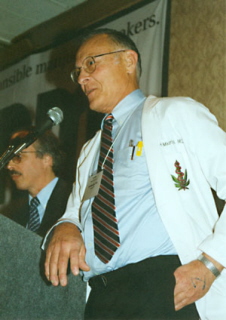
Tod Mikuriya addressing a NORML conference
Tod Mikuriya addressing a NORML conferenceSAN JOSE, Calif. - Hershey Co. has sued a Lafayette man who admitted to making marijuana-laced candy and soft drinks, claiming his products violated the company's trademarks.I'm not an expert in trademark law, but those donât sound like Hershey products to me.
Kenneth Affolter, 40, was sentenced in March to more than five years in prison for manufacturing forbidden treats with names like Stoney Rancher, Rasta Reese's and Keef Kat. [MSNBC]
Hershey's suit, filed earlier this month in U.S. District Court in San Jose, accuses Affolter of trademark infringement, trademark dilution and unfair competition.Unfair competition!? To whatever pathetic extent this man actually competed with Hershey, he's now been taken out of commission by the Drug Enforcement Administration. If there's anything unfair going on here, it's the incarceration of a man who provided marijuana edibles to sick people.
Harvard University researchers have found that, in both laboratory and mouse studies, delta-tetrahydrocannabinol (THC) cuts tumor growth in half in common lung cancer while impeding the cancer's ability to spread.I once witnessed Andrea Barthwell get stumped at an ONDCP press conference when someone asked her to cite a reference for her claim that marijuana caused lung cancer. That was funny, but this much funnier.
The compound "seems to have a suppressive effect on certain lines of cancer cells," explained Dr. Len Horovitz, a pulmonary specialist at Lenox Hill Hospital in New York City.
According to the researchers, THC fights lung cancer by curbing epidermal growth factor (EGF), a molecule that promotes the growth and spread of particularly aggressive non-small cell lung cancers.
On a typical weekday, stockbroker Irvin Rosenfeld has a marijuana cigarette before work, then goes to his firm's smoking area for another after he gets to the office. By day's end, he usually has smoked more than a half-dozen joints â and handled millions of dollars' in clients' holdings.In so many ways, the mere existence of Irv Rosenfeld demonstrates the fundamental wrongness of typical anti-marijuana rhetoric. That he receives his medicine directly from the federal government proves that they've always known the truth, despite subsequently pretending not to. His success demonstrates that marijuana, even in large doses, can be part of a healthy and productive lifestyle.
â¦
His firm, Newbridge Securities, supports his use of marijuana and says it hasn't hurt his performance.
None of the states with medical marijuana laws requires employers to make accommodations for the use of the drug in the workplace, says Bruce Mirken, spokesman for the Marijuana Policy Project.Medical marijuana has been legal in California for 10 years and it's "unclear" whether an incident has occurred. I think that says it all. Come what may, the truth will always be that competency is best determined by conventional means and not through urinalysis.
Yet, there are legal gray areas for companies, say employment lawyers such as Richard Meneghello of Portland, Ore., who does seminars for companies on the topic.
â¦
Meanwhile, there are questions about whether medical marijuana laws would offer any protection to employers if a worker who used marijuana to treat pain ended up injuring others or making a mistake on the job. It's unclear whether such an incident has occurred.
Scott Seidman, a Portland lawyer who represented Columbia [a company sued for firing an MMJ patient], says the company had to maintain its drug-free workplace policy because it is a federal contractor.Once again, the federal prohibition against medical marijuana is central to the problem. Unless, of course, you're one of the few people who receive medical marijuana in the mail each month from the same government that says there's no such thing.
New Mexico has officially become the 12th medical marijuana state, prompting reckless viciousness and incredulity from the Drug Czar. From AP:
"This is a triumph of politics over science," [Drug Czar John Walters] said, suggesting [New Mexico Governor Bill] Richardson sought "to curry the favor of wealthy donors who are marijuana legalization advocates."
That's rich. Considering overwhelming public support for medical marijuana, a more accurate political interpretation would assume that Richardson is attempting to "curry the favor" of almost everybody.
As I've said before, there are really only like six people on the "con" side of the medical marijuana debate. Our opposition otherwise consists of confused parents and arrogant moralists who would be panicking about something else if they hadnât been tricked by these six people (it used to be seven).
If John Walters wants to bark about the political viability of marijuana policy reform, let's buy him a bullhorn.
Christmas came nine months early with news that former drug-warring Congressman Bob Barr has repented and agreed to work with MPP on medical marijuana. One of our worst enemies has become one of our most promising allies in just a few years time. For me, this is perhaps the single greatest validation I've experienced since joining the drug policy reform movement (even though I had nothing to do with it).
It was November of '98 and I was finally 18. Lacking any significant interest in D.C. politics at the time, I deliberately registered to vote for the sole purpose of helping to pass Initiative 59 to protect Washington D.C.'s medical marijuana patients.
This was my first exposure to drug policy reform in my own community, and my first opportunity to participate in the democratic process. I spent the afternoon hanging out with friends and arrived at the polling site late afternoon in high spirits, eager to do my civic duty. I recall bumping into my dad, who assured me that he'd voted the right way on 59. Go, Dad!
Initiative 59 passed with 69%, making our city the cherry on top of MMJ victories in Alaska, Arizona, Nevada, Oregon, and Washington State.
I don't recall fully understanding the issue, but I knew it was the beginning of something important. Proposition 215 in California two years earlier had proven that compassion could triumph over tyranny in a democratic society, even beneath the shadow of the drug war's towering ramparts. I was inspired.
But then came the Barr Amendment to the D.C. Appropriations Bill:
An amendment to prohibit any funds to be used to conduct a ballot initiative which seeks to legalize or reduce the penalties associated with the possession, use, or distribution of any schedule I substance under the Controlled Substance Act or any tetrahydrocannabinois derivative.The first time I'd participated in the democratic process, the U.S. Congress intervened and overruled me. They also overruled my dad, and pretty much everyone I knew. A lot of people just shrugged it off, as D.C. residents had become accustomed to being marginalized politically. But I'd had my first taste of the hypocrisy of the drug war and the anti-democratic principles in which it is founded.
On Wednesday, a three-judge panel of the United States Court of Appeals for the Ninth Circuit found that while they sympathized with Ms. Raichâs plight and had seen âuncontroverted evidenceâ that she needed marijuana to survive, she lacked the legal grounds to exempt herself from federal law.I would argue that the right to not die for stupid political reasons is fundamental enough.
The court ârecognizes the use of marijuana for medical purposes is gaining traction,â the decision read. âBut that legal recognition has not yet reached the point where a conclusion can be drawn that the right to use medical marijuana is âfundamental.â â
U.S. District Judge Charles Breyer in San Francisco dismissed charges of tax evasion and money laundering against Ed Rosenthal, 62, an author and activist who has been dubbed the "Guru of Ganja."It's delightful to see the smug George Bevan held to account for his maliciousness, but frankly this only scratches the surface. Many have surmised that the targeting of Ed Rosenthal has always had everything to do with his notoriety as a cannabis cultivation expert. Considering what Rosenthal has been put through over the past several years, today's vindictive prosecution finding is long overdue.
â¦
The judge said he based his decision in part on the comments by prosecutor George Bevan during a hearing on the case. Bevan, according to transcripts, explained the decision to re-file charges, saying, "The purpose is this: Mr. Rosenthal, after the verdict, took to the microphone and said, 'I didn't get a fair trial.' ... So I'm saying, this time around, he wants the financial side reflected, fine, let's air this thing out. Let's have the whole conduct before the jury: Tax, money laundering, marijuana."
He was first arrested after a federal raid in February 2002 at a West Oakland warehouse where Rosenthal was growing marijuana for what he said was medical use, with the support of Alameda County and Oakland officials. At trial in 2003, Breyer refused to let jurors learn about the intended medical use of the plants and excluded evidence about Proposition 215, California's 1996 medical marijuana initiative.Breyer let Rosenthal off with a one-day sentence, humiliating federal prosecutors and sealing Ed's fate as a perpetual target.
Rosenthal was convicted of violating federal drug laws, but seven of the 12 jurors said afterward that their verdict would have been different if they had been allowed to consider evidence about the medical use of the marijuana and Rosenthal's status as an agent in the Oakland program.
Breyer did not throw out the drug charges, but noted that "the government agreed at oral argument" that it will not seek more than the one-day sentence on those counts.
That's right, American taxpayers. Behold the glorious retribution of the principled and incorruptible federal prosecutors who've exhausted untold sums and incalculable man hours to protect you from a safe and effective medicine. Amidst Iraq, Katrina, Medicare, etc. the federal government was trying to save you from Ed Rosenthal by putting him in jail for one goddamn day. And they're still working on it, knowing as they have all along, that this is the best they can hope for.
There can be no redemption for the spiteful, treacherous cretins who label medical providers as drug dealers and seek to deceive Californian jurors about California's laws in order to imprison Californians. There can be no redemption for them, for they are the real criminals and the story of their shameful vendetta becomes more obscene with each attempt to rewrite it.
Still, the question remains: when is it not vindictive prosecution to launch a political war on medical providers as they carry out the will of the people?