New York City Mayor Michael Bloomberg started to talk sense about drug legalization, but quickly fumbled. Meanwhile his police officers are arresting thousands of marijuana users -- in a city that has decriminalization!
An annual report by an independent advocacy group said that Mexico can no longer be considered to have a free press due to drug prohibition violence. According to Freedom House, Mexico was listed aside countries from North Africa and the Middle East as "not free" due to attacks on journalists, self-censorship and a climate of fear that persists in the nation. Reporting on the drug prohibition war is a tough situation for Mexican journalists, with some media outlets setting coverage guidelines and others declaring a blackout on coverage.
Mexicans are paying a high cost for drug prohibition -- the death toll of its drug prohibition war in April was 1,400, the highest number of monthly killings since the campaign began in late 2006. The previous record of casualties was 1,322 killings in August 2010. Attorney General Arturo Chavez says more than 15,000 people died in 2010, making it the deadliest year ever.
The United States has spent over $1 trillion promoting democracy in far-flung Iraq and Afghanistan while friendly neighbor Mexico gets a fraction of that in its prohibitionist fight against drug trafficking organizations. Mexico's frustration with Washington's priorities has plunged ties between the two allies to their lowest ebb in years. Last year alone, the U.S.-backed campaign claimed the lives of over 15,000 people in Mexico -- that is more than double the combined civilian deaths reported in Afghanistan and Iraq, where the United States has spent over $1.2 trillion in the past decade.
Another lesson in the futility of drug prohibition: Drug smugglers are using low-flying aircraft that look like motorized hang gliders to circumvent new fences along the U.S. border with Mexico. The planes, which began appearing in Arizona three years ago, are now turning up in remote parts of California and New Mexico. And in a new twist, the planes rarely touch the ground. Pilots simply pull levers that drop aluminum bins filled with about 200 pounds of marijuana for drivers who are waiting on the ground with blinking lights or glow-sticks. Within a few minutes, the pilots are back in Mexico.
The Economist reports on recent brutal killings and mass graves in Mexico. The killings undermine the governmentâs claim that drug prohibition war casualties are almost all criminals.
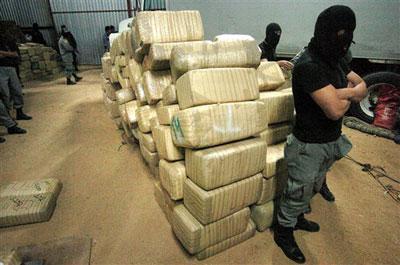
The busts keep on coming, but so do the drugs. (Image via Wikimedia.org)
With the current session of Mexicoâs Congress scheduled to expire Friday, members of Mexicoâs House of Deputies have less than a week to deliberate over extremely controversial changes to the countryâs National Security Law that would give the President the power to deploy Mexicoâs Armed Forces against broadly defined internal threats to Mexican national security. PT and Convergencia parties say that the 83-page initiative to change the law constitutes a threat to individual liberties and could create a state of exception in Mexico that would effectively put the country under military control. They remain deeply skeptical of proposed changes to the law, which advocate, among other things, the monitoring and recording of private communication for intelligence-gathering purposes. Organizations such as Human Rights Watch have drawn attention to frequent abuses by the Mexican military and contend that there is a widespread systemic failure to prosecute human rights violations in Mexican military courts.
While much of Mexico's mainstream media, especially television stations and local newspapers, has shied away from covering killings and naming the drug trafficking organizations involved, a blog and its anonymous curator publish graphic details of spiraling prohibition violence. At Mexico's "blog del Narco" the images are gruesome and unedited: a dead man in a sports jersey with his face covered in dried red blood and grey sand; a woman hanging from a rope above a busy urban over-pass and naked bodies lined up on the ground displaying clear, uncensored, signs of torture. Some recent headlines from the site include: "Entire town taken hostage by Gunmen in Chihuahua"; "Eleven year old arrested in Acapulco with AK 47"; "Sinaloa cartel welcomes new police chief with tortured body"; and "Mass narco grave, 60 bodies found, total 148 corpses".