
Civil Conflict

Mexican Drug War Analysis: It's Not Going Well

Reuters offers a dismal assessment of the Mexican drug war entitled "ANALYSIS-Mexico's Calderon bogged down in bloody drugs war". I'm left wondering, of course, why it is that one is said to be "analyzing" when pointing out that the drug war is failing. Must we place Mexico under the microscope in order to observe that there's a "bloody drugs war" going on there? Isn't that just a fact?

Calderon's first move on taking power 18 months ago was to launch a bold $7 billion army-led assault on powerful drug cartels, vowing to wrest back control of violence-scarred northern border states.

His army busts have put a string of senior smugglers behind bars and captured truckloads of cocaine and cash.

But the top drug lords are still free, and disrupting years-old trafficking alliances and protection networks has sparked an explosion in killings between rival gangs who dump hacked-off heads and tortured bodies in public.

The bloodshed has dented Calderon's popularity and left him bogged down in a vicious war with the odds of winning it stacked against him.

Calderon, 45, has defined success as reducing the violence, but drug murders have instead soared to more than 4,000 since his offensive began, and the turf wars intensified this year.

Perhaps one technically engages in analysis when suggesting that the odds of winning are stacked against Calderon, but we don't really need some credentialed academic to tell us that, do we? Has anyone ever won a drug war?
New York Times Calls For Massive U.S. Investment in Mexico's Drug War

Just last week, the NY Times delivered a dismal assessment of drug war progress in Mexico. Now its editorial board proposes that we spend billions in U.S. tax dollars funding the proven failure that is Mexico's war on drugs:

The timid assistance package proposed by the Bush administration and pared down by Congress suggests that Washington doesn’t grasp either the scale of the danger or its own responsibilities.
…

The Bush administration is right to acknowledge the shared threat and the common responsibility. But the three-year, $1.4 billion aid package it proposed doesn’t do the job. It is too small, notably so when compared with the billions the cartels earn in the United States.

The whole editorial all but refutes itself, observing that nothing is working, then calling for substantial investments in the same tactics that have produced only dramatic violence.

It really is amazing to think that the editors of one of our top newspapers have no concept of the social, economic, and historical dimensions of the war on drugs. What examples could they possibly be relying upon to conclude that larger investments are the key to drug war victory?

If the NYT thinks $1.4 billion isn't enough, then they should tell us how much they'd like to spend. Seriously. How much will it cost to win? How would you define success? If we buy a whole entire drug war for the Mexican government, will it be modeled after ours? If so, are you insane?

I'm so damned tired of being told that the drug war would work if we spent more and fought harder. How much are we really willing to sacrifice in order to prove how false that is?

Most Mexicans Think Drug Traffickers Are Winning the Drug War

It seems Mexican President Felipe Calderon's aggressive drug war tactics are impressing American politicians more than his own people:
A majority of Mexicans believe violent drug gangs are winning a war with President Felipe Calderon's government after one of the worst months on record for killings, Reforma newspaper reported on Sunday.

According to a poll by the newspaper, 53 percent of Mexicans think that drug traffickers hold the upper hand against government forces which are trying to clamp down on cartels that ship drugs to the United States.

Only 24 percent said they believed the government was winning the battle. The remaining 23 percent gave no opinion. [Reuters]
Since Calderon took office and promised a crackdown on drug trafficking, there have been over 4,000 drug war killings in Mexico. Mexicans must live amidst horrific and growing violence, with no end in sight, just so Calderon can stand proudly atop the drug war podium. Of course, he can only do so figuratively, for fear of being gunned down like his highest-ranking police officials.

Really, the question of who's winning the drug war shouldn't even have to be asked. Of course the cartels are winning, because there wouldn’t be cartels without the drug war. Every dollar they make, every bride they pay, every assassin's bullet is a product of drug prohibition's bloodstained legacy. The problem with the drug war isn’t that we aren’t trying hard enough, it's that trying hard is actually where all the worst violence and disorder comes from.

Obama Supports Mexico's Drug War Crackdown


Nowhere is the failure of drug prohibition more obvious than in Mexico, where President Calderon's crackdown has already produced over 4,000 deaths, without making a dent in the drug trade.

Yet Obama now joins John McCain in praising Mexico's brutal and ineffective anti-drug efforts:

Mexican drug cartels are terrorizing cities and towns. President Calderon was right to say that enough is enough. We must support Mexico’s effort to crack down. [suntimes.com]


I don't know how anyone can look at the dismal state of the Mexican drug war and find anything to be proud of. Still, I agree with Pete Guither who responded to Obama's comments by pointing out that we just can't expect a realistic drug policy platform from the major party candidates. They're not there yet.

Obama's good positions on needle exchange, medical marijuana, and sentencing have drawn interest from reformers, but there's simply no way to paint his praise of Mexico's bloody drug war crusade as anything other than typical prohibitionist "troop surge" rhetoric. It's the opposite of what's needed and it should give us pause before endorsing the popular perception among reformers that Obama "gets" the drug war issue.

When describing his plans to fund drug war activity in Central and South America, Obama says "we'll tie our support to clear benchmarks for drug seizures, corruption prosecutions, crime reduction, and kingpins busted," demonstrating a fundamental failure to grasp how those activities complement one another. Crime and violence will simply increase if enforcement increases, so any set of benchmarks will ultimately have to ignore one category or the other.

In regards to both Obama and McCain, however, we've got to recognize that ending violence in the international drug trade is the final stage of drug policy reform. It's the very last issue we'll have to confront and the last one about which we're likely to hear interesting or forward-thinking proposals from prominent politicians. There's no middle ground here. When we're ready to end violence and corruption in the drug trade, we'll stop waging the drug war.

(This blog post was published by StoptheDrugWar.org's lobbying arm, the Drug Reform Coordination Network, which also shares the cost of maintaining this web site. DRCNet Foundation takes no positions on candidates for public office, in compliance with section 501(c)(3) of the Internal Revenue Code, and does not pay for reporting that could be interpreted or misinterpreted as doing so.)

The Assassination of Mexico's Top Cop Proves That the Drug War is Failing

Anyone who thinks aggressive law-enforcement is going to solve the drug problem needs to look at what's happening in Mexico:

MEXICO CITY — Gunmen assassinated the acting chief of Mexico’s federal police early on Thursday morning in the most brazen attack so far in the year-and-a-half-old struggle between the government and organized crime gangs.

The Mexican police have been under constant attack since President Felipe Calderón took office in December 2007 and started an offensive against drug cartels that had corrupted the municipal police forces and local officials in several towns along the border with the United States and on both coasts. [NY Times]

Unbelievably, George Bush and the Drug Czar are trying to give Mexico a $1.4 billion aid package to fight the cartels, even as the futility of this battle becomes more apparent every day. It is precisely the process of trying to eradicate massive drug markets that creates such brutal and perpetual violence. Thus, giving Mexico more money for the drug war is just exactly what we must not do.

This excellent clip featuring the Wall Street Journal's Mary Anastasia O'Grady explains why the U.S. is responsible for the violence in Mexico and why the only solution is to deal with our own drug problem here at home.


O'Grady acknowledges that prohibition isn't working, and though she doesn’t say it outright, I think it's pretty clear that she knows what must be done. More of this type of talk at the Wall Street Journal is exactly what we need as the Drug Czar lobbies for funding to support even more drug war violence south of the border.

Drug Czar Pledges to Finally Do Something About All These Pot Smugglers

Gangstas better watch out. Hippies better stock up. The Drug Czar has had enough of the multi-billion dollar marijuana market, so he's decided to try even harder to stop it:
MEXICO CITY (AP) — Marijuana is now the biggest source of income for Mexico's drug cartels and the U.S. is committed to cracking down harder on traffickers, U.S. drug czar John Walters said Thursday.

"We're trying to increase the force with which we're attacking this problem," Walters said in a telephone interview with The Associated Press. "This is a focus because of the overlooked importance marijuana has in the violence."
Previously, you see, the Drug Czar was just trying really hard. But now he's gonna try really extra super 110% hard. It sounds like his strategy so far consists of issuing some sort of edict to prosecutors, probably by email, asking that they please put more people in prison for pot:
He added that the U.S. is "looking at additional ways in which we can have a stronger prosecutorial response," including requests for more funding and personnel.
So the Drug Czar, confronted with the failure of everything we've been doing for decades, will now request more funding to continue the same wasteful, destructive, redundant charade. Marijuana-related violence is one of the most unlikely and counterintuitive phenomena in human history, and yet it has become commonplace thanks to drug prohibition and its infinitely corrupting influence. The only remaining question is how many more declarations of redoubled drug war our nation's Drug Czars can pronounce before being pushed off their proverbial podium.

Drug Dealers Open Fire on Santa Claus Helicopter

Not even Santa Claus is safe from the violence caused by drug prohibition:
Drug traffickers in a Rio slum opened fire on a helicopter carrying a Santa to a children's party, apparently mistaking it for a police helicopter, police said on Tuesday.

"They thought it was a police operation and started shooting. Luckily, nobody was hurt," a police official said. [Yahoo]
Yeah, those drug traffickers are just lucky Santa Claus didn't go all Chuck Norris on them. You never know what kind of firepower he keeps on hand to protect his monopoly.

All I want for Christmas is a world free of drug war violence and disorder; a world in which men in big red suits can fly helicopters over Rio without being used for target practice by machinegun-toting thugs with free reign over the slums; a world where a man can frolic with carpenter elves and flying reindeer without getting his mistletoe confiscated by the government; a world in which a pungent piney aroma emanating from the den no longer gives police probable cause to search our cozy Christmas cabin.

So happy holidays to you all, whether hippie or hypocrite, activist or antagonist. May the New Year bring hope to the hopeless and clues to the clueless.

Christiania is in trouble again (video)

The marijuana friendly, Danish counter-culture enclave of Christiania is in trouble, according to an article in the UK newspaper The Independent, "On the barricades: Trouble in a hippie paradise." The intro to the article, authored by Cahal Milmo, reads:
[Christiania] was set up in the heart of Copenhagen as an antidote to the selfish society. But Europe's most famous commune is under threat from a right-wing government determined to 'normalise' this relic of the 1970s.
The Legalise Cannabis Alliance (UK) has video footage of what looks like a pretty serious police raid posted to YouTube -- there are links to more video there too.
We published a Chronicle news feature in January 2004 when hash sellers on Pusherstrasse burned their own stands in protest of a looming government crackdown, and again two months later when the trouble hit. Reason's Kerry Howley provides some "fun facts" about Christiania here. Why not just leave the hippies alone, conservative Danish government (and US government)?

Ponder This Graph for a Moment, Please

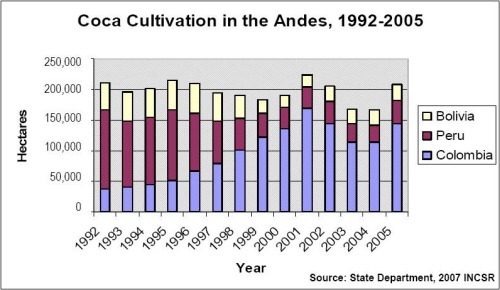
graph from WOLA and AIN (graph from WOLA/AIN memo, link below)
This graph shows what about $10 billion in US taxpayer dollars has accomplished. Note that while coca production has shifted within the region, the 1992 levels and the 2005 levels are essentially identical. Why is our coca eradication policy not subjected to cost-benefit analysis? Is there anyone who will argue that it is working? If so, I'd like to hear it. To be fair, that $10 billion has accomplished some things. It has engendered massive social conflict in all three countries, it has led to tens of thousands of peasant farmers being arrested as drug traffickers, it has led to thousands of deaths (especially in Colombia, where the eradication policy is part of the US's broader military intervention in that country's festering civil war). Your tax dollars at work. $10 billion is a lot of money. Heck, we could finance the Iraq war for a few weeks with it! Or we could give $100,000 college scholarships to 10,000 students. Or build $100,000 homes for 10,000 families. Or numerous other programs that, unlike the coca eradication program, might actually accomplish something. By the way, I came across the graph above in a memo from the Andean Information Network and the Washington Office on Latin America. That memo was occasioned by the US government's release of coca cultivation estimates for Bolivia. The US government has for months been complaining that Bolivian President Evo Morales' pro-coca policies were going to lead to a boom in production there. Surprise! It didn't. Read the memo for some juicy analysis.