
Drug Trade Funding Terrorists

DEA Agent Admits The Drug War Funds Terrorism

Well, not exactly. But it sure is astounding to hear DEA lament the black market's role in funding terror:
Nearly half of the 42 groups considered by the United States to be terror organisations fund their activities through drug trafficking, a top US official said in Israel Sunday.

The Drug Enforcement Administration's Michael Braun told a conference on "The Global Impact of Terrorism", organised by the International Institute for Counter-Terrorism, that the DEA "linked 18 of the 42 officially designated Foreign Terrorist Organisations (FTO) to drug trafficking activities of some sorts." [Yahoo News]
If there's anything surprising about this, it is the fact that Braun wants to continue the exact policies that make it possible for violent groups to make fast money.

Drug profits are being funneled into numerous terrorist organizations and the people who failed to prevent this sort of thing are instead citing it as evidence that their work is more important than ever.

No. It is 2007. You people have had enough time to try your idea. Clearly, you were wrong about everything. Rather than experiment with news ways of describing the same wrong ideas, it is time for these brave gentlemen to step aside and open up the floor to suggestions. Mine is to de-fund terrorists and countless other jerks by ending the drug war that makes them so damned rich.
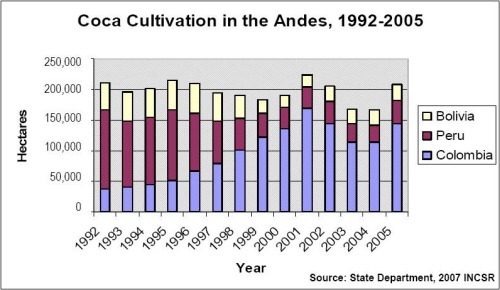
Ponder This Graph for a Moment, Please

graph from WOLA and AIN (graph from WOLA/AIN memo, link below)
This graph shows what about $10 billion in US taxpayer dollars has accomplished. Note that while coca production has shifted within the region, the 1992 levels and the 2005 levels are essentially identical. Why is our coca eradication policy not subjected to cost-benefit analysis? Is there anyone who will argue that it is working? If so, I'd like to hear it. To be fair, that $10 billion has accomplished some things. It has engendered massive social conflict in all three countries, it has led to tens of thousands of peasant farmers being arrested as drug traffickers, it has led to thousands of deaths (especially in Colombia, where the eradication policy is part of the US's broader military intervention in that country's festering civil war). Your tax dollars at work. $10 billion is a lot of money. Heck, we could finance the Iraq war for a few weeks with it! Or we could give $100,000 college scholarships to 10,000 students. Or build $100,000 homes for 10,000 families. Or numerous other programs that, unlike the coca eradication program, might actually accomplish something. By the way, I came across the graph above in a memo from the Andean Information Network and the Washington Office on Latin America. That memo was occasioned by the US government's release of coca cultivation estimates for Bolivia. The US government has for months been complaining that Bolivian President Evo Morales' pro-coca policies were going to lead to a boom in production there. Surprise! It didn't. Read the memo for some juicy analysis.

If Only Afghanistan Were More Like Colombia…

Colombian narcs who haven't been killed yet are holding police training seminars in Afghanistan. From The International Herald Tribune:
It is a measure of Afghanistan's virulent opium trade, which has helped revive the Taliban while corroding the credibility of the government, that U.S. officials now hope that Afghanistan's drug problem will someday be only as bad as that of Colombia.
…

"I wanted the Colombians to come here to give the Afghans something to aspire to," [DEA Kabul Chief Vincent] Balbo said. "To instill the fact that they have been doing this for years, and it has worked."
They're unearthing mass graves in Colombia. Cocaine is cheaper than ever. The president is embroiled in a massive corruption scandal. You can’t even grow bananas there without becoming a pawn in a paramilitary extortion scandal. Yet American drug warriors talk about Colombia like it's a shining beacon of justice and democracy.

Afghan narcs-in-training will learn what a joke this is when their Colombian instructors request asylum.

"Cannabis Cash 'Funds Islamist Terrorism'"--Here we go again.

The old "drug users fund terrorism" canard is getting new play in Europe this week, where French and Spanish intelligence agencies reported that, as the Guardian (UK) put it, "Cannabis cash 'funds Islamist terrorism'". The report was the result of an investigation launched after the 2004 Madrid train bombings that found the bomb plotters bought their explosives from former miners and paid them in hashish. The intelligence agencies also claimed that the Al Qaeda-linked Algerian Salafist Group for Preaching and Combat is using hash sales as part of "a complex network" of financing its terrorist operations. I don't doubt that. People who need money for nefarious schemes typically resort to the black market economy, whether it is drugs, diamonds, oil, or whatever commodity. It is so screamingly obvious that I hesitate to point it out, but pot smokers don't fund terrorism—prohibition does. You don't hear of barley or grapevines or tobacco leaves funding terrorism because they are used to make non-prohibited psychoactive drugs that are integrated into the legal, aboveground economy. If you want to stop Islamic terrorists from using the black market profits from the hash trade to buy bombs, the solution is clear: End the prohibition regime that creates the black market.

Drug War: The Ride

While Karen Tandy touts triumphs against traffickers, taxi drivers are treating drug-trade terrorism like a tourist attraction. From Reuters:
Streetwise cabbies in northern Mexico are cashing in on the chaos of a violent drug war by whisking wide-eyed visitors about town in macabre tours of seized narco properties and famous murder scenes, Mexico City's Reforma newspaper reported on Sunday.

Taxi drivers in the Pacific coast city of Mazatlan satisfy tourists' ghoulish fascination with a battle between cartels that killed 2,000 people last year, for about 200 pesos ($18) a trip, the newspaper said.
This is great. But we must extend these tours to more fully represent the worldwide horrors of the drug war. From the overflowing prisons in Texas to the barren fumigated hillsides of Colombia, the drug war touches everything and infects everything it touches with hopelessness and decay. Spring for the deluxe package and you can see a drug addict get executed in Thailand.

The Drug War Chronicle Andean Coca Tour 2007 is about to get underway

Friday night, I will be bedding down in Peru, after a day-long flight from Sioux Falls to Denver to Houston to Lima. That will be the first of 21 nights in Peru and Bolivia as the Drug War Chronicle explores the coca industry and its unsavory relative, the cocaine industry, in the Andes. While the process of making connections is ongoing and always a little shaky in developing countries, things are falling into place. While I will spend most of that first weekend resting and getting oriented, it looks like I'll have lunch Monday with Peruvian psychologist and coca expert Baldomero Caceres and Anthony Henman. Henman is a legendary name when it comes to coca. The British anthropologist (since gone native) is the man who, under a pseudonym, wrote "Mama Coca" back in the 1970s. That was the first serious ethnographic study of coca's history and use in the Andes for lay readers in English. I look forward to seeing what Henman has to say about the current state of affairs. Later that day, I will go to the upscale suburb of Miraflores for dinner with Ricardo Soberon, a leading Peruvian drugs and security expert. He was an advisor to coca grower leader turned congresswoman Nancy Obregon, but has since departed over unspecified political differences. I'll be sure to query him (and Nancy) about the nature of those differences. Speaking of Nancy, she is currently back home in northern Peru, so I won't be able to talk to her during that first week. But she will be back in Lima at the end of the month, and I will do an interview with her then. (I have to be out of Bolivia by February 28 because their visa requirements kick in on March 1.) I think I will fly from Lima to Ayacucho next Wednesday. That ancient city high in the Andes is the historic heartland of Sendero Luminoso, the Maoist guerrillas who led an uprising in the 1980s where tens of thousands were killed. The Senderistas are still around, though much weakened, and they try to gain the support of coca growers by killing policemen and anti-government drug workers. But Ayacucho is also the home of national coca growers' union leader Nelson Palomino, whom I will interview. Palomino and his crew have also promised to show me the coca fields and let me talk to farmers, so that should be enlightening. After that, I'll take a couple of days for the mandatory tourist visit to Machu Picchu outside Cusco, then I'll bus it from Cusco across the altiplano to Bolivia. At least that's the plan right now; there are reports of severe flooding right where I'll be crossing the border. I'm still trying to set things up with the American embassy in Lima and with the big Peruvian drug bureaucracies, ENACO (the coca monopoly) and DEVIDA (the drug enforcement bureaucracy). I've been talking with the US press officer in Lima about getting a meeting, but because I don't represent established media, I can't get official press status with the embassy, which means the press officer won't officially deal with me, but may manage to hook me up with some of the drug people in the embassy. Similar plans are in the works for Bolivia. Stay tuned.

Winning at Whack-A-Mole

Here's Robert J. Caldwell at Human Events gloating over our extradition of 11 major drug traffickers from Mexico:

A counter-narcotics war popularly disparaged as a chronic loser, yet vital to the national interests of both Mexico and the United States, is producing its biggest victories ever.

Heck, let's give it to him. Biggest drug war victory ever! If there's such a thing, this has got to be it. We've made "an enormous leap forward" Karen Tandy proudly exclaimed from atop the first rung of her towering ladder to the moon.

This glowing triumph will provide a great opportunity to see if the drug war actually works. Maybe the Biggest Victory Ever will lead to a rock shortage down on crack street. But if it doesn't (and it so totally won't), then this grand achievement will serve only to illustrate that top priorities of the international drug war still don't bring us a day closer to the fairytale ending our drug warriors daydream about.

Indeed, the black market is a dragon with a thousand heads that regenerate if you cut one off. We can battle it for generations, but the beast will only grow stronger until we stop feeding it.

Is the Bush Administration Getting Nervous About Afghan Opium Licensing Schemes?

When the European drug policy and defense think-tank the Senlis Council in late 2005 unveiled its proposal to deal with illicit Afghan opium by licensing growers and diverting production to the global legal medicinal market for opioid pain medications, just about nobody thought the idea had a chance of going anywhere. Since then, as opium production there has continued to increase—Afghanistan now accounts for 90% of the global illicit opium supply—and Taliban insurgents have gathered strength, the licensing scheme has picked up support from politicians in Canada, England, and Italy, but still remains a long-shot. This week, as I will report in the Chronicle on Friday, the licensing notion gained new support, as the British Medical Association is suggesting that Afghan opium be used to produce medicinal diamorphine (heroin) for use in the National Health Service. The licensing idea also made it to the op-ed pages of the Washington Post last week, when columnist Anne Applebaum wrote a piece, "Ending an Opium War; Poppies and Afghan Recovery Can Both Bloom, arguing that the US should do in Afghanistan now what it did so successfully in Turkey under President Nixon. Then, faced with an influx of Turkish heroin (the stuff of the infamous French Connection), the US worked with the Turkish government and farmers to regulate poppy production. Now, Turkey is the main supplier of medicinal narcotics to the US. The current US administration, however, is adamantly opposed to any such effort in Afghanistan. Instead, drug war extremists in Washington are pushing the Afghans to make stronger efforts to eradicate the poppy crop and are even trying to push herbicidal eradication down the throat of the Karzai government. That idea has little support in Afghanistan or even among our NATO allies. Both groups fear a sustained attack on the country's economic mainstay will lead to political upheaval and end up benefiting the Taliban, a not unreasonable worry. But it seems like the Bush administration is starting to worry that the licensing scheme is gaining too much ground. Or, at least, it has bestirred itself to attack the notion. In a letter from James O'Gara, the drug czars deputy for supply reduction in today's Washington Post, the administration tried to fight back:
The Wrong Plan for Afghanistan's Opium Anne Applebaum's proposal to foster legal Afghan opium ["Ending an Opium War; Poppies and Afghan Recovery Can Both Bloom," op-ed, Jan. 16] is based on a misdiagnosis of the problem. First, there is no licit demand for Afghanistan's enormous supply of opium, currently more than 90 percent of the world's illicit market and almost double the world's entire licit production requirement. The United Nations reports a current global oversupply of opium-based products from existing licit producers. Pouring vastly more legal opium into the world system would cause prices to plummet, making the illicit trade that much more attractive to farmers. Second, Afghanistan produces opium because some regions remain under attack and lack security, to say nothing of the controls that are a prerequisite for any legal trade in narcotics. In the absence of such institutional controls, the distinction between legal and illicit opium is meaningless. Afghanistan needs peace, a flourishing economy and the rule of law. Each of these conditions is undone by narcotics production. Nowhere in the world do narco-warlords willingly relinquish their stranglehold on poor opium farmers, and nowhere in the world do such farmers become rich. The opium trade must be broken, not fostered, before it undoes the rest of Afghanistan.
O'Gara first claims there is no global need for more opioid pain relievers, citing the International Narcotics Control Board. That claim is debatable. In its proposal, the Senlis Council begged to differ, citing serious undersupplies, especially in the underdeveloped world. Second, O'Gara suggests that opium is being grown in Afghanistan only because of a lack of security and an effective national state. But the US government's insistence on attacking the poppy crop is precisely what contributes greatly to continued insecurity and political conflict within the country. Does he really think an all-out assault on the poppies is going to bring peace and tranquility? Whether the idea of licensing Afghan opium production is a good idea is open for debate. It is certainly as reasonable a response to the problem as heavy-handed repression efforts, and is much less likely to incite peasant resistance and support for the Taliban. But what is really interesting about all this is the fact that the drug czar's office feels a need to attack supporters of the idea. That suggests the idea is getting enough traction to pose a threat to the drug war as usual. We'll be staying tuned to this debate.

The Drug Czar Has Another Brilliant Idea

Afghanistan is in flames. The Taliban are resurgent. The opium economy provides livelihoods for millions of Afghans. And now, US drug czar John Walters announces over the weekend, that Afghanistan will begin spraying the poppy fields with glyphosate, the same stuff we've been using with such great success in Colombia against the coca crops. (After six years of Plan Colombia spraying, the coca crop in Colombia is about the same size it was when we started.)