special to Drug War Chronicle
Monday night, Colorado's rapidly increasing number of medical marijuana patients and burgeoning medical marijuana industry won a major victory against state regulators trying to cramp their style -- and fiddle with a medical marijuana law written into the state constitution by voter initiative nine years ago. After a marathon public hearing packed with nearly 400 medical marijuana supporters, the Colorado Board of Health rejected a
controversial proposal from the state Department of Public Health and Environment that would have tightened up the definition of a caregiver and would have limited caregivers to providing for no more than five patients.
The vote comes on the heels of
Rhode Island legislation establishing a dispensary system, the third state in the nation to legislatively approve dispensaries, and the first on the east coast. Rhode Island's legislature overrode a veto by Gov. Donald Carcieri (R) to pass the law, which they did 35-3 in the Senate and 67-0 in the House.
"It's a great win for Colorado," said a tired but elated Brian Vicente Tuesday morning. "We took on the machine and won."
Vicente is head of
Sensible Colorado, which worked with Colorado NORML,
SAFER, the
Marijuana Policy Project, and
Americans for Safe Access to spearhead the campaign to keep the Colorado program intact.
The Board of Health was originally scheduled to vote on the proposal in February, but was forced to postpone the vote until it could find a venue large enough to accommodate the hundreds of people who wanted to have their voices heard during a public hearing. A 2004 effort by the Board of Health to impose similar restrictions was thrown out by the courts because it held no public hearing then.
"The health department seems to be a glutton for punishment," said Vicente. "This is the second time we've beaten them on this issue. I'm fairly confident this will keep them quiet for awhile."
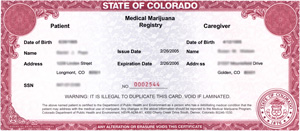
Between February and now, the state's medical marijuana program has gone into overdrive. The number of patients is increasingly dramatically, with some 2,000 patients added in June, bringing the state's total to more than 9,000. And with the change of administrations in Washington, dispensaries have begun proliferating. There are now nearly 40, most of them in the Denver metro area. Nearly 600 different physicians have issued recommendations for medical marijuana.
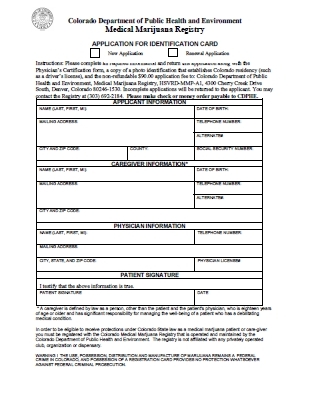
Two provisions of the health department proposal earned the most denunciations from patients and providers: One would tighten the definition of who qualifies as a licensed caregiver; the other would limit the number of patients a caregiver can provide for to five. There is currently no limit on the number of patients a caregiver can grow or otherwise provide for.
Supporters of the proposal -- basically limited to police, prosecutors, and the state's chief medical officer -- told the Board of Health Monday that the current situation, which sets no limits on the number of people for whom caregivers can provide, was susceptible to fraud and caused confusion over who could legally grow.
Dr. Ned Calonge, the chief medical officer, warned that the medical marijuana program will "continue to grow out of control" unless the restrictive rules were adopted. The 2000 initiative defines caregivers as people who have a "significant responsibility for managing the well-being of a patient," he said, adding that he did not think that allowed for the creation of dispensaries.
Capping the number of patients a caregiver could provide for at five was reasonable, Calonge said. "We define a primary caregiver as significantly participating in a patient's everyday care," he said. "If those caregivers are making home visits to each patient, considering travel time, they could visit five patients a day. We believe we have ample precedent and supportive evidence for this number," he said.
Denver Assistant District Attorney Helen Morgan told the board some counties aren't prosecuting marijuana grows because of confusion over who is allowed to grow medical marijuana. She also said that authorities in Denver have found large marijuana grows whose operators claim to be providing medical marijuana.
That claim was echoed by Holly Dodge, deputy district attorney for El Paso County, who spoke on behalf of the Colorado District Attorney's Council. "There is no way of appropriately protecting a patient when they have a caregiver with 300 other patients," she said. "That's not caregiving, that's marijuana growing."
But Calonge, Dodge, and Morgan were definitely in the minority, with the sometimes raucous crowd hissing and booing their comments. For most of the day, the board heard from patient after patient, as well as caregivers, dispensary operators, and doctors, that the system was working just fine as it is. The board was also clearly warned that it would be slapped with an already prepared lawsuit today if it voted to adopt the restrictive proposal.
 |
|
Colorado "Marijuana Boot Camp" for activists,
organized by SAFER, November 2008 |
|
One physician opposing the restrictive proposal was Dr. Paul Bregman, who warned it would drive patients to the streets in search of their medicine. "More regulation drives people to the black market, and that means patient care suffers," said Bregman.
Damien LaGoy told the board he smokes marijuana to counter the side effects, including nausea, of his daily doses of HIV medication. He gets his medicine from a caregiver who serves nine people, he said, adding that if couldn't use that caregiver he would be forced to trawl Colfax Avenue in search of street dealers. "I might as well not have a license and just go buy it on the street like everyone else," he said.
Dispensary operator Jim Bent told the board the proposal threatened patient health and treated marijuana dispensaries unfairly. "If this law passes, patients will lose their access to safe medicine and some will die," he said. "Please be compassionate." Bent also rejected any limits on the number of patients a dispensary can handle. "I'd like to be under the same standards as Walgreens or a Wal-Mart pharmacy," he said.
Former Denver senior deputy district attorney Lauren Davis told the board the proposal would not address law enforcement concerns raised earlier in the day and could even be counterproductive. "Limiting caregivers will increase the number of small-grower operations," she said.
At the end of the day, the Board of Health agreed with opponents of the rule change. It voted 6-3 to reject the proposal.
"They received more emails and written comments on this than they had on any issue in history," said Vicente. "They had hundreds of people show up to testify against this. They heard from an impressive array of experts, doctors, lawyers, writers of the law, sick patients, and caregivers. The board listened."


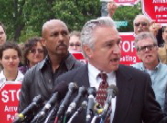 Montel at a 2005 press conference with Rep. Maurice Hinchey