Federal Government

Federal Government Subtopics:

Attorney General Promises Aggressive Marijuana Enforcement


I know, I've been getting a little smug lately about all the progress that's been made this year, so let me just burst my own bubble here with an ugly reminder that the drug warriors in Washington, D.C. are still suffering from severe hysteria:


I don't know which is worse, Sen. Colburn's claim that marijuana is "the #1 risk for our kids," or Attorney General Holder's reply that the Feds "will be vociferous in our enforcement efforts." It's the sort of unhinged drug war lunacy that remains easy to obtain in the Nation's Capital, even as supplies are drying up elsewhere.

My Published Criticism of the Drug Czar

I got the following comments published as a Letter to the Editor in both the online and print versions of my local newspaper, the Fresno Bee, http://www.fresnobee.com/ ---

Please Burn the Byrne Grants

Since Scott opined yesterday about the injustice of paramilitarized policing, I thought I would follow up by referring back to a related topic I've addressed from time to time -- coordinated drug busts as taxpayer-funded lobbying by law enforcement agencies, large numbers of raids conducted together as part of statewide operations, intended to garner publicity for a funding program known as the Byrne Grants and thereby avoid Congressional budget cuts. California and Kentucky were among the guilty parties last year, though I suspect they were not the only ones. Kentucky is at again, according to libertarian SWAT-critic Radley Balko of Reason magazine, writing last week for FoxNews.com:
Last month, police in Kentucy went on a 24-hour drug raid blitz. According to local media accounts, the raids uncovered 23 methamphetamine labs, seized more than 2,400 pounds of marijuana, identified 16 drug-endangered children and arrested 565 people for illegal drug use. ... "During 'Operation Byrne Blitz,'" a local television station reported, "state police and highway patrol agencies, local police and sheriff's departments, and drug task forces throughout the country conducted undercover investigations, marijuana eradication efforts and drug interdiction activities. The collaborative effort, named for the federal grant program which funds many of the anti-drug efforts, underscored the impact that cuts to this funding could have on local and statewide drug enforcement."
Perhaps because they often are tied to drug arrest statistics, it was task funded by the Byrne grants that perpetrated the racist scandals in Tulia and Hearne, in which large numbers of minorities were rounded up and prosecuted, only for it all to turn out to be fabrication. In the Overkill report, Balko has identified the grants as one of the reasons for the overwhelming increase in the use of SWAT teams for minor drug enforcement. The Bush administration, surprisingly, has taken the lead in trying to slash Byrne funding, while Democrats have led efforts to restore it, such as NY Sen. Chuck Schumer at a press conference late last month. A letter signed by 51 senators asked the chairman and ranking member of the Committee on Appropriations to restore cut Byrne funding, among them presidential contenders Clinton and Obama. To be fair to the candidates, some of our favorite senators unfortunately are on there too, such as Chris Dodd (D=CT), sponsor of the first Senate bill taking on the Higher Education Act drug penalty; Dick Durbin (D-IL); the justice-reform-minded Jim Webb (D-VA), others who've done some good things from time to time. Democrats clearly relish the support of national law enforcement unions, and it must be hard for any politician to resist getting to stand up next to law enforcement leaders at a press conference and call for more money for them. The Byrne grants fund other things besides arrests too, and the reasons for opposing the program may seem like harder sells from the point of view of a member of the "establishment" than it does for us out here. Also to be fair to the Democrats, those 51 signatories included 15 Republicans. A conservative commentator from the Heritage Foundation, Cully Stimson, also commented on FoxNews.com, but making the case for the grants, in Don't Burn the Byrne Grants, back in February. Still, if George Bush can get it right, I think it's lame for Democrats not to, especially when one of the results of this program is what happened in Tulia and Hearne, about as close to overt race-based persecution by government as can be found. I say, do burn the Byrne Grants, in fact please burn them. The fact that law enforcement groups quite transparently lobby for them by conducting massive numbers of drug busts to get attention ought to set off warning bells. Any good things the grants might also support can be funded through other channels. This program is badly structured and misdirected, and it should go.

Republican and Democratic Senators Query Gonzales on Crack Sentencing Views

User "puregenius" reports over in the Reader Blogs that Republican and Democratic senators -- Jeff Sessions and Pat Leahy -- queried Alberto Gonzales about his views on the crack/powder cocaine sentencing disparity, in last Tuesday's Senate Judiciary Committee hearing on Dept. of Justice oversight. Short answer -- he likes it, they don't. Update: Just saw this link on TalkLeft to the NAACP Legal Defense Fund's amicus brief to the Supreme Court in the case of Derrick Kimbrough, a federal prisoner serving time on a crack cocaine offense. LDF contends that "The Crack Cocaine Sentencing Guidelines Have Resulted in Vast Racial Disparities" and "The Racial Disparities Associated with the Crack Cocaine Sentencing Guidelines Have Caused Widespread Distrust of the Law.

The Latest Imprisonment Numbers Are Out; No Surprises

The Bureau of Justice Statistics will tomorrow officially release its latest annual report on the number of prisoners in America. It's pretty much the same old story, one I'm sick of writing every year, and it has a title like this: "Number of Prisoners in America At All-Time High (Again)" According to a BJS press release today (which apparently will not appear on their web site until tomorrow):
LARGEST INCREASE IN PRISON AND JAIL INMATE POPULATIONS SINCE MIDYEAR 2000 More Than 2.24 Million Incarcerated as of June 30, 2006 WASHINGTON -- During the 12 months that ended June 30, 2006, the nation's prison and jail populations increased by 62,037 inmates (up 2.8 percent), to total 2,245,189 inmates, the Justice Department's Bureau of Justice Statistics (BJS) reported today. State and federal inmates accounted for 70 percent of the increase. At midyear 2006, two-thirds of the nation.s incarcerated population was in custody in a state or federal prison (1,479,179), and the other one-third was held in local jails (766,010). The number of prisoners under the legal jurisdiction of state or federal correctional authorities -- some of whom were held in local jails -- increased by 42,942 prisoners (2.8 percent) during the 12 months ending June 30, 2006, to reach 1,556,518 prisoners. In absolute number and percentage change, the increase in prisoners under state or federal jurisdiction was the largest since the 12 months ending on June 30, 2000. The growth in state prisoners was due largely to a rise in prison admissions, up 17.2 percent between 2000 and 2005. During the same period, releases from state prisons increased at a slower rate, up 15.5 percent. New court commitments totaled 421,426 during 2005, a 20.3 percent increase since 2000, and parole violators returned to prison totaled 232,229, up 14.1 percent. Forty-two states and the federal system reported an increase in their prison populations during the 12 months ending June 30, 2006. Idaho had the largest percentage increase (up 13.7 percent), followed by Alaska (up 9.4 percent) and Vermont (up 8.3 percent). Eight states reported declines in their prison populations, led by Missouri (down 2.9 percent), Louisiana and Maine (both down 1.8 percent). The number of federal prisoners increased by 3.6 percent to reach 191,080 prisoners. At midyear 2006 the federal system had jurisdiction over more prisoners than did any single state, including California and Texas, which had jurisdiction over 175,115 and 172,889 prisoners, respectively. The number of local jail inmates increased by 2.5 percent during the year, the smallest annual percent change since 2001. Since 2000, the number of unconvicted inmates held in local jails has been increasing. As of June 30, 2006, 62 percent of inmates held in local jails were awaiting court action on their current charge, up from 56 percent in 2000.
There's more to the press release, but the above is the gist of it. This annual report does not, if I recall correctly, include a breakdown by offense, which means I have to hunt through other BJS reports to come up with a likely number of drug offenders behind bars. I've been saying "around a half million" for the past three or four years. Maybe now we'll be able to say "more than half a million." But you'll have to wait until Friday, when my story on this comes out. For those who can't wait to read the BJS report, it will be available here tomorrow morning. In the meantime, ain't it great to live in the land of the free?

Ed Rosenthal Convicted of Following State Law, Helping Sick People

After five years and enough drama and incompetence to appall even seasoned drug war observers like us, the ridiculous show trial of Ed Rosenthal is finally over.
SAN FRANCISCO -- The self-proclaimed "guru of ganja" was convicted again Wednesday in federal court of illegally growing hundreds of marijuana plants that he said were meant to treat sick people, which state law allows.

Ed Rosenthal was convicted after U.S. District Court Judge Charles Breyer prohibited the marijuana activist's lawyers from telling the jury he was working for a pot club sanctioned by Oakland government officials. [Star-Telegram]
Rosenthal will now serve one day in jail (time served), for the crime of helping the City of Oakland provide legal medicine to registered patients. Forgive me, but I've already said everything there is to say about this:
That's right, American taxpayers. Behold the glorious retribution of the principled and incorruptible federal prosecutors who've exhausted untold sums and incalculable man-hours to protect you from a safe and effective medicine. Amidst Iraq, Katrina, Medicare, etc. the federal government was trying to save you from Ed Rosenthal by putting him in jail for one goddamn day. And they're still working on it, knowing as they have all along, that this is the best they can hope for.
Today, a new group of jurors is learning that the federal government tricked them into convicting Ed Rosenthal of something that's legal in their state. Like the previous Rosenthal jury before them, they will be robbed of the pride that comes from serving the cause of justice and they may soon stand with him in solidarity as did their predecessors.

Even in victory, our government's campaign against medical marijuana stands naked before us, utterly fraudulent and disgraceful as ever before.

Back from the Chapare

I'm now back from the coca producing region of the Chapare. Yesterday was a real grind: Get up very early, fly from La Paz to Cochabamba, take a taxi to the Andean Information Network office where I met up with AIN's Kathryn Ledebur and her husband, former Chapare human rights ombudsman ("defensor del pueblo) Gotofredo Reinecke, hopped in his jeep with him, stopped for gas and coca leaves (it's a tiring journey), then drove about two hours over an 11,000-foot mountain pass and down into the jungly Chapare.
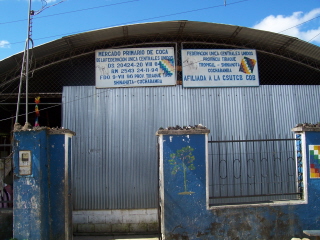
The coca leaf warehouse outside Shinahota. Here, local farmers bring their crops to be carefully weighed and sent on to legal markets within Bolivia. The entire process is controlled by the local growers' union.
But first, we had to traverse a major landslide on the highway caused by incessant rains. (We were extremely fortunate to have a mostly sunny day, a rarity this rainy season). At the landslide, buses and cargo trucks were backed up by the dozens, as they had been for days. The smell of rotting fruit in the trucks was pervasive. Bus passengers had to gather their bags and make a mile-long trek over a muddy path to get to buses waiting on the other side, but we left the jeep on the near side and walked right down the roadway itself—a shortcut—after Godofredo explained to the soldiers that I was a photojournalist shooting the "derrumbe." My sandals, socks, and jeans were covered with mud (which made quite an impression at the Cochabamba airport this morning). Once across the washed out area, it was onto the backs of small motorcycles for hire for another half-mile to where the buses and taxis were waiting for travelers trying to continue their journey, and then we hired a taxi for the tour of the Chapare. In the miserably hot and humid lowlands, we stopped for lunch, where Godofredo spotted veteran newspaper vendor and scene-observer Don Jaime Balderrama, with whom we had an interesting chat. Then it was on to the local military base for a talk with the comandante, which proved absolutely fruitless. He refused to say a word of substance, saying it all had to be cleared with the military high command. Sadly, this seems to be the attitude throughout the Morales government when it comes to coca matters, and as a result, I am not making much progress in getting interviews with government officials (although I still have some feelers out and some hopes, fading as they may be). The army fort, bought and paid for by US tax dollars was nicely constructed, and the colonel's office featured the only air conditioning I ran across on the whole trip. Sweet for him. Sweet for us, too. I didn’t want to leave, even though we were getting nothing from him.

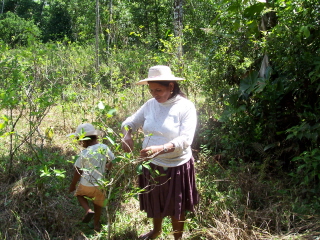
former cocalero leader Vitalia Merida with her daughter, in their coca field
Then it was on to visit Vitalia Merida, a former coca grower union leader (and current member), who has a coca field way out in the middle of nowhere. After her family suffered during the repression of the forced eradication years, she now reports that there is peace, if not prosperity. I'll be writing about what she had to say in a feature article this week. I have to say that is was an absolutely brutal hike in the mid-day sun to her coca patch. When I complained, Vitalia said, "You see how we suffer," although she sweated not a drop. Next was Shinahota, a small town that was the center of the Chapare cocaine economy during the Wild West days of the "cocaine coup" back in the early 1980s. Main street there features a bunch of two-story buildings erected at that time. Downstairs you bought cocaine, guns, and luxury items; upstairs you rented prostitutes. It's much quieter these days, and much less profitable. Just outside Shinahota, we stopped at a coca leaf warehouse operated by the local growers' union and had a nice chat with some Six Federation leaders who, sadly, were camera shy, and just a little bit suspicious of this wild-looking gringo. (I was indeed wild-looking by then: mud-splattered, sweat-drenched, my hair blown into knots as I hung my head out the window of the taxi seeking relief). We had an interesting conversation, though, and I will report on that in the Chronicle, too. Between Shinahota and Villa Tunari, we stopped briefly at a new coca leaf processing plant, which is being financed by Venezuelan President Hugo Chavez. He has promised to import coca products to Venezuela, which would violate the UN Single Convention, but as AIN's Kathy Ledebur noted, "Who's going to stop him?" No one there but construction workers, though. Shortly past the new coca plant, in Villa Tunari, is a municipal hospital staffed primarily by dozens of Cuban doctors and nurses. I couldn’t help but compare and contrast: The US builds forts and supplies the military, Venezuela helps Bolivia industrialize coca, and the Cubans heal the sick. So it goes. That's my report for today. I now have in essence a day and half left in Bolivia. I'm attempting to line up some last interviews, but I'm a little depressed by my lack of success with government functionaries, and just bad luck with some other people I hoped to talk to. But I still have 36 hours... More pictures will be posted here later today.

What a trip it's been, and it's only the end of week one!

Since last I blogged, I've gone by overnight bus from Lima to the Andean highlands city of Ayacucho, thence over the top of the Andes and down into the Amazonian selva (actually, the "ceja de selva," the eyebrow of the jungle) to the small towns of San Francisco, Ayacucho, and Kirimbiri, Cusco, on the other side of the rain-swollen Rio Apurimac deep in the heart of the coca growing region known as the VRAE (Valleys of the Apurimac and Ene Rivers), and then back to Ayacucho. It has been brutal—hours of travel on crappy, crappy dirt roads over mountains and across flooded out stretches of road through some of the poorest land in the country. Tomorrow (Saturday) morning, I get up a 5AM to catch a flight back to Lima and then on to Cusco, for a little rest and tourism at Machu Picchu. (Ayacucho is halfway between Lima and Cusco, but as they say, "you can’t get there from here." There are no city to city flights in Peru except to and from Lima. Go figure. An Aero Condor rep told me it's because they're a Fourth World country.) The travel to coca country was mind-bending: Huge mountains, endless switchbacks on dirt roads with no shoulder and a thousand-foot drop-off, indigenous people herding sheep and goats and burros and horses, the women wearing those funny Andean hats. (I hope Dave Borden will be good enough to post some more pictures here.) It is rainy season, so water is pouring down the mountains in spectacular cascades, but also ripping the road open and causing landslides that block the road. Local people come out to fix it, but put rocks in the road to collect a toll for their labors. From the crest of the Andes, somewhere at about 12,000 feet near Tambo, it was downhill all the way to the Apurimac River, a tributary of the Amazon. You go from jacket weather to dripping with sweat in the heat and humidity of the Amazon, pine trees turn to palm trees and tropical fronds. It was in some towns along the Apurimac that I hooked up with some local cocalero leaders and went out into the poverty-stricken countryside to view the fields myself. I've seen a lot of poverty in my day, but the conditions in which the coca farmers live are truly grim. They have to walk miles just to get to the nearest town, they have no running water or electricity, and even with four coca crops a year, they barely make enough money to feed and clothe their children. One of the highlights was one of the cocalero leaders pointing out the houses (more like shanties) of the cocaleros and demanding to know "Where are the narco mansions?" Well, certainly not around here. Every cocalero I've talked to has had the same refrain: This is our sacred plant, we have nothing to do with the drug trade, either leave us alone or provide real agricultural development assistance. And that refrain resonates: Of 70 municipalities in the VRAE, cocaleros hold power in all 70. This is also the home of the country's premier cocalero leader, Nelson Palomino of CONCPACCP, with whom I talked in Lima earlier this week. Will it be pretty much the same in Bolivia? I don't know. Check back later. Editor's Note: I certainly will post Phil's pictures, but it will be a little later this weekend. In the meanwhile, be sure to read Phil's Drug War Chronicle article from Peru, published earlier today -- three pictures, interviews with key people and lots of good info. -- Dave

With Baldomero Caceres in Miraflores

I´ve spent the last few hours with Baldomeo Caceres, the Peruvian psychologist and coca expert, walking around central Lima and talking about the politics of coca. Now, we´ve traveled to Baldo´s house in the upscale Lima suburb of Miraflores, where we´re going to have a nice Peruvian lunch, then I´ll pull out my laptop and do a formal interview with him. One of the points that Baldo hammered away on while we walked and talked was his frustration with the slow pace of efforts to get coca removed from the list of banned plants in the 1961 UN Single Convention on Narcotics. Evo Morales is supposedly ready to formally request coca´s removal from the list, but according to Baldo, he isn´t getting support from some of the quarters he should be in the world of the non-governmental organizations. We´ll see what Baldo is willing to say about that on the record. He was also pessimistic about the prospects for change at the UN General Assembly special session on drugs in Vienna next year. Again, we´ll see what he says about that on the record. I have just been called to lunch, so I will keep this short. After this, I go to interview Peruvian defense and drug policy analyst Ricardo Soberon, formerly an advisor to Congresswoman Nancy Obregon. I will have photos soon. I had to buy a cable for the camera so I can transfer the photos. I´ll try to post some this evening.