A bill to legalize the adult use, sale, and production of marijuana was approved Tuesday by a 4-3 vote in the California Assembly Public Safety Committee. While the vote was historicâit marked the first time a state legislative committee anywhere had voted for a marijuana legalization billâa Friday legislative deadline means the bill is likely to die before it reaches the Assembly floor.
 |
|
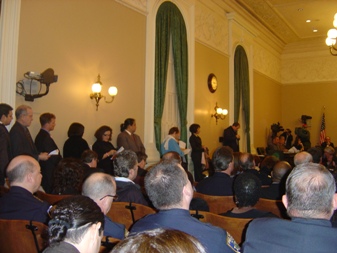
| hearing room audience |
|
Still, supporters pronounced themselves well pleased. "The conversation is definitely gaining traction in Sacramento," bill sponsor Assemblyman Tom Ammiano (D-SF) told a press conference at the capitol after the vote. "This is a significant vote because it legitimizes the quest for debate. There was a time when the m-word would never have been brought up in Sacramento."
âThis historic vote marks the formal beginning of the end of marijuana prohibition in the United States,â said Stephen Gutwillig, California state director of the
Drug Policy Alliance, who testified before the committee both Tuesday and in an earlier hearing. âMaking marijuana legal has now entered the public dialogue in a credible way. Decades of wasteful, punitive, racist marijuana policy have taken quite a toll in this country. The Public Safety Committee has demonstrated that serious people take ending marijuana prohibition seriously.â
"The mere fact that there was a vote in the Assembly to regulate and control the sale and distribution of marijuana would have been unthinkable even one year ago," said former Orange County Judge Jim Gray, a member of
Law Enforcement Against Prohibition, who also testified before the committee last fall. "And if the bill isn't fully enacted into law this year, it will be soon. Or, the bill will be irrelevant because the voters will have passed the measure to regulate and tax marijuana that will be on the ballot this November," Gray pointedly added.
The bill,
AB 390, the Marijuana Control, Regulation, and Education Act would impose a $50 an ounce tax on marijuana sales and would task the California Department of Alcoholic Beverage Control to regulate them. It was amended slightly from the original by Ammiano. In one example, the bill strikes "legalize" and replaces it with "regulate." It also strikes out language saying the bill would go into effect after federal law changes. And it adds language to clarify that medical marijuana does not come under its purview.
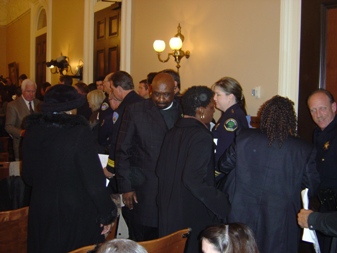
Tuesday's Public Safety Committee opened to a hearing room packed with legalization supporters, but also by more than a dozen uniformed police chiefs and high-ranking police officers from around the state. Law enforcement was out in force to make its displeasure known.
 |
|
| police and preacher present to oppose the Ammiano bill |
|
But first came Ammiano himself, recusing himself from his position as committee chair to testify in favor of his bill. "This is landmark legislation to legalize and regulate marijuana," Ammiano told his colleagues. "It would generate nearly a billion dollars annually in revenues, according to the Board of Equalization, and would leave law enforcement to focus on serious crimes, violent crimes, and hard drugs. The drug wars have failed," the San Francisco solon said emphatically. "Prohibition has fostered anarchy. Legalization allows regulations, and regulation allows order."
Since the primary hearing on the bill took place last fall, Tuesday's hearing was limited to 30 minutes (it was closer to 45), and witnesses either said their pieces succinctly or were gently chided by committee Vice-Chair Curt Hagman (R-Chino Hills). The Drug Policy Alliance's Gutwillig recapped testimony he gave last fall, as did the
Marijuana Policy Project California state director Aaron Smith.
"AB 390 is a historic reversal of failed marijuana policies," said Gutwillig. "It would begin to control a substance that is already commonly available and consumed, but unregulated. Prohibition has created enormous social costs and jeopardized public safety instead of enhancing it."
"This legislation would finally put California on track for a sensible marijuana policy in line with the views of most California voters," said Smith.
Also endorsing the bill was Matt Gray of
Taxpayers for Improving Public Safety, a California group lobbying for more progressive criminal justice policies. "We support the bill," said Gray. "Marijuana is the state's largest cash crop, and this bill will remove a revenue stream from organized crime and decrease availability for youth."
The opposition, led by law enforcement, church and community anti-drug groups, and a former deputy drug czar, threw everything short of the kitchen sink at the committee in a bid to sink the bill. Hoary old chestnuts reminiscent of "Reefer Madness" were revived, as well as new talking points designed to discourage members from voting for legalization.
 |
|
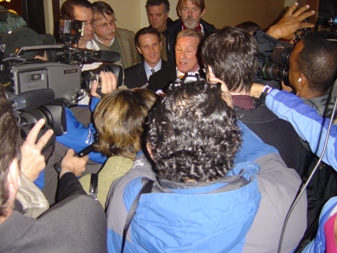
bill sponsor Assemblyman Tom Ammiano, with Dale Gieringer,
Stephen Gutwillig and Aaron Smith in background |
|
"I traveled here with a heavy heart," said former deputy director for demand reduction for the
Office of National Drug Control Policy Andrea Barthwell, the big hitter leading off for the opposition. "The eyes of America are upon you," she told the committee. "We don't want you to set a course that worsens the health of Americans for years to come. This is a scheme that will benefit drug cartel kingpins and corner drug dealers and create chaos in our public health system," she warned.
"People all over the country are afraid California will have this leverage in the same way the medical marijuana initiative was leveraged to create a sense that these are reasonable policies," Barthwell continued. "We've reduced drinking and smoking through public health, and prohibition is working for our young people to keep them drug free," she added.
"Legalization of marijuana will only increase the challenges facing us," said San Mateo Police Chief Susan Manheimer. "What good can come from making powerful addictive drugs more cheaply available? Don't we have enough trouble with the two legal drugs? Adding an additional intoxicant will lead to increase drugged driving and teen sex," she told the committee. "Marijuana of today is not the dope your parent's smoked," she added for good measure.
After mentioning that in the Netherlands cannabis cafes have "run rampant," asserting that "drug cartels will become legal cultivators," and that legalization would bring about "quantum increases" in the availability of marijuana, Manheimer swung for the fence. "To balance the budget on the back of the harm caused by illegal intoxicants is mind-bogglingâI would call it blood money," she said. Worse, "the addictive qualities of these drugs will cause more crimes as people struggle to find money to buy marijuana. We are very concerned about marijuana-related violence."
Then it was the turn of Claude Cook, regional director of the
National Narcotics Officers Associations Coalition. "This is dangerous work we do," Cook said by way of introduction. "We are strongly opposed to AB 390, we see no benefit for our communities. Marijuana is also carcinogenic. If we want to raise revenue, maybe it would be safer to just bring back cigarette vending machines. This is human misery for tax dollars." And by the way, "Drug offenders who are in prison have earned their way there by past criminal conduct," he added.
Cook predicted downright disaster were the bill to pass. "Use by juveniles will increase. Organized crime will flourish. California will become a source nation for marijuana for the rest of the country. The cartels will thrive. Highway fatalities will rise," he said without explaining just how he arrived at those dire conclusions.
 |
|
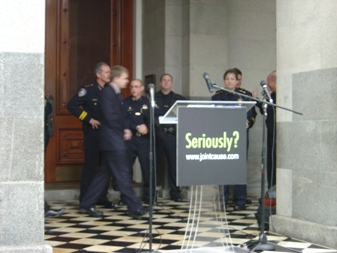
| police waiting to speak at anti-drug rally after committee vote |
|
"I see the devastation of marijuana and drugs in my community," thundered Bishop Ron Allen, "CEO and president" of the International Faith-based Coalition, and a self-described former crack addict who started with marijuana. "If marijuana is legalized and we have to deal with it in our liquor stores and communities, you have never seen a devastation like you're going to see. It's going to lose us a generation. You don't want this blood on your hands."
"I'm going to discount the ad hominems and alarmist attacks," Ammiano replied after the testimony. "Some of the arguments today reminded me of Reefer Madness," he said
Before moving to a vote, committee members briefly discussed their positions. Assemblywoman Nancy Skinner (D-Berkeley) noted that because of the state's medical marijuana law, "We have created a class difference, where a certain class of our population can utilize dispensaries for their own reasons to use marijuana, and on the other hand, we have the street activity around marijuana that is not under semi-legal status."
Skinner voted for the bill, while saying she was not sure she would support it on the Assembly floor. "I'm not supporting marijuana, but the question is who we regulate it and is it time to have a serious debate."
In the end, four of five Democratic committee membersâall from the Bay areaâsupported the bill, while one Democrat joined the two Republicans on the committee in opposing it."
The bill would normally head next to the Assembly Health Committee, but given the time constraints on the legislature, no further action is likely to be taken this session. Still, Tuesday was a historic day in Sacramento and in the annals of the American marijuana reform movement.