Harm Reduction

Harm Reduction and Allan's Diplomatic Faux Pas, on the Final Day of the U.N. Drug Treatment Conference, Vienna

At last, my final day in Vienna attending the United Nations' "Technical Seminar on Drug Addiction Prevention and Treatment: From Research to Practice" conference. (To read my scene-setting preamble from earlier this week, click here. Day 1 is here and day 2 is here.) It's a wind-down day for a conference that never wound up — the day when harm reduction was finally allowed to rear its head — so often unwelcome at any conference dominated, as this one is, by the United States, whose official governmental representatives are highly and categorically opposed to harm reduction. Harm Reduction appeared in that very earnest fashion whereby presenters say, "Here is the science. We need no more evidence. However, I can tell that you're not listening, so I'm going to tell you again that this all works, folks." It was also the day that I made a diplomatic faux pas (as we say in the language of diplomacy). More about that later. I missed the first couple of presenters as I was grappling with the sudden disappearance of Internet connectivity and was hoping that the coffee would kick in. The Viennese make good coffee although it's more of a utility tool than anything pleasurable, kind of like putting socks on in the morning. As I arrived, Dr. Shanti Ranganathan from TTK Ranganathan Treatment Centre in India had just finished her talk. I gather that she covered home detoxification and a camp for drug injectors (it could be fun to speculate how that camp would work). Speaking to a colleague later in the day, I learned that due to the rural nature of India, the approach to drug treatment there is very different from the way it's done in the northern hemisphere. It's very community oriented, and villages have a say-so in the process. I wish I'd caught more of Ranganathan's presentation, which was more along the lines of what I'd been hoping to get information about. How do you deliver drug services in resource poor countries? A gentleman behind me asked, "Haven't we overspecialized drug addiction treatment and shouldn't it be mainstreamed to take advantage of existing resources?" At last, a cri de coeur from the audience! Drug services including treatment, harm reduction, and diversion programs have all sprouted like varieties of weeds. They're somehow related, but the root system and the genetic coding are different. So how could countries and governments differentiate and choose among them? Or figure out how to construct the best array of services based upon what was on show? They couldn't, to my mind. After all, how could anyone possibly make sense of the patchwork quilt of treatment systems and social services in the north given that they don't necessarily make sense — or work — for drug users in their country of origin to begin with? It's as if we're displaying the leaning tower of Pisa or parading the Venus de Milo as models that they should aspire to, and then wondering why the resource poor world makes buildings that lean and statues that have no arms. One place I would not want to live is Sweden, where a random study of the kids at the youth program being trumpeted revealed that each youth suffered from an average of four mental disorders; the majority of parents had one. It must be good to have sane parents. Nothing like pathologizing the young, is there? The Dutch rolled into town with their admirably well-developed harm reduction knowledge and advocacy models. Dr. Wim van den Brink from the Academic Medical Centre at the University of Amsterdam in the Netherlands ran through the continuum of the stages of a drug user's drug taking career and discussed where, when, and which type of a wide range of interventions can and should occur. He included heroin maintenance in this list. (It is widely accepted that heroin maintenance is the fallback option for users who seek treatment but for whom methadone or buprenorphine has not worked. It's not usually a first line option. Outcomes are comparable to all other maintenance programs.) In van den Brink's view, drug-using patients should be able to talk over what their expectations are with their doctors and then negotiate their options. Fancy that. He was pretty much the first speaker who identified drug users as having a role in their own treatment. And he identified abstinence, maintenance, a safe high, and chaotic use as markers on a scale. That may be the first time in 20 years I've heard a clinician identify pleasure as part of the range of options. The legendary Dr. Franz Trautmann from the Netherlands Institute on Mental Health and Addiction ran through the evidence supporting harm reduction interventions including outreach, drop-in centers, and "drug consumption rooms" — the Dutch term for what we in the United States call safer injection facilities or medically supervised injection centers. (The panel facilitator, Gilberto Gerra, Chief of Health and Human Development Section of UNODC, chimed in to reassure everyone that drug consumption rooms do not violate international conventions). It was kind of a relief to hear Dr. Evgeny Krupitsky, head of a laboratory that conducts research on drug addiction at St. Petersburg State Pavlov Medical University, give a convoluted and amusingly wrong-headed talk about the desperate need for the Russians to make naltrexone the first-line response to drug addiction in Russia. (US rejection of harm reduction has its parallel in Russia's refusal to allow methadone.) Naltrexone is an opioid antagonist, which means you can't get high after you've taken it. The opioid receptors in the brain get too blocked up to let any more opioid in. However, as a form of treatment, it's just not very effective. So the Russians keep adding medications to the basic naltrexone dose, unwittingly creating an out of control medication pharmacopoeia for their patients. Monica Beg of UNODC had the task of informing everyone again that syringe exchange is effective in stopping the spread of HIV. Her PowerPoint showed the global distribution of exchange programs (probably limited to the UN-influenced world, to be fair) and did not cover the United States. "The science is clear. Syringe exchange works. The debate is over." Within UNODC there is no debate on the science but as mentioned in my original preamble, UNODC acts as the secretariat for the Commission on Narcotic Drugs (CND) and so when the member States of CND produce Political Declaration, those member states can completely ignore the science as is the case with the US and Russia. In fact, the HIV Prevention Unit deserve a medal for its work in pushing for support from within UNODC. And that's when I just had to speak. I pointed out that despite all of the evidence that needle exchange has been effective in the US (there are 200+ programs, with some of the larger ones federally funded; needle exchange has reversed the HIV epidemic in NYC, once the global epicenter of injection drug use and HIV; scientists at NIDA, NIH, CDC, NIAID are all on record as saying syringe exchange works), an article still appeared on CNN.com just this last July with David Murray, a supposed scientist for the Office of National Drug Control Policy, saying needle-exchange programs "do not succeed in its effort to control the contagion of disease." My point being that while the scientific debate may be over, the political debate continues in the US — not least in the way the US government has been disrupting the process leading up to this March's United Nations General Assembly Special Session on drugs. (While representatives to the UNGASS, plus numerous non-governmental agencies around the world have been calling for harm reduction to be recognized as an important part of demand reduction, US representatives have continued their war against it.) The chair responded to me by saying that there couldn't be a response to my point as it was a political question and inappropriate for this forum. And that science would win out. Stymied at not having a planned end point, I emotionally said that I was glad that this administration was now out. (Apparently it's taken as bad form to name names.) The interaction was filmed by an Iranian television crew that's covering the Iranian involvement in this meeting, which included Azarahksh Mokri of the Iranian National Center for Addiction Studies, who gave a wonderful presentation on how to introduce a methadone program into a country like Iran. He is a brilliant, charismatic speaker who was succint and on point throughout his talk. Christian Kroll of the UNODC HIV Unit, the last speaker before the closing, had that second returned from a UNAIDS Prgramme Coordinating Board meeting and was fired up from saying farewell to Peter Piot, the UNAIDS Executive Director and Under Secretary-General of the United Nations. Kroll ran through the history of the AIDS movement (accidently conflating Gay Men's Health Crisis and ACT-UP) and the importance of civil society input into the UN process. I kept waiting and waiting for the punch line. "Are you asking for more civil society input into UNODC?", I asked. Kroll's response: "Yes I am." Being practically the only representative from "civil society" at the meeting and definitely the only person that spoke, I can see his point. We then sang the Internationale and Mr. Kroll and I caught the subway home together. Allan Clear is executive director of the Harm Reduction Coalition.
Day One at the U.N. Drug Treatment Meeting -- Slightly More Interesting Than Predicted

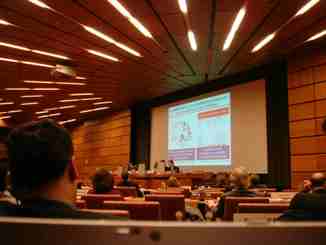
More than 200 people from around the globe have shown up for the first day of this drug treatment meeting at the United Nations Office on Drugs and Crime (UNODC) in Vienna. (If you're just tuning it, it may be helpful to read my first post, from yesterday, where I set the stage for what's to come.) Tantalizingly titled "Technical Seminar on Drug Addiction Prevention and Treatment: from Research to Practice," the tag line at the bottom of the conference program awkwardly hawks "NOTHING LESS than a qualified, systematic, science-based approach such as that used to treat other health conditions" — a fair enough goal. I tell you, the crowd was on tenterhooks for the event to begin.
In truth it was the most subdued, dead crowd ever gathered. Perhaps the most exciting event of the day was kangaroo hotpot on the canteen menu. To be clear, I have less interest in the science on show than on the subtexts of the dialogue and what is said and not said — all with an eye on the Commission on Narcotic Drugs (CND) meeting occurring next March. At that convening, countries will gather to review the last decade of UN-approved international drug policy, set forth at the first United Nations General Assembly Special Session (UNGASS) on Drugs in 1998, and issue a new UN Political Declaration. I suspect that the goings on at this prior conference may offer hints of what's to come. Antonio Maria Costa, the Executive Director of the UNODC, was in fine fettle opening the event. True to his pompous, unapologetic manner he was disrespectfully late, but his opening remarks were good. He wants the CND/UNGASS process to put increased money into demand reduction in order to put health at the center of the equation and reduce drug related crime. Consequently, Costa called for the rebalancing of drug control (by putting a greater emphasis on health), expressed concern that too little is spent on treating drug addiction, and acknowledged that law enforcement should not be used as an alternative to treatment. Costa also rejects the over-incarceration of drug users (he's been consistent about this). I'd like to think that Costa's comment re: over incarceration was an unsubtle dig at the US, where 1 in 31 US citizens live under the auspices of the criminal justice system. However, I suspect he's directing his remarks at the world below the equator or at Central Asia. In so many words, he admonished member states for not protecting their drug users and respecting their human rights. The day went downhill from then on in, as the conference morphed into a showcase for the disconnect between the science around drugs and addiction and the current reality re: which research-based policy recommendations are ever actually applied or funded or prioritized by governmental bodies. Consider the presentation of the keynote speaker, Dr. Nora Volkow, who heads the United States' National Institutes on Drug Abuse. I like Volkow. She cares about people who use drugs, and exudes compassion and even fire when she defends them. Before her presentation, we had a conversation about the federal ban on the funding of syringe exchange, and she expressed real excitement about working for Barack Obama.

Ingo Michels, representative of Germany's Ministry of Health
Certainly Dr. Volkow's presentation on the science of addiction was well done, and it affirmed much of what has been said for years by those of us who are involved in harm reduction. She ran through her Positron Emission Tomography (PET) Scan studies (they show the effect of drugs on the brain) and noted that there is hope of our someday being able to know in advance who is vulnerable to problematic drug use. In stating that abstinence is 'magical thinking' and addiction has a smorgasbord of serious medical consequences, including hiv/hcv, cancer, and mental illness, associated with it, she laid out a fine argument for embracing harm reduction without connecting the dots of course. She noted that people are people are at risk due to environmental factors. But looking at the blues, reds and yellows in the dissected brains on show, one would be hard pressed not to consider the color of the person who possessed this brain to begin with and then the hard, cold facts re: the skin color of who actually gets locked up for long periods of time in the US for having what Dr. Volkow was describes as a brain disease. The drug war in the US has disproportionately affected people and communities of color. Looking at the science of addiction doesn't dispel the effects of institutionalized racism. Nor does it reunite families, deliver education, or prevent HIV transmission. Scientific discovery is only the first step; it won't do us much good unless and until it's translated into real world policies and services. Hopefully that's Dr. Nora Volkow's dream under Obama (and Obama's dream as President): to put the theories that come out of what she and her colleagues are learning in the lab into practice. Most of the rest of the presentations were equally predictable. Drug treatment works. Drug prevention is cost effective. Drug treatment is cost effective. Addiction is a brain disease. Methadone works. Buprenorphine works. And that's all to the good. But will any of the policy recommendations that come out of this research ever actually be applied or funded or prioritized by governmental bodies? Anywhere? Vladimir Poznyak, from the Department of Mental Health and Substance Abuse at the World Health Organization (WHO), was the first person to bring up harm reduction. Clearly there is some tension between WHO and this UNODC meeting. Given the consistent commitment WHO has expressed for harm reduction, Poznyak pointedly highlighted needle exchange and harm reduction as HIV prevention in a WHO technical manual during his talk. But for my money the Man of the Day was Ingo Michels from the Ministry of Health in Germany. Michels' presentation, which detailed Germany's comprehensive drug treatment system and included information on safer injection sites, heroin prescription, and drug user organizations, clearly rejected the extent to which harm reduction had remained hidden and unspoken during the first day. It was also the first indication that harm reduction is more than just a means of HIV prevention. Your intrepid reporter then got the first question in. Prattling on in my usual fashion that is never succinct and always more about making a point rather than asking a simple question, and bearing in mind what I said in yesterday's post about the way in which US governmental representatives at these UN meetings always suppress the extent of harm reduction and needle exchange programs in the US and their success, I went at it. I detailed out the number of needle exchange programs in the US; noted out that the larger programs are federally funded (except for needles); and pointed out that they represent a continuum of care for drug users, act as a safety net for drug users who are "out of treatment," and make referrals to drug treatment. In short, I argued that the UN is cornering itself by limiting harm reduction programs as just an HIV intervention. Well, that set Michels off. He slammed the US representatives for blocking the UNGASS process and said he hoped the Obama Presidency would mean that there would be a new UNGASS delegation at this March's meeting. (Being fairly new to this process, I think he probably overstepped his bounds. Excellent stuff.) Surprisingly, the conservative panel facilitator, Gilberto Gerra, Chief of Health and Human Development Section of UNODC, also animatedly joined the discussion by saying that UNODC believes that harm reduction should be part of the "comprehensive package." I'll be damned. More battle to be joined tomorrow. Allan Clear is executive director of the Harm Reduction Coalition.

FDA Embraces Harm Reduction…Sort of

Check out this interesting logic from the FDA:

WASHINGTON - A top government health official rejected the idea of an immediate ban on cough and cold medicines for young children, saying it might cause unintended harm.

Food and Drug Administration officials at a public hearing Thursday said they need to gather more data on whether over-the-counter remedies are safe and effective for children ages 2 to 6.

The FDA is also worried that a ban — as sought by leading pediatricians' groups — might only drive parents to give adult medicines to their youngsters. [MSNBC]


Well, that sounds like a logical concern. People tend to make safer choices when available and more dangerous ones when their options are restricted. Yet federal law still blocks funding for needle exchange and criminalizes people who use marijuana as an alternative to powerful opioid-based pharmaceuticals.

                                                                                                                                                                              {Thanks, Caryn]

How to Use Drugs Without Ruining Our Lives

Cato Unbound has a wonderful piece, Towards a Culture of Responsible Psychoactive Drug Use, by Earth and Fire Erowid, the founders of Erowid.org. The article provides a rational discussion of why people use psychoactive substances and what can be done to minimize the harms and maximize the benefits of such use. Over the next week, Cato will post responses from Jonathan Caulkins, Jacob Sullum, and Mark Kleiman.

I read the piece last night in its entirety and don’t recall finding a single word I disagree with. What struck me is how far removed modern drug education is from even discussing these commonsense principles. Do this information sound dangerous to you?


Fundamentals of Responsible Psychoactive Use

* Investigate the health risks and dangers of the specific psychoactive and of the class of drugs to which it belongs.
* Learn about interactions with other recreational drugs, medications, supplements, and activities.
* Review individual health concerns, predispositions, and family health history.
* Choose a source or product carefully to help ensure correct identification and purity
(avoid materials with an unknown source or of unknown quality).
* Know whether the drug is likely to reduce the ability to drive, operate equipment, or pay attention to necessary tasks.
* Take oneself "off duty" from responsibilities that might be interfered with (job, child care, etc.), and arrange for someone else to be “on duty” for such responsibilities.
* Anticipate reasonably foreseeable risks to oneself and others and employ safeguards to minimize those risks.
* Choose an appropriate occasion and location for use.
* Select and measure dosages carefully.
* Begin with a low dose until individual reactions are known and thereafter use the minimum dose necessary to achieve the desired effects: lower doses are safer doses.
* Reflect on and adjust use to minimize physical and mental health problems.
* Note changes in health over time that may be related to use.
* Modify use if it interferes with work or personal goals.
* Check in with peers and family and accept feedback about one’s use.
* Track reactions to specific drugs and dosages in order to avoid repeating mistakes.
* Seek treatment if needed.
* Decide not to use when the time isn’t right, the material is suspect, or the situation is otherwise problematic.

Anyone who has a problem with any of this should contemplate the consequences of allowing young people to learn these lessons the hard way. The fact that these ideas might be considered controversial should serve to remind us how badly our society has demolished its own ability to discuss drug use with people who use drugs.

More Reports from Warsaw

Allan Clear continues his reporting from the International Harm Reduction Association conference in Warsaw, this time covering days two and three. Click the "read full post" link below or here to read the whole thing. Day 2 On the morning plenary, Fabio Mesquita provided two case studies of the national responses to HIV among injectors in Brazil and Indonesia. Fabio was instrumental in altering the landscape for drug injectors in Sao Paolo and Brazil as whole. He now works in Indonesia. A couple of notable points were that 28% of the population of Brazil have taken an HIV test and the phenomenal scale up of syringe exchange in Indonesia, from 17 to 129 over two years. The INPUD drug user session was extremely well attended. Bijay Pandey talked about his organizing in Nepal. As NDRI's Sam Friedman pointed out it's hard enough to organize around user's lives in general. To do so during a civil war is particularly impressive. Like all specific user organizing the future of the work is in jeopardy but the effort has been put in. Perhaps there's no more supportive drug researcher than Sam Friedman. A tireless advocate for drug users, Sam provided a Marxist Leninist dialectical critique of global socio-economic substructural micro organized community ventures that help diffuse the totalitarian oppression we all live under in this post soviet imperialistic world. User dominated of course. Alexander Rumyanzev talked about the way drugs are used to affect social movements and oppress drug users. There has been a long line of very articulate drug user activists in the history of harm reduction - John Mordaunt, Matt Southwell, Annie Madden, Jude Byrne, Louis Jones, Bill Nelles, for example – and one of the most articulate drug user activists for the last decade has been the USA's Paul Cherashore so it was good to see him back on form. He urged drug users to strike back at the system. He wasn't clear on a strategy for doing so but made valid comparisons between gay rights and drug user rights using the San Francisco gay community's response to the murder of Harvey Milk and later talked about the Stonewall riots as flashpoints that eventually changed policy and society as a whole. more...

Allan Clear Reports from the International Harm Reduction Conference in Warsaw

(DRCNet is pleased to welcome Allan Clear, executive director of the Harm Reduction Coalition, as a special guest correspondent for the Stop the Drug War Speakeasy. Allan is currently in Warsaw, Poland, attending the 18th International Conference on the Reduction of Drug Related Harm, and has graciously agreed to report for us on the proceedings. He has come through with photos and all. Because I was offline most of the last few days, Allan's first few posts are all coming out together in one. Any subsequent posts from the conference will come out one by one. Here Allan writes about getting to the place, the place, pre-conference meetings of the International Network of People Who Use Drugs and various satellite groups, and the conference's first day. - DB) Allan Clear Stijn Goossens & Luiz Paolo Guanabara, at the conference (Click the "read full post" link below or here to read Allan's full reports, with more pictures.)

Canadian Federal Government Demands More Research on Safe Injection Site, But Won't Pay For It

The Canadian federal government -- relatively hostile to harm reduction measures like safe injection sites since the Conservative Party took power in the last elections -- will not fund further research for Vancouver's InSite safe injection site, Health Ministry spokesman Eric Waddell told the Drug War Chronicle this afternoon. That was news to the site's operator, the Vancouver Coastal Health Authority, whose spokesperson Viviana Zonacco said she had not been informed of that aspect of the ministry's decision.

Vancouver MP Leading Fight to Save Safe Injection Center

I spoke this morning with Vancouver East Member of Parliament Libby Davies for an article I'll publish Friday on the effort to ensure that Health Canada continues the exemption for INSITE, the safe injection site. The Conservative government of Prime Minister Harper is hinting it wants to shut the whole thing down, and Davies says she is "concerned" but hopeful Harper will retreat in the face of strong local support and good, solid evidence it is working. Donald McPherson of Vancouvers drug policy office told me yesterday the city is also strongly behind it. I suspect Vancouver Coastal Health will say the same thing when I speak to them. We could all take a lesson from the way Vancouver mobilizes for drug reform.