Reentry/Rehabilitation

Life After the War on Drugs: Reviewing Past and Present Policies with an Eye Toward Legal Reform

University of the District of Columbia David A. Clarke School of Law
2011 Law Review Symposium

David A. Clarke School of Law
 

"Life After the War on Drugs: Reviewing Past and Present Policies With an Eye Toward Legal Reform"


Introduction (10:00 – 10:15 a.m.)
• John Brittain, Professor, UDC-DCSL, Chief Counsel and Senior Deputy Director of the Lawyers' Committee for Civil Rights Under Law (2005-2009)

Panel 1: Drug Policy at Home and Abroad (10:15 a.m. – 12:00 p.m.)
• Eric Sterling, Advisory Board Member, Law Enforcement Against Prohibition (LEAP)
• Brooke Mascagni, PhD Candidate, University of California, Santa Barbara
• Jordan Blair Woods, PhD Candidate, Cambridge University (U.K.), J.D. University of California Los Angeles

Lunch (12:00 – 1:00 pm)
• Lunch Keynote Speaker: Ronald C. Machen, Jr., United States Attorney for the District of Columbia

Panel 2: Conflicts between State and Federal Drug Laws (1:00 – 3:30 p.m.)
• Andrew Ferguson (Moderator), Professor, UDC-DCSL, Public Defender Service of the District of Columbia (2004-2010)
• Robert Hildum, Director, D.C. Dept. of Youth Rehabilitation Services (2010)
• Sumeet H. Chugani, Esq. and Xingjian Zhao, Esq., Diaz, Reus & Targ, LLP (Miami, FL)
• Alex Kreit, Director, Center for Law and Social Justice, Thomas Jefferson School of Law (San Diego, CA)

Panel 3: The Unknown Effects of the War on Drugs (3:45 – 5:00 p.m.)
• Brian Gilmore, Director, Michigan State University College of Law Housing Clinic
• Ken Lammers, Deputy Commonwealth Attorney, County of Wise and City of Norton in Virginia
• Michael Liszewski, Board of Directors, Students for Sensible Drug Policy

Cocktail Reception (5:10 – 6:00 p.m.)

Plenary Panel: Life After the War on Drugs (6:00 – 9:00 p.m.)
• Keynote Speaker: Wade Henderson, President and CEO, The Leadership Conference on Civil and Human Rights
• Jasmine Tyler, Deputy Director of National Affairs, Drug Policy Alliance
• Mark Osler, Professor, University of St. Thomas School of Law (Minneapolis, MN)
• The Honorable Arthur L. Burnett, Sr., National Executive Director, National African-American Drug Policy Coalition
• Dr. Faye Taxman, Director, Center for Advancing Correctional Excellence, George Mason University

The event is free and open to the public, but registration is limited. To register, see http://www.law.udc.edu/events/event_details.asp?id=136549.

For any questions, please contact Symposium Editor Leila Mansouri at [email protected].
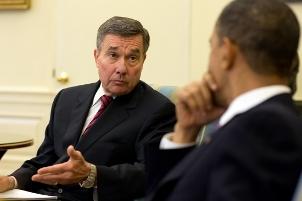
Drug War Autopilot and Co-Autopilot: ONDCP Director Gil Kerlikowske with President Obama

The 2012 Federal Drug Budget: More of the Same [FEATURE]

The Obama administration has submitted its 2012 federal drug control budget proposal. There's not much new there, and little evidence the administration is putting its money where its mouth is.

Republican Lawmakers Shifting Tough-On-Crime Stance As State Budget Problems Multiply

In no state is the philosophical U-turn more abrupt than in Oklahoma, where last year the Legislature was barreling in the opposite direction. New Republican Speaker of the House Kris Steele is expected to unveil a package of proposals that would divert thousands of nonviolent lawbreakers from the prison system and ramp up paroles. Similar crash prison reductions are going on from coast to coast. Michigan has shuttered 20 correctional facilities and slashed spending by nearly 7 percent. South Carolina expects to reduce its inmate numbers by 8 percent by putting drug dealers, burglars and hot check writers into community programs instead of behind bars.

Barriers to Ex-Offender Employment Could Cost the Nation at Least $57 Billion

According to a study from the Center for Economic and Policy Research's senior economist John Schmitt, ex-offenders' barriers to employment lowers the nation's employment on average by 1.5 million to 1.7 million workers. Multiply that number by the average output that these workers would be putting into the economy, if they were employed, and the loss totals at least $57 billion, he said. This figure is growing as more of the hundreds of thousands of people put into jail during the prohibitionist war on drugs in the 1980s and 1990s are released.

Iowa Drugs Appeal Case Headed to Supreme Court

Two attorneys say they'll take an Iowa case before the nation's highest court next week that could alter how federal judges sentence convicts after appeals. The issue is if judges can weigh a convict's efforts at rehabilitation while an appeal is pending.

Growth of Ex-Offender Population in United States Is a Dramatic Drag on Economy (Press Release)

For Immediate Release:November 15, 2010
Contact: Alan Barber, (571) 306-2526

Washington, D.C.- Three decades of harsh criminal justice policies have created a large population of ex-offenders that struggle in the labor market long after they have paid their debts to society, according to a new report from the Center for Economic and Policy Research (CEPR). Because prison records and felony convictions greatly lower ex-offenders' chances of finding work, the United States loses between $57 billion and $65 billion a year in lost output.

“It isn't just that we have the highest incarceration rate in the world, we have created a situation over the last 30 years where about one in eight men is an ex-offender,” said John Schmitt, a Senior Economist at CEPR and a co-author of the report.

The new report, “Ex-offenders and the Labor Market,” found that in 2008 there were between 5.4 million and 6.1 million ex-prisoners and between 12.3 million and 13.9 million ex-felons in the United States. Over 90 percent were men.

In 2008, about one in 33 working-age adults was an ex-prisoner, and about one in 15 working-age adults was an ex-felon. Among working-age men in that same year, about one in 17 was an ex-prisoner and one in eight was an ex-felon.

Because ex-offenders face substantial barriers to employment, the authors estimate that the large ex-offender population in 2008 lowered employment that year by the equivalent of 1.5 million to 1.7 million workers.

"The rise in the ex-offender population overwhelmingly reflects changes in the U.S. criminal Justice system, not changes in underlying criminal activity," says Schmitt. "We incarcerate an astonishing share of non-violent offenders, particularly for drug-related offenses. We have far better ways to handle these kinds of offenses, but so far common sense has not prevailed."

The report warns that in the absence of reforms to the criminal justice system, the share of ex-offenders in the working-age population will rise substantially in coming years, increasing the magnitude of employment and output losses estimated for 2008.

###

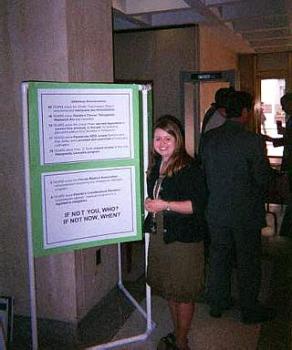
Jodi James at work
Jodi James at work

Veteran Drug Reformer Wins Florida House Primary

A face we're used to seeing at drug reform conferences will now be plastered on campaign posters as Floridian Jodi James wins her state House Democratic primary and focuses on knocking off the Republican incumbent.

Second Chance Conference Website Released


Justice Center

July 14, 2010

Making Second Chances Work
Conference Website Released

The National Reentry Resource Center, with support from the Bureau of Justice Assistance, U.S. Department of Justice, has launched the Making Second Chances Work conference website. Conference participants and others interested in reentry can view the videotaped sessions with experts and download materials used during the conference on some of the most pressing issues facing the field.

Making Second Chances Work: A Conference for Grantees Committed to Successful Reentry was held May 26-27, in Washington, D.C. It brought together 2009 Second Chance Act grantee representatives. Individuals from state and local governments, community and faith-based organizations, and federally recognized Indian tribes participated in two days of meetings with experts in the fields of housing, employment, mental health and substance abuse treatment, community supervision, and other areas important to people transitioning from prison or jail to the community.

Many sessions focused on grantees making the most of the federal investment in their programs by highlighting accountability issues and key practices such as assessing an individual's risk for committing future crimes, designing data-driven programs, and effectively allocating the limited resources available for people returning from prisons and jails. Special attention was dedicated to sharing strategies on meeting the distinct needs of youth returning to schools and families from detention in a secure facility in an effort to interrupt the costly cycle of crime and incarceration.

To visit the website, please click here.

If you have any questions, please contact Shawn Rogers at 646.383.5745 or by e-mail at [email protected].


The National Reentry Resource Center (NRRC) provides education, training, and technical assistance to states, tribes, territories, local governments, service providers, nonprofit organizations, and corrections institutions working on prisoner reentry. The NRRC is coordinated by the Council of State Governments (CSG) Justice Center, with support from the Bureau of Justice Assistance, U.S. Department of Justice (www.ojp.usdoj.gov/BJA). For more information, visit http://www.nationalreentryresourcecenter.org. For more about the CSG Justice Center, see http://www.justicecenter.csg.org.

The NRRC was established by the Second Chance Act (Public Law 110-199), which was signed into law on April 9, 2008. The Act was designed to improve outcomes for people returning to communities from prisons and jails. This first-of-its-kind legislation authorizes federal grants to government agencies and nonprofit organizations to provide employment assistance, substance abuse treatment, housing, family programming, mentoring, victims support, and other services that can help reduce recidivism. For more information about the Act, see http://www.nationalreentryresourcecenter.org/about/second-chance-act.

The NRRC's work also is directed by the Justice Center's key project partners: the Urban Institute; Association of State Correctional Administrators; American Probation and Parole Association; and Shay Bilchik, research professor/center director, Georgetown University Public Policy Institute. Additional guidance is provided by advisory committees that include representatives of nearly 100 leading nonprofit organizations and service providers in the reentry field.


Our postal address is
100 Wall St
20th Floor
New York, New York 10005
United States