Death Penalty

Egypt Hates Hemp - Man Could Get Death for Importing Hemp Seed Oil (Press Release)

FOR IMMEDIATE RELEASE: February 4, 2011

CONTACT: Adam Eidinger 202-744-2671 or [email protected]

American Health Food Exporter Speaks Out About Month Long Ordeal in Egyptian Jail for Importing Nutritious Hemp Food
Hemp Industry Asks US Department of State to Help Innocent Man in Limbo

WASHINGTON, DC –
The Hemp Industries Association (HIA), the nation’s leading trade organization working to promote non-drug industrial hemp, learned last week of the plight of Mostafa Soliman, an America citizen who has lived in the U.S. for 40 years and was wrongly imprisoned by Egyptian authorities on December 30, 2010 for importing organic hemp seed oil used in salads, and other healthy recipes.    If convicted, he is potentially facing death by hanging.

After almost a month in jail, Mr. Soliman was finally granted bail as protests raged across Egypt.  Just as he was about to be released on January 28th, his jail  was attacked by protesters and set on fire.  Guards and police fled leaving the prisoners to die in the burning jail, many of whom were crammed in 8 by 8 foot cells with as many as 30 people.  Eventually the protesters entered the jail and smashed the locks on the prisoner’s cells amidst smoke and tear gas, releasing Mr. Soliman and others in a scene that can only be described as dangerously chaotic.

Over the next few days Mr. Soliman along with attorneys in the U.S. working with the HIA asked the U.S. Embassy in Cairo to help reissue Mr. Soliman a passport so he can return to the U.S.  However, the embassy has refused to issue the new passport so far for no apparent reason except that he is facing unfounded drug charges in Egypt.

The Egyptian born Mr. Soliman, 62, is owner of Health Harvest, the company which exported the hemp seed oil from Canada and operates in Egypt.  He lives in Aventura, Florida, but was spending time in Egypt to manage the arrival of products that he exports from the U.S. and Canada.

“This is a tragic mistake that could be solved with a simple drug test.  Mr. Soliman is being falsely accused of importing ‘hash oil’ when  in fact it was healthy hemp food,” says Eric Steenstra, Executive Director of the HIA.  “The HIA and Votehemp.com are launching a campaign to free Mostafa Soliman that will hopefully jump-start action at the U.S. State Department.  We recognize that the unrest in Egypt will make it more difficult for U.S. authorities to act, but this terrible mistake by Egyptian authorities was made well before the recent protests began and in many ways symbolizes the corruption the protestors are resisting,” adds Steenstra.

To arrange interview with Mostafa Soliman via Skype or telephone from his home Cairo, Egypt or spokespeople for the Hemp Industries Association please call Adam Eidinger at 202-744-2671 or email [email protected].

###

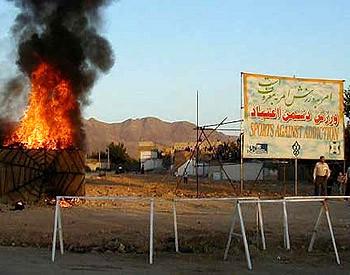
International Anti-Drugs Day drug burn, Tehran

Iran in Drug Offender Execution Frenzy

Iran is already one of the world's leading death penalty countries, but it has been hanging drug offenders at a record pace so far this year.

Former Senior China Anti-Drug Official Gets Death Penalty for Drug Trafficking

A court handed down the death penalty to the former deputy head of anti-narcotics efforts in China's most populous metropolis, Chongqing. Luo Li had been collaborating with drug dealers in Chongqing since 2005 and took 1.2 million yuan ($233,038) in bribes to turn a blind eye to the activities of two of them, the official Xinhua news agency said, citing a court statement.
New Picture (5).png
New Picture (5).png

Huff Post: UN Drug Policy in the Dark Ages

I'm on Huffington Post again tonight, with a post chastising the UN (and western governments generally) for: 1) continuing the ludicrous coca runaround in South America's Andean region for another year; and 2) turning a blind eye year after year to the indirect support that western funds and cooperation gives to the death penalty for nonviolent drug offenses, mostly in Asia and the Middle East. Check it out here -- comments welcome in either location. If you haven't already, check out our Chronicle articles on these two topics here and here.

ENCOD Statement to the Malaysian government

Brussels, 4 March 2010 To: Yang Amat Berhormat Dato’ Sri Mohd Najib Bin Tun Abdul Razak Prime Minister of Malaysia Dear Excellency, Today we write to you as European citizens concerned with the impact of global drug policies, with an urgent request. We believe the death sentence that is applied to drug law offenders in Malaysia is an inappropriate measure, and would like to offer you our collaboration in identifying better solutions to the drug problems in your country. With certain regularity, reports appear in the Malaysian press on people being sentenced to death for the possession of illegal drugs, including cannabis. The exact number of those who are actually brought to death remains unknown. Human rights organisations estimate that currently some 300 convicted prisoners await execution on death row, most of them for drug-related offences. These sentences clearly violate international standards for a fair trial. The presumption of guilt and the mandatory death sentence in drug cases places the charge on the accused to prove his or her innocence and leaves a judge with no discretion over the sentence. Competent legal assistance is unavailable to many of those people, leaving them with little capacity to mount a defence at any stage of the proceedings. UN human rights bodies have concluded that drug offences fail to meet the condition of “most serious crime”, under which the death penalty is allowed as an “exceptional measure”. We are aware of the argument that drugs cause problems in Malaysian society. However, we doubt that these problems will be solved by harsh punishments, let alone executions of drug offenders. Malaysia, like any other country in the world, is not and never will be 100 % drug-free. As long as people in Malaysia want to consume drugs, other people will continue to supply them. Because of the fact that drugs are prohibited, drug trafficking is the core business of criminal organizations that in most cases operate internationally. The people who are occasionally caught by authorities with relatively small amounts do not have major responsibilities in this business. Killing them will not scare the drug gangs away. On the contrary: thanks to these harsh punishments, the leaders in the drug business can continue to justify extraordinary high prices for their goods,. Thus it maintains a vicious circle of violence and danger. On the other hand, it is important to make a serious assessment of the problems that drugs may or may not cause. Cannabis for instance is a plant, a natural product, a non-lethal substance. Its consumption has been widespread around the world for thousands of years among many different cultures and people. All these people do not use cannabis because it endangers their health or wellbeing, but rather because they experience the opposite. According to increasing amounts of scientific evidence, the so-called dangerousness of cannabis has been largely exaggerated and driven by moral in stead of rational considerations. The prohibition of cannabis was installed and promoted worldwide by Western countries, especially the USA, during a period in which they dominated the world. Meanwhile, in most European countries, cannabis possession for personal consumption is not penalised anymore. In a growing number of states in the USA, major law changes are taking place that legally regulate the cultivation and distribution of cannabis to adults for medicinal purposes. It would be extremely sad to see Malaysia continue executing people found in possession of cannabis, while the countries that have installed its prohibition have come to the insight that this is a useful substance whose consumption can be perfectly integrated in society. In Europe, during the past decades, we have been able to compare the results of different, sometimes opposing drug policies in societies that are similar in demographical, material and socio-cultural development. The conclusion is that drug policies, whether they are repressive or flexible, have a very minor impact on the drug phenomenon itself. In countries where authorities are relatively tolerant, the use of drugs may be lower than in neighboring countries where policies are more repressive. Another conclusion is that drugs-related harms can only be reduced by effective social and health policies. Innovative strategies for reaching out to the affected population and reducing the harms related to drug use are needed. The harsh implementation of drug law enforcement is an impediment to the introduction of these strategies. For these reasons, we are convinced that the death penalty is actually counterproductive to efforts to reduce the harm caused by drugs. We call upon your wisdom to apply principles of sound governance and let Malaysia join the majority of nations by declaring a moratorium on executions with a view to total abolition of all death sentences for drug offenses, as called for by the United Nations. We offer you our kind co-operation in transmitting knowledge and experience of public health policies that have proven effective in addressing drug-related problems. Sincerely yours, Marisa Felicissimo, Fredrick Polak, Jorge Roque and Antonio Escobar Members of the Steering Committee of the European Coalition for Just and Effective Drug Policies

Hands Off Cain Daily eNewsletter - IRAN: 12 CONVICTS HANGED

[Courtesy of Hands Off Cain] In this issue: IRAN. 12 CONVICTS HANGED NORTH CAROLINA (USA). DEATH ROW INMATE WALKS FREE-129TH EXONERATION DRC. FIGHTING TO ESTABLISH THE UNCONSTITUTIONALITY OF THE DEATH PENALTY SAUDI ARABIA. 3 PAKISTANIS EXECUTED FOR HASHISH SMUGGLING IRAN. 12 CONVICTS HANGED Drug traffickers after being executed in Iran May 5, 2008: Iran has hanged 12 convicted criminals, including nine drug traffickers and three rapists, the latest in a growing number of executions in the Islamic republic, reports said. Nine drug traffickers were hanged, one of them in public, in the northeastern city of Bojnourd, Kayhan newspaper reported, without giving the date of the executions. This appears to be the first report of a public execution in Iran since judiciary chief Ayatollah Mahmoud Hashemi Shahroudi ordered in January that there should be no more public executions without his approval. "One person was hanged in public," said Kayhan, without giving further details. Shahroudi's decree came after a growing number of public executions in Iran, including the hanging of two convicted murderers in the centre of Tehran. It was not clear if he had approved the reported public execution in Bojnourd. Meanwhile, three criminals convicted of kidnapping and raping at least 11 girls were sent to the gallows in the southwestern city of Ahvaz on May 3, the Quds newspaper reported. -------------------------------------------------------------------------------- NORTH CAROLINA (USA). DEATH ROW INMATE WALKS FREE-129TH EXONERATION May 2, 2008: The state of North Carolina dropped all charges against Levon Jones, and he was freed after spending 13 years on death row. U.S. District Court Judge Terrence Boyle overturned Jones's conviction two years ago, but he was held in prison awaiting a possible retrial until prosecutors announced that they were dismissing all charges. Judge Boyle criticized Jones's defense attorneys for "constitutionally deficient" performance, noting their failure to research the history and credibility of Lovely Lorden, the prosecution's star witness. The judge noted, "Given the weakness of the prosecution's case and its heavy reliance on the testimony of Lovely Lorden, there is a reasonable probability that, but for counsel's unprofessional errors, the result of the proceeding would have been different." In April, Jones's new defense team filed an affidavit in which Lorden said, "Much of what I testified to was simply not true." She also stated that a detective coached her on what to say. Additionally, she collected $4,000 from the governor's office for offering the clues that led to the arrest of Jones. Jones's retrial was set to begin May 12th, 2008. Duplin County District Attorney Dewey Hudson decided to ask the judge in the case to drop all charges. Jones was originally convicted of robbing and shooting a bootlegger named Leamon Grady. Levon Jones is the 129th inmate to be exonerated and freed from death row since 1973. He is the 8th such inmate freed from North Carolina, and the 6th person in the country exonerated in the past 12 months. -------------------------------------------------------------------------------- DRC. FIGHTING TO ESTABLISH THE UNCONSTITUTIONALITY OF THE DEATH PENALTY Liévin N'Gondji May 1, 2008: ongoing penal code reform in the Democratic Republic of Congo is giving abolitionists the chance to have the death penalty recognised as unconstitutional. The current Democratic Republic of Congo constitution, in place since early 2006, recognises the "right to life" and the "inviolable nature of human beings". A proposition for an article explicitly abolishing the death penalty was rejected by the national parliament during the text's elaboration in 2005. "We have submitted two requests, one to the director of public prosecutions' office and a second to the Ministry of Justice" to formally establish the unconstitutionality of the death penalty, explains Liévin N'Gondji, a lawyer and president of Culture for Peace and Justice (CPJ), member of the World and Congolese Coalitions against the death penalty. Thanks to international aid, the DRC's judicial system is being reformed and donors financing the project have invited CPJ to participate in the joint justice Commission, principally responsible for revising the penal code. N'Gondji estimates that "approximately three quarters of those present were in agreement" with his position on the unconstitutionality of capital punishment. According to N'Gondji, the Commission will make its recommendations to the government by the end of May. The latter should then make a decision quickly. "The next three months will be crucial", he believes. -------------------------------------------------------------------------------- SAUDI ARABIA. 3 PAKISTANIS EXECUTED FOR HASHISH SMUGGLING May 1, 2008: Zargar Sadajan, Roajan Sodajar, and Naik Mohammed Malak Mohammed, all Pakistanis, were executed in Riyadh, Saudi Arabia, after being convicted of receiving large quantities of hashish. A statement released by the Saudi Interior Ministry confirmed that the men were convicted by the court, and the verdict was approved by the Cassation Court and the Supreme Judicial Council.