Legalization

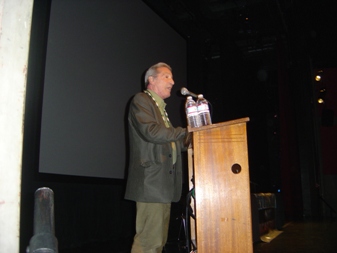
Assemblyman Ammiano at the Students for Sensible Drug Policy Conference

Tom Ammiano addressing the conference
California Assemblyman Tom Ammiano (D-SF), the author of California's marijuana legalization bill, is not just a serious guy, he's a seriously funny guy, and Ammiano's comedic talent was on full display Saturday afternoon as he closed out the first full day of the Students for Sensible Drug Policy (SSDP) conference at the Fort Mason Center in San Francisco. After a long day of grueling panels on medical marijuana, psychedelics, state and local drug reform, the Mexican drug war, marijuana legalization, and harm reduction, among others, a taste of Ammiano was just the thing to revive flagging student activists. Mixing earthy language and humor, the openly gay Ammiano sketched the intertwined history of gay activism, the AIDS crisis, and medical marijuana in the Bay Area, and he didn't let party loyalty get in the way of telling it like it was. "Bill Clinton was shit on this issue," he said. "He put out that edict that doctors couldn't prescribe it," referring to the Clinton administration's effort to try to intimidate doctors by threatening to jerk their DEA licenses to prescribe drugs if they recommended medical marijuana to patients. "That's not an adult way to deal with an issue, and it's certainly not a statesman-like way." The administration lost that one in the Supreme Court. Ammiano was a bit kinder to the current White House occupant. "In terms of Obama," he said, "the messaging is good, but it's sometimes contradictory. Still, history isn't always linear. But I'm here to tell you this movement has never been stronger; we've never been on the cusp in such a pronounced way." Mentioning the Tax and Regulate Cannabis 2010 initiative that will in all likelihood be on the California ballot in November, Ammiano said he was working closely with initiative organizers and that their efforts were not competitive, but complementary. He also unleashed a bit of pot humor, noting that 57 people had signed initiative petitions twice. "You can imagine what they were doing just before that," he said before switching into a stoner voice. "Dude, let me sign this again to make sure it passes," he role-played to gales of laughter.
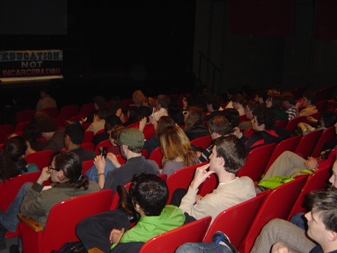
students and others attending Ammiano talk
Regarding his bill's prospects in Sacramento, the dapper and diminutive Ammiano reported that there is a lot of sympathy, even among conservatives, but many are still afraid to say so out loud or to vote yes for the record. "If we voted in the capitol hallways, we'd be home free," he said, before engaging in a replay of dialogues he's had with other lawmakers. "They come up to me and say, 'Man, I used to smoke that shit in college, let's tax the hell out of it.' And I'd say, 'Are you with me then?' and they'd say, 'Oh, no, man, I can't do that.'" Ammiano also mentioned Barney Frank's federal decriminalization bill. "I guess it's a queer thing," he said, mincing mightily and pretending to swoon over Frank. "You guys ought to get married," someone yelled from the audience to more laughter. Ammiano predicted victory -- if not this year, soon. "We have a strategy," he said. "We have our shit together, boys and girls, and that's something they're not ready for." And then he was gone, leaving an appreciative audience reinvigorated, still laughing, and clapping wildly. There is much more to report about on the SSDP conference. Look for a feature article on it sometime this week. in the exhibitor space

In US First, California Assembly Committee Approves Marijuana Legalization Bill

A bill to legalize the adult use, sale, and production of marijuana was approved Tuesday by a 4-3 vote in the California Assembly Public Safety Committee. While the vote was historic—it marked the first time a state legislative committee anywhere had voted for a marijuana legalization bill—a Friday legislative deadline means the bill is likely to die before it reaches the Assembly floor.
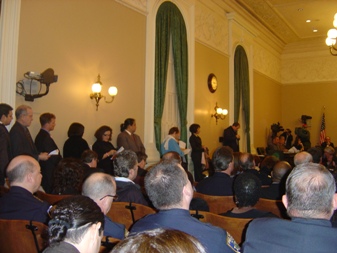
hearing room audience
Still, supporters pronounced themselves well pleased. "The conversation is definitely gaining traction in Sacramento," bill sponsor Assemblyman Tom Ammiano (D-SF) told a press conference at the capitol after the vote. "This is a significant vote because it legitimizes the quest for debate. There was a time when the m-word would never have been brought up in Sacramento." “This historic vote marks the formal beginning of the end of marijuana prohibition in the United States,” said Stephen Gutwillig, California state director of the Drug Policy Alliance, who testified before the committee both Tuesday and in an earlier hearing. “Making marijuana legal has now entered the public dialogue in a credible way. Decades of wasteful, punitive, racist marijuana policy have taken quite a toll in this country. The Public Safety Committee has demonstrated that serious people take ending marijuana prohibition seriously.” "The mere fact that there was a vote in the Assembly to regulate and control the sale and distribution of marijuana would have been unthinkable even one year ago," said former Orange County Judge Jim Gray, a member of Law Enforcement Against Prohibition, who also testified before the committee last fall. "And if the bill isn't fully enacted into law this year, it will be soon. Or, the bill will be irrelevant because the voters will have passed the measure to regulate and tax marijuana that will be on the ballot this November," Gray pointedly added. The bill, AB 390, the Marijuana Control, Regulation, and Education Act would impose a $50 an ounce tax on marijuana sales and would task the California Department of Alcoholic Beverage Control to regulate them. It was amended slightly from the original by Ammiano. In one example, the bill strikes "legalize" and replaces it with "regulate." It also strikes out language saying the bill would go into effect after federal law changes. And it adds language to clarify that medical marijuana does not come under its purview. Tuesday's Public Safety Committee opened to a hearing room packed with legalization supporters, but also by more than a dozen uniformed police chiefs and high-ranking police officers from around the state. Law enforcement was out in force to make its displeasure known.
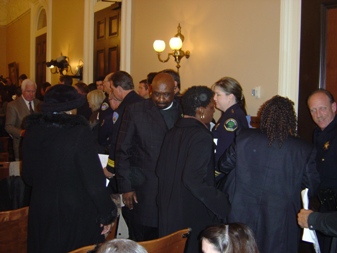
police and preacher present to oppose the Ammiano bill
But first came Ammiano himself, recusing himself from his position as committee chair to testify in favor of his bill. "This is landmark legislation to legalize and regulate marijuana," Ammiano told his colleagues. "It would generate nearly a billion dollars annually in revenues, according to the Board of Equalization, and would leave law enforcement to focus on serious crimes, violent crimes, and hard drugs. The drug wars have failed," the San Francisco solon said emphatically. "Prohibition has fostered anarchy. Legalization allows regulations, and regulation allows order." Since the primary hearing on the bill took place last fall, Tuesday's hearing was limited to 30 minutes (it was closer to 45), and witnesses either said their pieces succinctly or were gently chided by committee Vice-Chair Curt Hagman (R-Chino Hills). The Drug Policy Alliance's Gutwillig recapped testimony he gave last fall, as did the Marijuana Policy Project California state director Aaron Smith. "AB 390 is a historic reversal of failed marijuana policies," said Gutwillig. "It would begin to control a substance that is already commonly available and consumed, but unregulated. Prohibition has created enormous social costs and jeopardized public safety instead of enhancing it." "This legislation would finally put California on track for a sensible marijuana policy in line with the views of most California voters," said Smith. Also endorsing the bill was Matt Gray of Taxpayers for Improving Public Safety, a California group lobbying for more progressive criminal justice policies. "We support the bill," said Gray. "Marijuana is the state's largest cash crop, and this bill will remove a revenue stream from organized crime and decrease availability for youth." The opposition, led by law enforcement, church and community anti-drug groups, and a former deputy drug czar, threw everything short of the kitchen sink at the committee in a bid to sink the bill. Hoary old chestnuts reminiscent of "Reefer Madness" were revived, as well as new talking points designed to discourage members from voting for legalization.
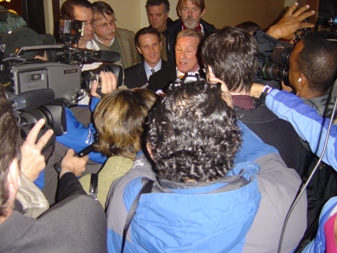
bill sponsor Assemblyman Tom Ammiano, with Dale Gieringer,
Stephen Gutwillig and Aaron Smith in background
"I traveled here with a heavy heart," said former deputy director for demand reduction for the Office of National Drug Control Policy Andrea Barthwell, the big hitter leading off for the opposition. "The eyes of America are upon you," she told the committee. "We don't want you to set a course that worsens the health of Americans for years to come. This is a scheme that will benefit drug cartel kingpins and corner drug dealers and create chaos in our public health system," she warned. "People all over the country are afraid California will have this leverage in the same way the medical marijuana initiative was leveraged to create a sense that these are reasonable policies," Barthwell continued. "We've reduced drinking and smoking through public health, and prohibition is working for our young people to keep them drug free," she added. "Legalization of marijuana will only increase the challenges facing us," said San Mateo Police Chief Susan Manheimer. "What good can come from making powerful addictive drugs more cheaply available? Don't we have enough trouble with the two legal drugs? Adding an additional intoxicant will lead to increase drugged driving and teen sex," she told the committee. "Marijuana of today is not the dope your parent's smoked," she added for good measure. After mentioning that in the Netherlands cannabis cafes have "run rampant," asserting that "drug cartels will become legal cultivators," and that legalization would bring about "quantum increases" in the availability of marijuana, Manheimer swung for the fence. "To balance the budget on the back of the harm caused by illegal intoxicants is mind-boggling—I would call it blood money," she said. Worse, "the addictive qualities of these drugs will cause more crimes as people struggle to find money to buy marijuana. We are very concerned about marijuana-related violence." Then it was the turn of Claude Cook, regional director of the National Narcotics Officers Associations Coalition. "This is dangerous work we do," Cook said by way of introduction. "We are strongly opposed to AB 390, we see no benefit for our communities. Marijuana is also carcinogenic. If we want to raise revenue, maybe it would be safer to just bring back cigarette vending machines. This is human misery for tax dollars." And by the way, "Drug offenders who are in prison have earned their way there by past criminal conduct," he added. Cook predicted downright disaster were the bill to pass. "Use by juveniles will increase. Organized crime will flourish. California will become a source nation for marijuana for the rest of the country. The cartels will thrive. Highway fatalities will rise," he said without explaining just how he arrived at those dire conclusions.
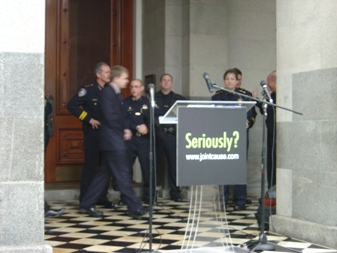
police waiting to speak at anti-drug rally after committee vote
"I see the devastation of marijuana and drugs in my community," thundered Bishop Ron Allen, "CEO and president" of the International Faith-based Coalition, and a self-described former crack addict who started with marijuana. "If marijuana is legalized and we have to deal with it in our liquor stores and communities, you have never seen a devastation like you're going to see. It's going to lose us a generation. You don't want this blood on your hands." "I'm going to discount the ad hominems and alarmist attacks," Ammiano replied after the testimony. "Some of the arguments today reminded me of Reefer Madness," he said Before moving to a vote, committee members briefly discussed their positions. Assemblywoman Nancy Skinner (D-Berkeley) noted that because of the state's medical marijuana law, "We have created a class difference, where a certain class of our population can utilize dispensaries for their own reasons to use marijuana, and on the other hand, we have the street activity around marijuana that is not under semi-legal status." Skinner voted for the bill, while saying she was not sure she would support it on the Assembly floor. "I'm not supporting marijuana, but the question is who we regulate it and is it time to have a serious debate." In the end, four of five Democratic committee members—all from the Bay area—supported the bill, while one Democrat joined the two Republicans on the committee in opposing it." The bill would normally head next to the Assembly Health Committee, but given the time constraints on the legislature, no further action is likely to be taken this session. Still, Tuesday was a historic day in Sacramento and in the annals of the American marijuana reform movement.
California Tax and Regulate Cannabis Initiative Suspends Signature Gathering--Because They Have Enough Already!

The Tax and Regulate Cannabis 2010 initiative, sponsored by Oakland medical marijuana entrepreneur Richard Lee, has laid off its paid signature gatherers, saying they already have sufficient signatures to qualify for the November 2010 ballot. Lee told the Chronicle this afternoon that more than 650,000 signatures have been turned in, and that he expects an additional 50,000 or so to dribble in in the coming weeks. Precisely 433,971 valid signatures of registered California voters are required for an initiative to be approved for the ballot. That leaves Lee and the initiative a substantial cushion of about a quarter-million signatures to make up for any invalid signatures. The campaign will wait to turn in signatures until January 15. If they were turned in this month, the initiative would appear on the June ballot, not the November ballot. Lee wants the initiative on the latter. Lee's initiative, which would allow individuals up to 25 square feet to grow their own and would allow counties and municipalities to opt to tax and regulate marijuana sales on a local basis, is controversial. Some national figures believe it is premature and risks going down in flames at the polls, thus setting the movement back, while some California activists believe it does not go far enough and does not entice voters with potential revenues for the crisis-ridden state budget. But it will be on the November 2010 ballot, provided the signatures are certified by election officials in February. It may not be the only legalization initiative on the ballot. At least two other signature-gathering campaigns for competing initiatives are under way.

The Staggering Incoherence of Drug Warrior Charles Grassley

Earlier this month, notorious drug war cheerleader Sen. Charles Grassley (R-IA) provoked outrage by attempting to censor debate about drug policy reform in Congress. He proposed an amendment that would literally ban a congressionally appointed expert panel from discussing legalization or decriminalization as part of a broad evaluation of criminal justice policies.

It's just a transparently pathetic strategy of defending the drug war status quo by outlawing meaningful debate and keeping alternatives off the table. Fortunately, just about everyone saw right through it. Pete Guither points out that Grassley is so cornered, he's now begging his constituents in Iowa to back him up on this. And the harder he tries to defend it, the weaker it sounds:

First and foremost, Congress ought to tackle issues whenever possible before bucking them to commissions. Increasingly, Congress is using commissions to avoid doing what Americans elect members to do: ask tough questions, identify possible answers, debate policy solutions and take a stand. [Des Moines Register]

Yeah, who needs experts when we've got politicians to make all our decisions for us?

This commission also would cost $14 million. It's hard to justify that expenditure in the current fiscal situation, especially when it's work that Congress should be doing itself.

Wait, so you can justify spending $50 billion a year on the war on drugs, but we can't justify $14 million to evaluate whether it makes any sense?

Finally, I put forward an amendment to address the issue of decriminalization and legalization of any controlled substance. I filed this amendment in an effort to start a debate on this important issue.


Really, Chuck? Really? How exactly does banning discussion of something promote debate? Everything, from the language of Grassley's amendment to his rich history of ignorant pro-drug-war posturing, proves what a total lie that is. The very essence of this controversy is that he blatantly attempted to prevent experts from looking into the issues he doesn’t want to talk about. Clearly, Grassley greatly underestimated the growing public demand for a new dialogue about our drug policies and got burned by his own arrogance, to such an extent that he is now hilariously masquerading as the champion of that critical discussion.  

The obvious bottom line here is that Grassley is consumed by his fear about what the experts will say. That is just implicit in all of this. If he wasn't deeply afraid of their conclusions, he wouldn’t be introducing amendments telling them what conclusions not to reach.  

The commission hasn’t even been appointed yet, so the very notion that it will become a referendum on the urgent need for sweeping reforms to our drug policy is purely a product of his paranoid imagination (combined perhaps with a subconscious recognition that the drug war is a gaping suckhole and smart people aren't exactly in love with it anymore). If Congress had named an expert panel consisting of Ethan Nadelmann, Rob Kampia, Jacob Sullum, Paul Armentano, Micah Daigle, Norm Stamper, Pete Guither and Willie Nelson, then maybe Charles Grassley could be forgiven for tearing from D.C. to Des Moines on horseback, flailing a dinner bell over his head and screaming that the legalizers are coming.  

Until that happens, the drug war pep squad would be well advised to just pipe down for the time being, lest their suggestions that we not discuss certain things should lead to yet more discussion of the things they don’t want discussed.

Update: Turns out Grassley's piece was a response to this Op-ed by Marni Steadham of University of Iowa SSDP. More coverage here.

The Debate Rages On (And We're Winning it)

CBS is hosting an excellent point-counterpoint discussion about legalizing marijuana, featuring Judge James Gray of LEAP and David Evans of the Drug Free America Foundation. You rarely get to see the debate unfold in this much detail, so it's a very illuminating dialogue, even though Evans has thus far failed to actually address Gray's main arguments. Judge Gray just laid down the law in his last entry, so we'll find out tomorrow if Evans has anything left.

On a side note, my attention was immediately drawn to the pictures of Gray and Evans that appear at the top of the page. Judge Gray appears in full color, while Evans is in black & white. This struck me as the perfect metaphor for the debate that follows.

Outrage: Drug Warrior Congressman Tries to Prohibit Discussion of Legalization

Sen. Jim Webb (D-VA) has introduced legislation calling for a thorough evaluation of the U.S. criminal justice system, namely for the purpose of exploring ways to reduce our world-record prison population. As you might guess, simply discussing whether we should keep millions of American behind bars is enough to terrify the drug war's most committed champions.

They can’t handle the tough questions, so they're trying to make it illegal to even ask. Drug war hall-of-famer Sen. Charles Grassley (R-IA) today introduced an amendment to Webb's bill that would literally prohibit the commission from talking about legalization or even decriminalization:

AMENDMENT intended to be proposed by Mr. GRASSLEY
….
SEC. ll. RESTRICTIONS ON AUTHORITY.
The Commission shall have no authority to make findings related to current Federal, State, and local criminal justice policies and practices or reform recommendations that involve, support, or otherwise discuss the decriminalization of any offense under the Controlled Substances Act or the legalization of any controlled substance listed under the Controlled Substances Act.


These words are a legal blueprint for silencing all criticism of the war on drugs before the experts even get a chance to discuss it. The whole thing flagrantly violates the spirit of the entire inquiry and renders meaningless everything Webb is trying to do. And yes, that's exactly the point.

No one has done more than Charles Grassley to make the drug war into the horrible mess that it's become, so you can bet he'll do anything to protect his shameful legacy. If he succeeds, the bill will almost certainly end up protecting bad policies instead of exposing them. We can’t let that happen. Click here to tell your Senators to oppose this misguided amendment and let the experts do their job without political interference.

A serious evaluation of criminal justice and drug policies is long overdue and that effort means nothing unless all options are debated openly.

Marijuana Debate! Former Judge vs. Several Complete Idiots


The debate over legalization is heating up in California, and from the looks of things, the two sides aren’t even speaking the same language. Here's Judge James Gray speaking from experience about the advantages of regulating marijuana:


And here's the best response the opposition could put together:


Stay tuned, folks. There will be plenty more stupid crap where that came from, I assure you. But if those tired old clichés were worth anything anymore, legalization wouldn’t be on the tip of every tongue in California and beyond.

This conversation is an inherent victory for us, while our opposition's response is just another embarrassment for them.

A Historic Hearing on Marijuana Legalization in Sacramento Today

Wednesday was a historic day at the California state capitol. For the first time since the state banned marijuana in 1913, marijuana legalization was the topic of a hearing in the state legislature. The hearing was organized by Assemblyman Tom Ammiano (D-San Francisco), head of the Assembly's Public Safety Committee, to discuss his marijuana legalization bill, AB 390. For three hours, proponents and opponents of reform clashed before an overflowing hearing room--the hearing was so popular capitol employees had to add a monitor in the hallway for those who couldn't get into the session. Both supporters and foes of legalization were well represented, and they mostly followed their predictable scripts. To this observer, law enforcement's dire warnings and objections sounded increasingly threadbare and shopworn and the arguments of legalizers especially compelling, but then, I agree with the legalizers. I think what is important about Wednesday's hearing is not so much what was said--we've heard it all before, on both sides--as where it was said and in what context. Just a few days ago, they were talking legalization at the statehouse in Boston; now, they're doing it at the statehouse in Sacramento. Nobody expects the California bill to pass this year, but the fact that legalization is finally getting a serious hearing is a sign of progress. I'll be reporting on the hearing and the preceding press conference in more detail later this week for the Drug War Chronicle. Check out the article on Friday.

John Stossel & Bill O'Reilly Debate Drug Legalization

Stossel just took a job over at FOX News and if that means we'll be seeing more of this, I'm all for it (the good stuff starts at 2:25):


All it takes is a few words from Stossel to send O'Reilly (who's been known to vaguely support medical marijuana) into a rambling tailspin about how legalizing medical marijuana causes heroin addicts to sell it to children. Yeah, that's pretty much what we've learned to expect from him, but as much as O'Reilly makes me sick, I think he epitomizes the sort of pure drug war lunacy that's done so much to alienate the public.

Apparently, the producers at FOX see it too, which would help to explain why they've brought Stossel in on the conversation.