
ONDCP

ONDCP Staffer Makes Threatening Phone Call to SSDP Office

Mere hours after SSDP's Tom Angell posted this amusing letter from ONDCP noting that the agency will respond to his FOIA request in 200 years, ONDCP's Assistant General Counsel Daniel R. Peterson called SSDP's office to voice his objections.

Peterson, the author of this ironic typo, accused Tom of being childish and threatened to respond with similar tactics. Incredulous, Tom replied "so does that mean you guys are going to start mentioning us in your blog?" Peterson declined.

Now I've got to admit to some sympathy for the other side here. This was a simple mistake, the severity of which pales in comparison to numerous things ONDCP does deliberately. Tom has previously humiliated the federal government with FOIA requests, so the idea of scrupulously drafting responses to perceived harassment from him must surely frustrate and distract these busy bureaucrats from their book-cooking.

Unfortunately for ONDCP, the unintentional irony of the error makes for good fun in the blogosphere. Stalling, you see, has become a trademark of the federal drug war; a necessary tactic whenever facts come in conflict with the status quo. We've seen this with regards to ASA's Data Quality Act lawsuit, MAPS's marijuana research lawsuit, sentencing reform, needle exchange and marijuana rescheduling. Heck the entire federal drug war is really just a few agencies constantly stalling in the hopes that we'll eventually stop asking so many questions and learn to live with false promises and fake progress.

So when Daniel Peterson tells SSDP that he'll respond to their FOIA appeal in 200 years, it's a perfect Freudian slip. Once again, ONDCP's most truthful and candid remarks occur entirely by accident.

ONDCP: We Don't Care What You Dorks on YouTube Think

A Seattle Post-Intelligencer story about political messages on YouTube.com contains this delightful quote from ONDCP:
The White House Office of National Drug Control Policy said it expects its YouTube messages to be ridiculed, laughed at, remade and spoofed. And they are.

The irony here is that, predictable as it may have been, ONDCP had no clue that this was going to happen. They deliberately generated media coverage of their YouTube page, only to find their videos marred by harsh comments and dismal viewer ratings. ONDCP quickly disabled these options, but the damage was done.

If they had genuinely anticipated this level of hostility from viewers, they would have optimized their page before sending out press releases about it. Because they did not, most ONDCP videos are now permanently stamped with the lowest-possible rating of one star.

This is to say nothing of the countless parodies that are now drowning out ONDCP’s unpopular propaganda. Since YouTube automatically recommends similar videos anytime you watch something, viewers of ONDCP’s materials are unavoidably connected to these abundant counter-messages. It is almost certainly for this reason that ONDCP has not uploaded a single new video since the page was first launched back in September 2006.

In a case like this, the mature decision would be to ignore them. But I find it amusing that even something as perfectly logical as expecting ridicule on YouTube turns out to be a lie when it comes from ONDCP.

David in the Liar's Den

Ever wonder what it's like to watch a drug warrior squirm? I've had the pleasure a few times now, but the discussion I witnessed this afternoon at the Cato Institute was particularly intense.

Today, Matthew B. Robinson and Renee G. Sherlen presented the findings of their new book Lies, Damned Lies, and Drug War Statistics: A Critical Analysis of Claims Made by the Office of National Drug Control Policy. Impressively, ONDCP's brave "Chief Scientist" David Murray was on hand to address this particularly comprehensive attack on the credibility of his office.

The authors delivered a tight synopsis of their findings, bashing ONDCP propaganda with charts, graphs, and effects. Dr. Murray made a show of feigned surprise and eye-rolling, but the breadth and substance of the criticism leveled against his work was too substantial to shrug off. It almost felt like a set-up; the dignified Cato equivalent of strapping a mob snitch to a chair and beating him with a blackjack.

In turn, Dr. Murray spat blood on his tormentors, dismissing their analysis as biased and incompetent. Unlike his disciplined performance at last year's medical marijuana debate, Murray was irreverent and visibly angry. From my second row seat I could see his face turn crimson, but his voice never shook. Murray's composure and efficiency is the reason he makes these appearances instead of his boss.

The question of the day among my colleagues was why ONDCP would even respond to such a categorical refutation of its right to exist. As a young reformer, I learned from Eric Sterling that drug warriors typically avoid debate because doing so inherently legitimizes opposing viewpoints. Moreover, the discussion of statistics paints ONDCP into a particularly dark corner by rendering irrelevant the emotional appeals and factually-vacant soundbites that generally dominate their rhetoric.

This level of engagement between ONDCP and its critics is rare if not unprecedented. Hostile as it may have been, today's conversation demonstrates that the federal government no longer perceives itself as impervious to criticism. Murray praised the Cato Institute's work in other areas and was clearly exasperated to find himself in its crosshairs. ONDCP's crumbling monopoly on serious drug policy discussion becomes increasingly vivid when calls for accountability emerge from prestigious think-tanks, Congress, and the GAO.

As the old cliche goes, "First they laugh at you. Then they ignore you. Then they fight you. Then you win." They're fighting back now.

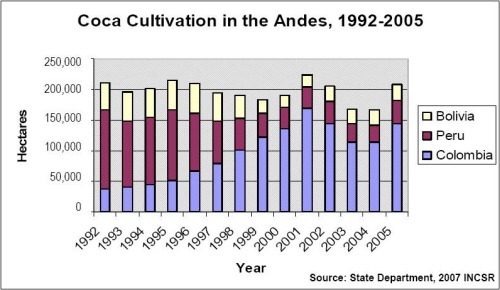
Ponder This Graph for a Moment, Please

graph from WOLA and AIN (graph from WOLA/AIN memo, link below)
This graph shows what about $10 billion in US taxpayer dollars has accomplished. Note that while coca production has shifted within the region, the 1992 levels and the 2005 levels are essentially identical. Why is our coca eradication policy not subjected to cost-benefit analysis? Is there anyone who will argue that it is working? If so, I'd like to hear it. To be fair, that $10 billion has accomplished some things. It has engendered massive social conflict in all three countries, it has led to tens of thousands of peasant farmers being arrested as drug traffickers, it has led to thousands of deaths (especially in Colombia, where the eradication policy is part of the US's broader military intervention in that country's festering civil war). Your tax dollars at work. $10 billion is a lot of money. Heck, we could finance the Iraq war for a few weeks with it! Or we could give $100,000 college scholarships to 10,000 students. Or build $100,000 homes for 10,000 families. Or numerous other programs that, unlike the coca eradication program, might actually accomplish something. By the way, I came across the graph above in a memo from the Andean Information Network and the Washington Office on Latin America. That memo was occasioned by the US government's release of coca cultivation estimates for Bolivia. The US government has for months been complaining that Bolivian President Evo Morales' pro-coca policies were going to lead to a boom in production there. Surprise! It didn't. Read the memo for some juicy analysis.

This is Not Your Parents' Cocaine

From The Baltimore Sun:
The United States and its Latin American allies are losing a major battle in the war on drugs, according to indicators showing that cocaine prices dipped for most of 2006 and American users were getting more bang for their buck.
We've already covered this story, but it's beginning to generate broader coverage. Of course, no amount of negative publicity will silence our brave drug warriors even momentarily. Here's Karen Tandy just yesterday:
"Plan Colombia is working. The amount of land used for the cultivation of coca is at an historic low in Colombia," the head of the US Drug Enforcement Administration, Karen Tandy, told a drug law enforcement conference in Madrid. [AFP]

So why does Washington cover up increased cocaine potency, while aggressively trumpeting increased marijuana potency? The answer is simple, although if you asked the drug czar, he'd turn purple and pretend not to understand what you mean.

In the case of cocaine, the federal government has long identified reducing purity and increasing price as the primary goals of our ridiculously expensive and ongoing South American drug war investments. Increased cocaine potency in 2007 raises serious doubts about the efficacy of the brutal jungle wars we've been bankrolling for 10 years.

In the case of marijuana, however, the government's primary interest is in convincing an experienced public that this isn’t the same drug that has so consistently failed to hurt anyone. Jacob Sullum puts it best:

These warnings have to be understood mainly as a rationalization for the hypocrisy of parents (and politicians) who smoked pot in their youth and thought it was no big deal then but feel a need to explain why it is a big deal now.
Of course, while drug war demagogues are fond of comparing today's more potent marijuana to cocaine, there's really nothing to which they can compare today's stronger cocaine. I dunno, anthrax maybe? When I start hearing reports about weaponized nose-candy, I'm totally moving to Jupiter.

Reuters Admits Flawed Marijuana Reporting

Given ONDCP's ongoing claims of 20-30 fold increases in marijuana potency, yesterday's announcement that potency has merely doubled feels more like a concession than the latest drug war scare tactic. Yet thanks to lazy reporting, this lukewarm story became the next great threat to public safety.

From Associated Press:
The government estimates that 4.1 million Americans use marijuana. Use by teenagers has declined recently, but federal officials worry that marijuana is being cited more often in emergency room visits.
From Reuters:
The marijuana being sold across the United States is stronger than ever, which could explain a growing number of medical emergencies that involve the drug, say government drug experts.

Neither story explained the concept of "emergency room mentions" from which these claims were derived. And these two reports were republished in major papers everywhere from Dallas to Sydney.

Importantly, people who mentioned marijuana to doctors weren't in most -- if any -- cases directly injured by it. Upon admission to the emergency room, you're instructed to report any drugs in your system in case they could interfere with your treatment (and it's really not marijuana they're worried about). Patients who mention marijuana include everyone from heroin users to gunshot victims to various people who fell and couldn't get up.

Marijuana is growing in popularity as a medicine, which could also help explain why sick people report having used it.

Fortunately, thanks to incredulous readers, Reuters was forced to clarify:

Lots and lots of readers asked for examples of these emergencies. We updated the story with an explanation which should have been made clear from the start, that medical emergency "means that the patient mentioned using marijuana and does not mean the drug directly caused the accident or condition being treated."

Is it any wonder that readers were confused? Statements such as "marijuana is being cited more often in emergency room visits" or "a growing number of medical emergencies that involve the drug" clearly imply that marijuana caused or contributed to the patient's hospitalization. That was ONDCP's intention, passed along uncritically by Reuters and AP with the inevitable effect of confusing the public.*

Like many things you read in an ONDCP press release, the statement on emergency room visits was so misleading that it becomes false if you change any of the words. "Mentioned" is simply not the same as "involved." Thus the media reports became more misleading than the press release they were based on, which was pretty bad to begin with.

Even when properly explained, "emergency room mentions" remain a vague and ultimately unhelpful measure upon which to base alarmist claims. ONDCP's reliance on such tenuous, circumstantial evidence speaks to the credibility of their position on marijuana policy in general.

*Reuters made a partial correction, but AP has not. Contact them here.

Review of Lies, Damned Lies and Drug War Statistics by Matt B. Robinson and Renee G. Scherlen (SUNY Press, 2007).

(Click here to read about DRCNet's book offer for members.) Reviewed by Randall G. Shelden, UNLV Looking back on my career and what I have learned there is a rather consistent theme in my thinking and writing about the subject of crime and justice. It might go something like this: we have a system in place that has a vested interest in keeping crime (including drug use) at a certain level. All sorts of careers and a lot of money (literally tens of billions of dollars each year) are dependent upon a steady supply of offenders - even if they have to pass new laws creating new categories of offenders (this especially applies to drugs). This is why many have used such terms like "crime control industry" or "criminal justice industrial complex." Agencies within this complex can sort of "have their cake and eat it too" in that they can have it both ways: when what they do is clearly failing they can merely claim that the problem still exists and they need to continuing doing the same thing (with more money of course). Obviously when things are going well they can take responsibility. This is the pattern with local police departments and in fact the entire system, namely that when crime is down they take credit because of some program in place; however, when crime goes up, they can shift responsibility to all sorts of variables. Favorites include a growing population in their jurisdiction (which is not usually that relevant), a growing youth or "crime risk" population (again, not that critical), "broken" or "dysfunctional" families and, two of my favorites, "outside influences" (e.g., gangs moving) or "liberal programs." Another way of putting this is that, as Jeff Reiman has observed, nothing succeeds like failure! A friend once told me something he learned when studying for his MBA. It is called "optimal starting and stopping points." What this means is that in order to bolster your argument or to make a case that what you are doing is working you pick out a time period that best represents your success and avoid time periods that do not. So it has been with the Office of National Drug Control Policy (ONDCP) and Matt Robinson and Renee Scherlen do an exceptional job of showing exactly this in Damned Lies and Drug War Statistics. They do this by critically examining six years (2000-2006) of the National Drug Control Strategy. They read through each and every annual report, looking especially for both accurate and inaccurate use of statistics and evidence of honesty and dishonesty in each report. They examined each and every claim made by ONDCP and evaluated ONDCP's stated goals (e.g., reducing drug use and drug availability). What they found for each year, almost without exception, was an almost total misuse of some very simple statistics (e.g., from various annual drug surveys, such as NHSDA, ADAM, MTF). They discovered that in many instances ONDCP employed the "optimal starting and stopping points." For instance, Robinson and Scherlen found that for the 2000 strategy report ONDCP uses a baseline of 1985 that shows a decline in drug use from that year to 1999. Yet the ONDCP was not started until 1988 and the largest drop in drug use was between 1985 and 1988, with the rate remaining steady for the rest of the decade. Other reports use 1979 as a starting point (the peak of drug use). On another occasion the ONDCP claims to prove that George Bush's goal during his 2002 "State of the Union speech of a 10% reduction of drug use by youth within two years was met, but uses a time period that started one year prior to Bush's speech! The authors also found numerous instances where they cite declines in youth drug use during a certain period, but ignore the fact that drug use was increasing among adults. In some cases the ONDCP reproduces a chart that clearly shows drug use increasing, but fail to comment on this rather obvious evidence of failure. On the other hand, on some occasions the ONDCP readily admits "disturbing trends" such as the fact that throughout the decade of the 1990s drug use among 8th, 10th and 12th graders (Monitoring the Future) is "close to record highs." Yet in this case, the ONDCP sort of ignores such an obvious failure and instead uses this as evidence of a need to get tougher in the war on drugs! Nothing succeeds like failure! Robinson and Scherlen note that ONDCP tends to "celebrate declines even when they are short-term or occurred a decade ago, and downplay increases unless they are being used to create alarm" (p. 66). More examples like this are presented throughout this book. Perhaps more importantly, even when there are some decreases in drug use, ONDCP fails to provide any evidence that this is because of what they did. Moreover, like I said above concerning police departments, Robinson and Scherlen note that "ONDCP only takes credit when drug use trends decline, but takes no responsibility when drug use trends increase" (p. 68). One of the most important chapters in this book is chapters 5 and 6 where they examine ONDCP's claims of success in "healing America's drug users and disrupting drug markets" and claims concerning the costs of the drug war. In these two chapters Robinson and Scherlen also critically examine ONDCP claims about the nature of the drug problem itself. First, ONDCP fails to differentiate between drug use and drug abuse and instead claims that "Drug use promises one thing but delivers something else – something sad and debilitating for users, their families, and their communities. The deception can be masked for some time, and it is during this time that the habit is 'carried' by users to other vulnerable young people." This is an outlandish claim totally lacking empirical foundation. As Robinson and Scherlen correctly note, drug use does not lead to such outcomes and in fact the majority of youths who use drugs do so only a few times and quit completely in their early 20s (p. 96). Such a conclusion is a general consensus by drug experts – obviously a group ONDCP fails to consult! ONDCP also claims that drug testing is effective, yet can cite only anecdotal evidence (such as a statement by one woman based upon a one conversation with a grocery bagger – see p. 102) and ignore comprehensive studies that find that it clearly does not work (e.g., as cited on the Monitoring the Future web site). This is called "confirmation bias" – selecting evidence that supports your position while ignoring contrary evidence. The ONDCP clearly has failed to disrupt drug markets and there has been a steady decline in the price of illegal drugs, as Robinson and Scherlen clearly show with charts taken from ONDCP's report. Yes, you read this correctly: ONDCP reproduces charts that show prices falling yet fail to make any statement that suggests that their goal of raising prices by disrupting drug markets is not working! This is one of the best points about the Robinson and Scherlen book in that they use readily available data – some reproduced by ONDCP – which clearly contradict ONDCP's claims! Robinson and Scherlen also examined claims about the costs of drugs and the drug war. Once again, they demonstrate that ONDCP misuses statistics. Here the authors show that the bulk of the costs of drugs stems from the drug war itself and the fact that some drugs have been criminalized. I could go on and on with more examples. Suffice it to say that Robinson and Scherlen have provided a thorough critique of the claims made by those in charge of the drug war. This book will no doubt prove to be a valuable resource for those trying to make sense of a war that has created so much havoc within our society. Incidentally, the first two chapters provide the reader with an excellent overview on the how the drug war came to be, including a brief history of anti-drug legislation. For those not familiar with this history, these chapters will provide much needed information to fill this gap. Read it, learn from it, use it. Randall G. Shelden is Professor of Criminal Justice, University of Nevada-Las Vegas, where he has been a faculty member since 1977. He is the author or co-author of several books, including Girls, Delinquency and Juvenile Justice (3rd edition), with Meda Chesney-Lind (which received the Hindelang Award for outstanding contribution to Criminology in 1992); Youth Gangs in American Society (3rd ed.), with Sharon Tracy and William B. Brown (both with Wadsworth); Controlling the Dangerous Classes: A History of Criminal Justice (2nd forthcoming, Allyn and Bacon); Criminal Justice in America: A Critical View, with William B. Brown (a revised edition of this book is forthcoming with Waveland Press). His most recent book is Delinquency and Juvenile Justice in American Society (Waveland Press). His web site is: www.sheldensays.com. (Click here to read about DRCNet's book offer for members.)
Review of Lies, Damned Lies and Drug War Statistics by Matt B. Robinson and Renee G. Scherlen (SUNY Press, 2007).

(Click here to read about DRCNet's book offer for members.) Reviewed by Randall G. Shelden, UNLV Looking back on my career and what I have learned there is a rather consistent theme in my thinking and writing about the subject of crime and justice. It might go something like this: we have a system in place that has a vested interest in keeping crime (including drug use) at a certain level. All sorts of careers and a lot of money (literally tens of billions of dollars each year) are dependent upon a steady supply of offenders - even if they have to pass new laws creating new categories of offenders (this especially applies to drugs). This is why many have used such terms like "crime control industry" or "criminal justice industrial complex." Agencies within this complex can sort of "have their cake and eat it too" in that they can have it both ways: when what they do is clearly failing they can merely claim that the problem still exists and they need to continuing doing the same thing (with more money of course). Obviously when things are going well they can take responsibility. This is the pattern with local police departments and in fact the entire system, namely that when crime is down they take credit because of some program in place; however, when crime goes up, they can shift responsibility to all sorts of variables. Favorites include a growing population in their jurisdiction (which is not usually that relevant), a growing youth or "crime risk" population (again, not that critical), "broken" or "dysfunctional" families and, two of my favorites, "outside influences" (e.g., gangs moving) or "liberal programs." Another way of putting this is that, as Jeff Reiman has observed, nothing succeeds like failure! A friend once told me something he learned when studying for his MBA. It is called "optimal starting and stopping points." What this means is that in order to bolster your argument or to make a case that what you are doing is working you pick out a time period that best represents your success and avoid time periods that do not. So it has been with the Office of National Drug Control Policy (ONDCP) and Matt Robinson and Renee Scherlen do an exceptional job of showing exactly this in Damned Lies and Drug War Statistics. They do this by critically examining six years (2000-2006) of the National Drug Control Strategy. They read through each and every annual report, looking especially for both accurate and inaccurate use of statistics and evidence of honesty and dishonesty in each report. They examined each and every claim made by ONDCP and evaluated ONDCP's stated goals (e.g., reducing drug use and drug availability). What they found for each year, almost without exception, was an almost total misuse of some very simple statistics (e.g., from various annual drug surveys, such as NHSDA, ADAM, MTF). They discovered that in many instances ONDCP employed the "optimal starting and stopping points." For instance, Robinson and Scherlen found that for the 2000 strategy report ONDCP uses a baseline of 1985 that shows a decline in drug use from that year to 1999. Yet the ONDCP was not started until 1988 and the largest drop in drug use was between 1985 and 1988, with the rate remaining steady for the rest of the decade. Other reports use 1979 as a starting point (the peak of drug use). On another occasion the ONDCP claims to prove that George Bush's goal during his 2002 "State of the Union speech of a 10% reduction of drug use by youth within two years was met, but uses a time period that started one year prior to Bush's speech! The authors also found numerous instances where they cite declines in youth drug use during a certain period, but ignore the fact that drug use was increasing among adults. In some cases the ONDCP reproduces a chart that clearly shows drug use increasing, but fail to comment on this rather obvious evidence of failure. On the other hand, on some occasions the ONDCP readily admits "disturbing trends" such as the fact that throughout the decade of the 1990s drug use among 8th, 10th and 12th graders (Monitoring the Future) is "close to record highs." Yet in this case, the ONDCP sort of ignores such an obvious failure and instead uses this as evidence of a need to get tougher in the war on drugs! Nothing succeeds like failure! Robinson and Scherlen note that ONDCP tends to "celebrate declines even when they are short-term or occurred a decade ago, and downplay increases unless they are being used to create alarm" (p. 66). More examples like this are presented throughout this book. Perhaps more importantly, even when there are some decreases in drug use, ONDCP fails to provide any evidence that this is because of what they did. Moreover, like I said above concerning police departments, Robinson and Scherlen note that "ONDCP only takes credit when drug use trends decline, but takes no responsibility when drug use trends increase" (p. 68). One of the most important chapters in this book is chapters 5 and 6 where they examine ONDCP's claims of success in "healing America's drug users and disrupting drug markets" and claims concerning the costs of the drug war. In these two chapters Robinson and Scherlen also critically examine ONDCP claims about the nature of the drug problem itself. First, ONDCP fails to differentiate between drug use and drug abuse and instead claims that "Drug use promises one thing but delivers something else – something sad and debilitating for users, their families, and their communities. The deception can be masked for some time, and it is during this time that the habit is 'carried' by users to other vulnerable young people." This is an outlandish claim totally lacking empirical foundation. As Robinson and Scherlen correctly note, drug use does not lead to such outcomes and in fact the majority of youths who use drugs do so only a few times and quit completely in their early 20s (p. 96). Such a conclusion is a general consensus by drug experts – obviously a group ONDCP fails to consult! ONDCP also claims that drug testing is effective, yet can cite only anecdotal evidence (such as a statement by one woman based upon a one conversation with a grocery bagger – see p. 102) and ignore comprehensive studies that find that it clearly does not work (e.g., as cited on the Monitoring the Future web site). This is called "confirmation bias" – selecting evidence that supports your position while ignoring contrary evidence. The ONDCP clearly has failed to disrupt drug markets and there has been a steady decline in the price of illegal drugs, as Robinson and Scherlen clearly show with charts taken from ONDCP's report. Yes, you read this correctly: ONDCP reproduces charts that show prices falling yet fail to make any statement that suggests that their goal of raising prices by disrupting drug markets is not working! This is one of the best points about the Robinson and Scherlen book in that they use readily available data – some reproduced by ONDCP – which clearly contradict ONDCP's claims! Robinson and Scherlen also examined claims about the costs of drugs and the drug war. Once again, they demonstrate that ONDCP misuses statistics. Here the authors show that the bulk of the costs of drugs stems from the drug war itself and the fact that some drugs have been criminalized. I could go on and on with more examples. Suffice it to say that Robinson and Scherlen have provided a thorough critique of the claims made by those in charge of the drug war. This book will no doubt prove to be a valuable resource for those trying to make sense of a war that has created so much havoc within our society. Incidentally, the first two chapters provide the reader with an excellent overview on the how the drug war came to be, including a brief history of anti-drug legislation. For those not familiar with this history, these chapters will provide much needed information to fill this gap. Read it, learn from it, use it. Randall G. Shelden is Professor of Criminal Justice, University of Nevada-Las Vegas, where he has been a faculty member since 1977. He is the author or co-author of several books, including Girls, Delinquency and Juvenile Justice (3rd edition), with Meda Chesney-Lind (which received the Hindelang Award for outstanding contribution to Criminology in 1992); Youth Gangs in American Society (3rd ed.), with Sharon Tracy and William B. Brown (both with Wadsworth); Controlling the Dangerous Classes: A History of Criminal Justice (2nd forthcoming, Allyn and Bacon); Criminal Justice in America: A Critical View, with William B. Brown (a revised edition of this book is forthcoming with Waveland Press). His most recent book is Delinquency and Juvenile Justice in American Society (Waveland Press). His web site is: www.sheldensays.com. (Click here to read about DRCNet's book offer for members.)