State & Local Executive Branches

New Mexico Medical Marijuana Update -- Richardson Says Full Steam Ahead Despite Attorney General's "Prank"

Late Thursday night we reported in the Chronicle that New Mexico's Dept. of Health had balked at supplying medical marijuana to patients following a warning from state Attorney General Gary King that he wouldn't defend state workers if the feds prosecuted them. Gov. Richardson, who is running for president in the Democratic primary, has ordered the Health Dept. to comply with the law, and has urged President Bush to stop the medical marijuana prosecutions. I'm not surprised by Richardson's stance, given how hard he fought to rescue the bill last spring when its demise had already been pronounced. Looking at the text of the law, I really have to say I think King is full of it. The law does not tell the Health Dept. to have its own employees grow or distribute marijuana; it tells the department to license people to grow it. Then those licensees will be taking their chances with the feds, for their own individual reasons. But that's not the same thing as state employees being subject to federal prosecution themselves. There have certainly been federal raids of medical marijuana providers in states that have licensed them, but not of the state agencies who have issued them licenses to protect them from state prosecution. Good for Bill Richardson, shame on Gary King, did he really think he could put that one over?

I'm as angry as I've been in a long time over this one...

This one has me as angry as I've been in a long time. Tampa Bay, Florida, area resident Mark O'Hara served two years of a 25-year mandatory minimum sentence for 58 Vicodin pills. (Vicodin is an opiate pain reliever.) Sound like an extreme sentence for such a small amount, even if it was trafficking as the charges read? But there's more. O'Hara had a prescription for the pills. He's a pain patient. His doctor confirmed that he had prescribed the Vicodin to O'Hara and that he had been treating O'Hara for years. But prosecutors moved against him, and -- astonishingly -- argued to the judge that the jury shouldn't be informed that O'Hara had a prescription for the Vicodin, because there's no "prescription defense." And the judge -- doubly astonishingly -- actually bought it. Never mind the fact that the drug law O'Hara was charged with violating specifically exempts people who have a prescription. The appellate judges who threw out his conviction used words like "ridiculous" and "absurd" to describe it. Sickeningly, prosecutors have yet to say that O'Hara is off the hook and won't be taken to trial again. I think we need to organize on this one and press the system to do justice to the prosecutors and judge for the terrible atrocity they committed against Mark O'Hara. Knowingly imprisoning an innocent person is the functional equivalent of kidnapping. It should be treated as such. Prosecutors Mark Ober and Darrell Dirks should be in chains; their continued status as individuals holding power in the criminal justice system poses a threat to the safety of all Americans. The judge who enabled the kidnapping, Ronald Ficarrotta, may only be completely incompetent, but I'm not sure he should get that benefit of the doubt. Read more at Reason.

Giuliani's Cocaine Connection

This post is a little more sympathetic than the title might seem to suggest. One of the big news stories today was the indictment of Rudy Giuliani's now-former South Carolina campaign chairman Thomas Ravenel, the state's now-suspended Treasurer, on federal cocaine distribution charges. Drug policy academic Mark Kleiman points out that Ravenel does not appear to have been a drug dealer:
The other guy indicted in the case seems to be the dealer. Ravenel seems to have been one of his customers, who bought cocaine in quantity to share with friends. Under federal law, there's no crime of selling drugs; the crime is "distribution," which includes giving the stuff away.
(Talking Points Memo, linking to Kleiman, observes that Ravenel would have been buying for "what was probably going to be a pretty big bash".) Ravenel should be considered innocent until proven guilty, of course, and Kleiman points out what I think is a pretty good reason why:
The most likely scenario here: The state cops nailed the dealer (he was already in custody on state charges when the indictment was handed up yesterday), and the dealer gave them a prominent customer in order to buy himself some consideration at sentencing time.
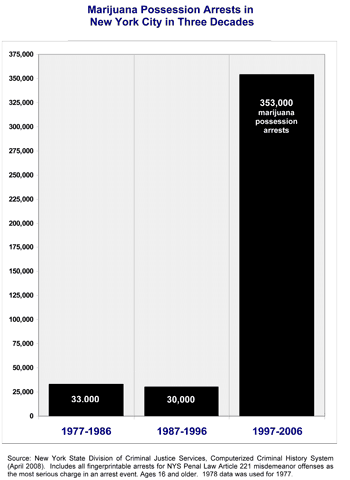
As a legalizer, I have to have some sympathy for anyone caught up in the drug war's headlights. Still, Ravenel was a political official at the highest levels in a state that has some real "tough on drugs" policies in place. Unless he was actively involved in working for serious drug policy reform -- and I'm not aware that he was -- and assuming the accusations made against him are accurate, there's a hypocrisy angle here. Furthermore, the candidate he was involved in trying to elect as president, Rudy Giuliani, is a drug warrior who increased arrests in New York when he was mayor, who tried to shut down methadone maintenance in the city, and who opposes needle exchange and medical marijuana. It's especially hypocritical for a drug user to chair a state campaign for a drug warrior trying to be president, who would presumably continue to be a drug warrior if elected president. Then again, maybe Ravenel intended to quietly lobby Giuliani to shift his views/policies on drugs. I tend to doubt it, but I don't know the guy so I can't say for sure. As for Giuliani, did he have no idea about his friend's (alleged) drug proclivities, or no one who could inform him about them? I've heard from a knowledgeable source that when Giuliani was the US Attorney in New York, the safest place to sell drugs was in front of City Hall. Bottom line: If you're a top-level state official, it's probably not a good idea to organize all-out (all night?) cocaine fests. But if you are in the habit of organizing cocaine fests, speak out against the war on drugs too, so at least people won't think you're a hypocrite if you get caught. Actually, speak out against the drug war in any case.

Latest Entry in the Annals of Excess Department

This is not directly drug war related, but this is such an asinine abuse of both police and prosecutorial power that I thought I needed to share it. Alright, here's the tale in a nutshell: Kid riding in pick-up that gets pulled over, kid videotapes cop during encounter (just as cop-car camera videotapes the pick-up), cops seizes camera, arrests kid, cop consults with prosecutor, then charges kid with felony wiretapping, punishable by up to seven years in prison. To stupidly repressive to be true? Here it is: Video Recording Leads to Felony Charge:
Brian D. Kelly didn't think he was doing anything illegal when he used his videocamera to record a Carlisle police officer during a traffic stop. Making movies is one of his hobbies, he said, and the stop was just another interesting event to film. Now he's worried about going to prison or being burdened with a criminal record. Kelly, 18, of Carlisle, was arrested on a felony wiretapping charge, with a penalty of up to 7 years in state prison. His camera and film were seized by police during the May 24 stop, he said, and he spent 26 hours in Cumberland County Prison until his mother posted her house as security for his $2,500 bail. Kelly is charged under a state law that bars the intentional interception or recording of anyone's oral conversation without their consent. The criminal case relates to the sound, not the pictures, that his camera picked up.
Yes, that's right. Apparently, operating a video camera is a crime in Pennsylvania. Who knew? I'm not aware of mass busts of video camera operators at weddings, in parks, at concerts, at family reunions, or any of the thousand and one other places they are commonly used. I haven't seen the Pennsyvlania cops rounding up media camera operators, either, come to think of it. Oh, and the police have an exemption. They can videotape you, but you can't videotape them. Funny how that works.

What the heck is going on in Licking County, Ohio?

There's something funny going on in Licking County, Ohio. According to the local newspaper's courthouse roundup, a bunch of people were charged with drug trafficking, but the charges don't seem to match the facts. Let me show you what I mean:
• Ti C. Warner, 27, last known address 381 N. Executive Drive, Newark, was charged with aggravated trafficking in drugs, a second-degree felony. The charge also carries a specification of selling drugs near a school. Between March 29 and 30, Warner allegedly was observed by Central Ohio Drug Enforcement Task Force buying a total of about seven grams of methamphetamine on two occasions, according to court reports. Both purchases were allegedly made in the vicinity of a Newark City school, according to court reports. Branstool set Warner’s bond at $40,000. • Sherry L. Runyon, 46, last known address 16328 Pleasant Hills, Newark, was charged with trafficking in crack cocaine, a fifth degree felony. On April 11, she allegedly was observed by Central Ohio Drug Enforcement Task Force buying less than one gram of crack cocaine, according to court reports. Branstool set Runyon’s bond at $10,000. • Kevin L. Barker, 29, last known address 9215 Lancaster Road, Hebron, was charged with aggravated trafficking in drugs, a fourth-degree felony. On March 26, he allegedly was observed by Central Ohio Drug Enforcement Task Force buying 1.64 grams of methamphetamine, according to court reports. Branstool set Barker’s bond at $10,000.
Do you see what I mean? These are people who were apparently caught buying drugs. And they are charged with drug trafficking? I don't know who is responsible for these charging decisions—either the Central Ohio Drug Enforcement Task Force or local prosecutors—but they don't seem to be supported by the facts. And here's one more bizarre charging example from Licking County:
• Kelly L. Mihelarakis, 32, last known address 633 Mount Vernon Road, Newark, was charged with permitting drug abuse, a fifth-degree felony. Between March 29 and 30, Mihelarakis allegedly allowed an associate to buy about seven grams of methamphetamine on two occasions. Both alleged purchases were made in the vicinity of a Newark City school, according to court reports. Branstool set Mihelarakis’ bond at $5,000.
Excuse me!? "Permitting drug abuse"? This person is charging with not stopping someone else from buying speed? This is a crime? You have got to be kidding. Well, my hat is off to the Central Ohio Drug Enforcement Task Force and the Licking County criminal justice system. With their apparently unjustified charging decisions, they are certainly doing their part to ensure that Ohio's chronic prison overcrowding crisis continues.

Coordinated Drug War Raids as Taxpayer-Funded Lobbying

Peter Guither at the Drug WarRant blog has pointed out what he calls a "blatant and pathetic effort" by the State of Kentucky to secure drug war funding from Congress:
State police, local law enforcement, sheriff's offices, HIDTA and multi-jurisdictional drug task forces throughout the nation collectively conducted undercover investigations, search warrants, consent searches, marijuana eradication efforts, drug interdiction and arrest warrants for a period of one week. This collective effort, Operation Byrne Drugs II, was conducted from April 23-29 to highlight the need and effectiveness of the Byrne grant funding and the impact cuts to this funding could have on local and statewide drug enforcement.
Actually it is the media efforts that seem to be coordinated, in addition to the drug enforcement. I noticed a suspiciously similar press release distributed by the California Dept. of Justice last July about a suspiciously similar incident:
BNE task forces, comprised of state, local and federal law enforcement agencies, throughout the state served 16 search warrants, seized three firearms, confiscated 53 pounds of methamphetamine, 91 pounds of marijuana, and 37,747 marijuana plants. State drug enforcement agencies across the U.S. on July 27, 2006 participated in a "national day of drug enforcement." Organized by the National Alliance of State Drug Enforcement Agencies, "Operation Byrne Drugs" promoted the continued funding of the Byrne Justice Assistance Grant program that supports local and statewide drug enforcement. The federally funded program has suffered deep cuts over the last few years, directly affecting BNE. In fiscal year 2001-02, BNE received more than $11.5 million for personnel and operating costs. In fiscal year 2006-07, BNE received less than $6 million, nearly a 50% decline over five years.
your tax dollars at work to get more of your tax dollars
Now I run an advocacy group, and I can tell you with confidence that this is exactly what groups who want to achieve a legislative objective will do -- organize media-worthy events in order to get the attention of the policymakers you need to influence, in this case Congress. The main differences between what we do and what the narcs are doing are that: 1) They are using taxpayer funds to carry out their media/lobbying campaign to secure taxpayer funds; and 2) They are using the authority the government has given them to wield state power including guns in order to arrest and incarcerate people, as a component of their media-lobbying campaign. We will generally just hold a press conference or a rally, or issue a report. I suspect that in strict legal terms they have not violated the law. But make no mistake -- this is lobbying of Congress by state agencies to get our money, and they are destroying numerous lives in order to do it. I don't agree with drug enforcement at all (as readers know), but even for those who do, clearly enforcement decisions about when and whom to raid should be based on law enforcement/public safety needs, NOT politics. Unfortunately, it is not only drug money that corrupts our law enforcement; it is drug war money too.

Tyrone Brown is one step from freedom, and you can help today!

Last month, the Chronicle featured the story of Tyrone Brown, the Texas black man doing life in prison for testing positive for marijuana while on probation for participating in a penny-ante armed robbery back in 1990. He's been languishing in prison ever since, but in the past year, a movement to free Tyrone Brown has really taken off, thanks to a pair of ABC News 20-20 reports that featured his sad story.

Spying on Rock Festivals: High-Tech Hidden Surveillance at Wakarusa

UPDATE: Drug War Chronicle story about this incident online now. We wrote about police harassment of attendees at the Wakarusa Music and Camping Festival when the event occurred in June, but little did we know that was only the tip of the iceberg. Now, thanks to the bragadoccio of a high-tech surveillance equipment manufacturer and a resultant puff piece in an industry rag, we know that state, local, and federal law enforcement officials were all on hand at Wakarusa to check out a demo of some very sophisticated surveillance equipment. With hidden cameras, night vision equipment, and thermal imaging, cops were able to surveil up to 85% of the festival grounds, spot drugs and money changing hands, watch people roll joints, and subsequently make arrests.