Oakland's new cannabis tax was highlighted on the PBS Lehrer News Hour report last night. The tax, counterintuitively, was supported by members of the Oakland medical marijuana community who are now subject to it -- an effective demonstration of the value the quasi-legal marijuana trade has for the Oakland community as a whole, at least that's the idea.
I haven't had a chance to review the footage yet -- talk amongst yourselves. Favorable, neutral or otherwise, it's very much a sign of the times.
Fresh from the Hemp Industries Association (HIA) annual convention last weekend in Washington, DC, a pair of real life farmers who want to plant hemp farmers joined with hemp industry figures and spokesmen to travel across the Potomac River to DEA headquarters in Arlington, Virginia, where, in an act of civil disobedience, they took shovels to the lawn and planted hemp seeds. Within a few minutes, they were arrested and charged with trespassing.
Hoping to focus the attention of the Obama administration on halting DEA interference, North Dakota farmer Wayne Hauge, Vermont farmer Will Allen, HIA President Steve Levine; hemp-based soap producer and Vote Hemp director David Bronner, Vote Hemp communications director Adam Eidinger, and hemp clothing company owner Isaac Nichelson were arrested in the action as another dozen or so supporters and puzzled DEA employees looked on.
"Who has a permit?" demanded a DEA security official. "A permit--that's what we want from the DEA," Bronner responded.
After being held a few hours, the Hemp Six were released late Tuesday afternoon. On Wednesday, two pleaded guilty to trespassing and were fined $240. The others are expected to face similar treatment.
Although products made with hempâeverything from foods to fabrics to paper to auto body panelsâare legal in the US, under the DEA's strained interpretation of the Controlled Substances Act, hemp is considered indistinguishable from marijuana and cannot be planted in the US. According to the hemp industry, it is currently importing about $360 million worth of hemp products each year from countries where hemp production is legal, including Canada, China, and several European nations.
The DEA refused to comment on the action or the issue, referring queries instead to the Department of Justice, which also refused to comment beside pointing reporters to its filings in the ongoing hemp lawsuit.
Currently, eight states-- Hawaii, Kentucky, Maine, Maryland, Montana, North Dakota, Vermont, and West Virginia--have programs allowing for industrial hemp research or production, but their implementation has been blocked by DEA bureaucratic intransigence. This spring, however, President Obama instructed federal agencies to respect state laws in a presidential directive on federal pre-emption:
"Executive departments and agencies should be mindful that in our federal system, the citizens of the several States have distinctive circumstances and values, and that in many instances it is appropriate for them to apply to themselves rules and principles that reflect these circumstances and values," said Obama. "As Justice Brandeis explained more than 70 years ago, 'it is one of the happy incidents of the federal system that a single courageous state may, if its citizens choose, serve as a laboratory and try novel social and economic experiments without risk to the rest of the country.'"
The hemp industry and hemp supporters see several paths forward. Farmer Hauge is a plaintiff in a lawsuit challengingly the DEA's interpretation of the Controlled Substances Act. That lawsuit is now before the 8th US Circuit Court of Appeals in St. Louis. US Reps. Ron Paul (R-TX) and Barney Frank (D-MA) are sponsoring a bill that would allow farmers to plant hemp in states where it is permitted, and the industry is urging President Obama and the Justice Department to follow their own example on medical marijuana and leave hemp farmers alone as long as they are legal under state law.
But despite all their efforts, nothing is happening. Tuesday's civil disobedience was designed to begin breaking up the logjam.
"We're getting frustrated," said Bronner, president of Dr. Bronner's Magic Soaps, which has been used hemp oil in its soaps since 1999. "This is supposed to be change with Obama, and things aren't changing. We just had the DEA and local DA go nuts on the dispensaries in San Diego where I live. We spent money on a lobbying firm to get a statement from the Justice Department along the lines of Holder's statement on medical marijuana, but nothing is happening. This would be easy to do, but it's not happening. We understand that Obama has a lot going on, but we're getting increasingly disappointed and frustrated. We hope this will help catalyze something in this administration."
"We're like the fired-up hempsters, we're keeping Jack Herer's ideas alive," said Eidinger still fired up a day after his arrest Tuesday. "We're beginning a new chapter of hemp activism, and there needs to be a lot more of this stuff. Civil disobedience has to be part of a comprehensive campaign in the courts, in Congress, and out on the streets, in front of DEA offices all over the country."
"We've passed a law in Vermont that you can grow industrial hemp," said Allen, the white-haired, pony-tailed proprietor of Cedar Circle Farm. "The only barrier now is the DEA, so we're trying to convince them to back off on this like they backed off on enforcing the medical marijuana law in California. Here, we have a crop that isn't going to get anybody high. We grow organic sunflower and canola, and we'd like to have another oil crop in rotation at our location. It just makes economic sense, and it's a states' rights thing. The DEA shouldnât be involved in this; this isn't a drug."
"We want to get some attention for the cause and show the distinction between industrial hemp and marijuana," said North Dakota farmer Hauge, who is licensed by the state to grow hemp and who is a plaintiff in the lawsuit against the DEA now before the 8th US Circuit Court of Appeals. "It's not a drug; it's just another crop that can be grown in rotation. If it wasn't for the DEA, I would be harvesting my crop right now."
Getting himself arrested for hemp activism in Washington, DC, was a totally new experience for Hauge, who is usually hunkered down on a few hundred acres of North Dakota prairie just south of the Canadian border and just east of the Montana state line. "It was definitely a first for me," said Hauge. "I've never even been stopped for anything."
"We need industrial hemp here in the US, we need to bring jobs to this country," said Nichelsen, founder, owner, and CEO of Livity Outernational, a California-based fashion and accessory company that mixes art and activism. "I'm sick of making all our stuff in China cause thatâs the only place I can get the raw materials. We sent the message that there is a clear distinction between marijuana and industrial hemp," Nicholson said. "We need the support of our president and our law enforcement branches. They need to understand that the US is missing out on a giant opportunity. The myth that hemp causes any problems in society has been completely dispelled."
Even DEA underlingsâif not their higher upsâget it, said Nicholson, recounting his exchange with one agency employee on Monday. "One DEA official came out and said, 'What's the connection between weed and hemp?' and we said, 'Exactly.'"
The action brought some much-needed media attention to the issue, said Eidinger. "We got a really good article in the Washington Post, the Washington Times wrote about it, too, CNN used our video, NPR talked about the action, the Associated Press picked it up, we had a number of TV stations do reports, so we definitely reached a national audience," he recounted. "And North Dakota media has covered this closely; I've been on the phone with all the media in Bismarck.
It wasn't just civil disobedience in front of the cameras. After the HIA convention ended, hempsters headed for Capitol Hill, where dozens of people attended over 20 scheduled meetings with representatives of their staffs to lobby for the Frank-Paul hemp bill. Some unannounced, unscheduled meetings also took place, Eidinger said.
If the hemp movement indeed adopts further civil disobedience actions, it will have added another prong to its multi-prong strategy of pressing for the end of the prohibition on industrial hemp planting in the US. It might be time for other segments of the drug reform movement to start thinking about civil disobedience, too.
Facing a $5 million budget deficit, the Minneapolis Police Department responded Monday by disbanding its narcotics squad. That makes Minneapolis the only major city in the US without one.
Last year, the 14-member narcotics squad investigated nearly 4,000 cases resulting in 519 federal and state charges. Officers seized about $300,000 in drug money, as well as 24 guns and 26 vehicles.
Police Chief Tim Dolan said the department still has sufficient resources to handle drug cases. He said community resource teams in the departmentâs five precincts will handle street-level and mid-level dealing, while the Violent Offender Task Force will work on high-level cases. The department also has officers seconded to an anti-drug task force with state, local, and DEA members, and it has just started a gang unit, he said.
"Are we going to be as good as we were before in dealing with drug cases? I don't know," he said. "Their stats speak for themselves."
The former head narc, Lt. Marie Przynski, was not happy. "This unit has been highly productive, if not the most productive unit in the Minneapolis Police Department," Przynski said. "I'm disappointed, and so are my officers, about this decision."
The 14 former narcs will be reassigned, with three of them joining the Financial Crimes unit, including an asset forfeiture specialist and a specialist in pharmaceutical investigations ranging from forged prescriptions to insurance fraud. Other members of the defunct dope squad will be assigned at least temporarily to street patrols.
The department still needs to cut 50 positions to get under budget. It may also reduce the number of deputy chiefs from three to two. Still, Dolan said neither street patrols nor key units, such as homicide, robbery, sex crimes, juvenile, and domestic abuse would be reduced.
One city council member, Ralph Remington, suggested that the department could have more money if its members quit misbehaving. Just three weeks ago, the city paid out $495,000 to a man slugged by a Minneapolis police officer during a drug raid last year. That was only the most recent high-profile settlement paid by the city for departmental misbehavior.
"The department could save a lot of money if they corrected the bad behavior of a few bad cops," said Remington.
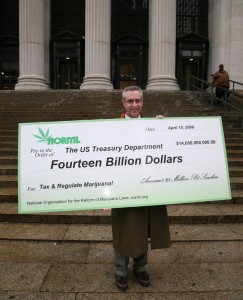
Our friends at NORML paid a visit to the Treasury Department today:
Earlier this morning, the organization presented a mock check to the U.S Treasury Department in the sum of $14 billion dollars. The check total represents the combined savings and tax revenues that would be generated by regulating the sale and production of cannabis like alcohol.
"We represent the millions of otherwise law-abiding cannabis consumers who are ready, willing, vocal and able to contribute needed tax revenue to Americaâs struggling economy," NORML Executive Director Allen St. Pierre said at a press conference at the steps of the general post office in New York City. "All we ask in exchange for our $14 billion is that our government respects our decision to use marijuana privately and responsibly." [The Hill]
Is anyone still confused about why marijuana reform is an economics issue? Mr. President?
Anyway, assuming the desperate folks at the treasury didn't attempt to cash it, let me be the first to offer a home for that large novelty check which would surely just take up space around the NORML office. It will make a sweet conversation piece. Give me that giant check, you hippies.
CJPF President Eric Sterling has a simply fantastic article at Huffington Post illustrating the virtually infinite economic harm caused by drug prohibition and over-incarceration.
I highly recommend reading this, particularly because I often find reformers getting confused about the economics of prohibition. Itâs easy to look at the prison guard unions, the small towns with big SWAT teams, the forfeiture-funded drug task forces, etc. and find oneself arguing that the drug war is all about making money. Itâs true that drug war profiteering may help explain why certain interests will always shamelessly defend their piece of the prohibition pie. Yet, as Eric helpfully explains, the criminal justice system is hemorrhaging resources on every imaginable level, not only through the cost of maintaining our massive prison population, but also in terms of the lost economic participation of millions of inmates and felons. Â
To whatever extent certain individuals and institutions may profit from the war on drugs, they do so at the expense of the economic health of the nation. Educating ourselves and the public about this concept is vital to framing the drug war debate in terms all Americans can relate to.
So you might ask, âwhatâs so special about heroin traveling through Turkey? Itâs just like any other trade between the middle-east and Europe.â The troublesome point is who controls the trafficking through the country and receives the profits of the trade. This happens to be the PKK, or Kurdistan Workerâs Party, a militant organization with a 30-year history of fighting the Turkish government to establish a separate Kurdish state. âAccording to Interpol [â¦] the PKK was orchestrating 80 % of the European drug marketâ back in 1992, and â[o]ther sources similarly indicate that the PKK controlled between 60 % to 70 %â in 1994 reported the Turkish Daily News.
The state of Turkey has been increasing its process of Westernization recently in its desire to join the EU, and this has meant adopting a Western policy on drugs. Turkey has been very successful recently in increasing its police and border control effectiveness and eliminating corruption. The Turkish Daily News gave some convincing numbers: âAccording to the deputy customs undersecretary, there was a 400 percent increase in drug-operation success in the period between 2002 and 2006, when compared to the 1999-2002 period.â
However, even though Turkey has been, in recent years, dealing more and more forcefully with both the PKK militants and the drug trade, has this actually reduced the trafficking of drugs and the profits of the PKK? In the Turkish Daily News: â[t]he annual revenue made by the outlawed Kurdistan Workers' Party (PKK) has increased to 400-500 million euros, a top Turkish general said late Tuesday.â If the PKKâs revenue has increased, then it is logical to assume Turkeyâs military campaign against them may not be considered a huge success. Not only that, but â200-250 million euros of [the PKKâs] revenue comes from drugs [â¦] Gen. Ergin Saygun, deputy chief of General Staff said.â That makes drug trafficking 50% of the organizationâs income!
The Turkish state has had a history of valuing the effectiveness of force. It was born from war, and the constitution has a controversial but often-utilized article that allows the Turkish army to organize a coup to eliminate the possibility of having a religious party in power. What is the point of these so-called âhard-lineâ approaches to dealing with the nationâs problems if they are rather ineffective? Very little of course. The trouble comes from what the state could say to its citizens, to the international community, if it negotiated with the violent PKK or began to take the drug trade into the light by moving it towards legalization and either private or state control? If Turkey tried to clean up its smuggling and black market in such a way the majority of Europe, if not the greater âglobal community,â would probably condemn the entire nation of betraying humanity and literally becoming evil. The reaction of many Turkish citizens would be perhaps lighter, but of a similar nature if the state sat down to negotiations with the âterroristâ PKK. These are strong influences on the Turkish state, and severely limit its options. Therefore it seems Turkey doesnât have much of a choice but to pursue the same policy of force it has pursued for more than 30 years, whether it benefit the people or not.
What do you do when you've been kicked out of Iraq for killing civilians and your company's reputation is in shambles? Fear not, the drug war is always hiring, and there's nothing on earth you could do to disqualify yourself from employment in the accountability-free industry of international drug prohibition.
While Blackwater's mercenaries beg for mercy for killing a baby and 19 other people in Baghdad on Sunday, they're already working on another lucrative government contract on yet another foreign adventure: the "war on drugs." [Village Voice]
Details are sketchy since the government doesn't report eagerly on the creepy deals it makes with baby-killing mercenary groups. But Village Voice says they're building giant remote-control surveillance blimps.
It remains unclear what these blimps will be used for or what other secretive drug war endeavors Blackwater will be undertaking, but this much is for sure: it will all be phenomenally expensive and it won't change a damned thing.
Peter Guither at the Drug WarRant blog has pointed out what he calls a "blatant and pathetic effort" by the State of Kentucky to secure drug war funding from Congress:
State police, local law enforcement, sheriff's offices, HIDTA and multi-jurisdictional drug task forces throughout the nation collectively conducted undercover investigations, search warrants, consent searches, marijuana eradication efforts, drug interdiction and arrest warrants for a period of one week. This collective effort, Operation Byrne Drugs II, was conducted from April 23-29 to highlight the need and effectiveness of the Byrne grant funding and the impact cuts to this funding could have on local and statewide drug enforcement.
Actually it is the media efforts that seem to be coordinated, in addition to the drug enforcement. I noticed a suspiciously similar press release distributed by the California Dept. of Justice last July about a suspiciously similar incident:
BNE task forces, comprised of state, local and federal law enforcement agencies, throughout the state served 16 search warrants, seized three firearms, confiscated 53 pounds of methamphetamine, 91 pounds of marijuana, and 37,747 marijuana plants.
State drug enforcement agencies across the U.S. on July 27, 2006 participated in a "national day of drug enforcement." Organized by the National Alliance of State Drug Enforcement Agencies, "Operation Byrne Drugs" promoted the continued funding of the Byrne Justice Assistance Grant program that supports local and statewide drug enforcement. The federally funded program has suffered deep cuts over the last few years, directly affecting BNE. In fiscal year 2001-02, BNE received more than $11.5 million for personnel and operating costs. In fiscal year 2006-07, BNE received less than $6 million, nearly a 50% decline over five years.
your tax dollars at work to get more of your tax dollars
Now I run an advocacy group, and I can tell you with confidence that this is exactly what groups who want to achieve a legislative objective will do -- organize media-worthy events in order to get the attention of the policymakers you need to influence, in this case Congress. The main differences between what we do and what the narcs are doing are that: 1) They are using taxpayer funds to carry out their media/lobbying campaign to secure taxpayer funds; and 2) They are using the authority the government has given them to wield state power including guns in order to arrest and incarcerate people, as a component of their media-lobbying campaign. We will generally just hold a press conference or a rally, or issue a report.
I suspect that in strict legal terms they have not violated the law. But make no mistake -- this is lobbying of Congress by state agencies to get our money, and they are destroying numerous lives in order to do it. I don't agree with drug enforcement at all (as readers know), but even for those who do, clearly enforcement decisions about when and whom to raid should be based on law enforcement/public safety needs, NOT politics. Unfortunately, it is not only drug money that corrupts our law enforcement; it is drug war money too.
The [U.S. asparagus] industry has been decimated by a U.S. drug policy designed to encourage Peruvian coca-leaf growers to switch to asparagus. Passed in 1990 and since renewed, the Andean Trade Preferences and Drugs Eradication Act permits certain products from Peru and Colombia, including asparagus, to be imported to the United States tariff-free. â¦
Meanwhile, the Washington industry is a shadow of its former self. Acreage has been cut by 71 percent to just 9,000 acres.
Well at least something got eradicated. Perhaps Washington farmers will now turn to growing America's number one cash crop instead.
Notwithstanding divergent views on free trade among our readership, I'm sure we can all agree that tariffs shouldn't be arbitrarily lifted in support of a failed drug war policy in Peru. Any success achieved in South America (there hasn't been any, but bear with me) must be measured against the sacrifices American farmers are forced against their will to make impact of abandoning protectionism spontaneously. Factoring this against ONDCP's otherwise already pathetic claims of progress leaves a worse taste in one's mouth than that of canned asparagus.
This is what we're trying to tell you about the U.S. war on drugs. The people running this thing will screw over confuse American farmers while pretending to protect our nation's interests.
If they didn't anticipate this outcome, they are incompetent and should be permanently enjoined from drafting economic policy. And if they did anticipate this inevitable outcome, and took no action to mitigate it, they should be jailed for treasonous malfeasance and fed forever on the bitter canned fruits and vegetables of their hypocrisy.
Full disclosure: I don't like asparagus. Thus, it's humorous to contemplate the irony that we can now add asparagus proliferation to the growing list of undesirable drug war consequences. Our resident vegetable enthusiast Dave Borden might disagree, but I'm sure he'd trade all the asparagus in the world for an end to the ongoing international disaster of drug prohibition.
Update: In response to comments below and at Hit & Run, it's not my contention that U.S. farmers are entitled to protection against foreign competitors. My point is that drug war politics should rarely, if ever, be used as a justification to waive policies otherwise deemed appropriate by Congress.
A new report proving that marijuana is America's number one cash crop has sparked significant interest around the blogoshere, mostly from fair-weather friends of our cause who recognize the absurdity of prohibiting a product of such enduring popularity.
Indeed, this news highlights the failure of prohibition, both for failing to eliminate the market, and for driving its value above that of various more popular vegetables.
But the fun part is reading what the anti-pot crowd has to say. The most entertaining entry in this regard is from Scott Whitlock at Newsbusters: Exposing and Combating Liberal Media Bias, who cites this story as evidence of a liberal media bias at CNN.