In 2008, the latest year tallied in the FBI's
Uniform Crime Report, more than 14,000,000 people were arrested in the United States, and uncounted millions more were subject to "stop and frisk" searches either on the streets or after being stopped for an alleged traffic violations. Of all those arrests in 2008, more than 1.7 million were for drug offenses, and about half of those were for marijuana offenses. For both pot busts in particular and drug arrests in general, nearly 90% of those arrested were for simple possession.
 |
|
| 10 Rules is available with a donation to StoptheDrugWar.org now! |
|
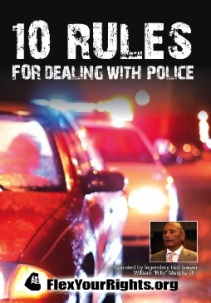
"10 Rules" will help the both the entirely innocent and those guilty of nothing more of possessing drugs in violation of our contemptible drug laws reduce the harm of their run-ins with police. Not that it encourages the violation of any laws -- it doesn't -- but it does clearly, concisely, and effectively explain what people can do to exercise their constitutional rights while keeping their cool, in the process protecting themselves from police who may not have their best interests in mind.
Those stops and those arrests mentioned above, of course, were not random or evenly distributed among the population. If you're young, or non-white, or an identifiable member of some sub-culture fairly or unfairly associated with drug use, you are much more likely to be stopped, hassled, and perhaps arrested. The writers of "10 Rules," Scott Morgan and Steve Silverman of Flex Your Rights understand that.
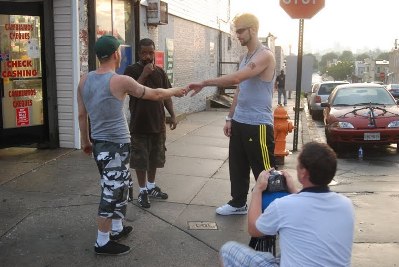
Building on the foundation of their 2003 video, "Busted: A Citizen's Guide to Surviving Police Encounters," which featured mainly young, white people involved in police encounters, Morgan and Silverman have expanded their target audience. In three of the four scenarios used in the video -- a traffic stop and search, a street stop-and-frisk search, and a knock-and-talk home search -- the protagonists are a young black man, a young Latino man, and a black grandmother, respectively. In only one scene, two young men apparently doing a dope deal on the street, are the citizen protagonists white.
That's not to say that "10 Rules" is intended only for the communities most targeted by police, just that the writers understand just who is being targeted by police. The lessons and wisdom of "10 Rules" are universally relevant in the United States, and all of us can benefit from knowing what our rights are and how to exercise them effectively. "10 Rules" does precisely that, and it does so in a street-smart way that understands cops sometimes don't want to play by the rules.
"10 Rules" build upon the earlier "Busted" in more than one sense. While "10 Rules" is expanding the terrain covered by "Busted," it has taken the cinematic quality to the next level, too. While "Busted" was made using a beta cam, this flick is shot in High Definition video, and that makes for some great production values, which are evident from the opening scene. "10 Rules" was shot on a bigger budget that "Busted," it has more actors (including some drug reform faces you might recognize), and more professional actors, and it has more of the feel of a movie than most video documentaries.
And it has legendary defense attorney William "Billy" Murphy, who plays the role of socratic interlocuter in the video. (You may remember him from appearances on HBO's "The Wire.") Appearing in a courtroom-like setting before a multi-ethnic group of very interested questioners, the pony-tailed lawyer begins with a basic discussion of the rights granted us by the US Constitution, especially the Fourth, Fifth, and Sixth amendments dealing with the right to be free of unwarranted searches, the right to stay silent, and the right to legal counsel. His performance, folksy, yet forceful; scholarly, yet, street-savvy, sparkles throughout; his natural charisma shines through.
From there, we alternate between Williams and his audience and the scenarios mentioned above. We see the young black man, Darren, get pulled over in traffic, produce a bit of bad attitude, and suffer mightily for his efforts. He gets handcuffed, manhandled, and consents to a search of his vehicle, after which the cop leaves his belongings strewn in the wet road and gives him a traffic ticket.
Then it's back to the courtroom, where Darren, angry and feeling disrespected, tells his tale. Murphy is sympathetic, but explains that Darren broke rule #1.
"Rule #1, always be calm and collected," the veteran attorney intones. "A police encounter is absolutely the worst time and place to vent your frustrations about getting stopped by the police. As soon as you opened your mouth, you failed the attitude test. Don't ever talk back, don't raise your voice, don't use profanity. Being hostile to police is stupid and dangerous."
Such advice may be frustrating, but it's smart, and it's street-smart. Murphy noted that things could have turned out even worse, as the video showed in an alternate take on the scene with Darren twitching on the ground after getting tasered for his efforts. He also threw in some good advice about pulling over immediately, turning off the car, keeping your hands on the wheel, and turning on an interior light just to reduce police officers' nervousness level.
Murphy uses the same scenario with Darren to get through rule #2 ("You always have the right to remain silent"), rule #3 ("You have the right to refuse searches), rule #4 ("Don't get fooled" -- the police can and will lie to you or tell you you'll get off easier if you do what they ask), and rule #5 ("Ask if you are free to go"). This time, the cop still has a bad attitude and Darren still gets a ticket, but he doesn't counterproductively antagonize the cop, he doesn't get rousted and handcuffed, he doesn't allow the cop to search his vehicle, he doesn't get intimated by the officers' threat to bring in a drug dog that will tear up his car, and he does ask if he's free to go. He is.
Which brings us to a discussion of probable cause and and rule #6: "Don't expose yourself" and give police probable cause to search you. The video shows a car with bumper stickers saying "Got Weed?" "Bad Cop, No Donut," and "My other gun is a Tech-9" -- probably not a smart idea unless you really enjoy getting pulled over and hassled. More generally, "don't expose yourself" means that if you are carrying items you really don't want the police to see (and arrest you for), don't leave them lying around in plain sight. That's instant probable cause.
|
 |
I'm not going to tell you the rest of the rules because I want you to see the video for yourself. But I will tell you about the heart-rending scene where the black grandmother lets police search her home in the name of public safety -- there have been some gang gun crimes, they explain pleasantly -- and ends up getting busted for her granddaughter's pot stash, arrested, and is now facing eviction from her public housing. Under Murphy's guidance, we rewind and replay the scene, with grandma politely but firmly exercising her rights, keeping the cops out of her home, and not going to jail or threatened with losing her home.
In a time when police are more aggressive than ever, "10 Rules" is an absolutely necessary corrective, full of folksy -- but accurate -- information. "10 Rules" is the kind of basic primer on your rights that every citizen needs to know, it's well-thought out and well-written, and it not only is it full of critically important information, it's entertaining.
Go watch it and learn how to flex your rights. Better yet, watch it together with your friends, your family, or your classmates, then practice putting the rules into effect. Sometimes it's as simple as saying a simple phrase -- "Officer, am I free to go?" Do some role-playing, practice saying the magic words, and "10 Rules" can help you survive any police encounter in better shape than otherwise. When you're done, watch it and practice again -- familiarity is the best help when facing an intimidating police officer staring down at you.
We all owe a debt of gratitude to people who feel strongly enough about the rule of law in this country to help others learn how the law protects them and how to protect themselves within the law. A big thank you to the guys at Flex Your Rights is in order. And they would be the first to tell you the best way to thank them is to learn and apply the "10 Rules."