Arrests
DEA's "Project Deliverance" Will Undoubtedly Fail to Deliver
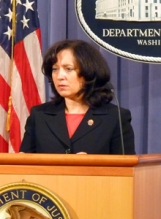
DEA acting chief Michele Leonhart, and her boss, US Attorney General Eric Holder, are bragging about a major, DEA-led operation that has netted 2,200+ arrests, with pounds of drugs and millions of dollars seized. "Project Deliverance" involved more than 300 law enforcement agencies, more than 3,000 DEA agents, and took 22 months. According to DEA's press release, they captured 1,262 pounds of methamphetamine, 2.5 tons of cocaine, 1,410 pounds of heroin, and 69 tons of marijuana, plus $154 million.
Operationally, Deliverance was certainly a big project -- it's easy to see why they're excited. And for the thousands of people throughout the US who were arrested in it, it's a life-changing event, though for the worse. But will Project Deliverance make any real difference in drug use and the drug trade? Is the operation really a big deal, when examined next to the reality of drug use and the drug trade in the United States today?
I hate to be a wet blanket, but if history is a guide, Project Deliverance will have no long-term impact on the drug trade. Though notable in its scale, the operation is only one of many carried out by the US and allied governments over decades. During that time, the measure of drug availability -- price, an increase implies a product is less available, relative to its demand* -- has gone in the opposite of the intended direction, and dramatically. For example, the average US street price of cocaine is less than a fifth in real terms than it was in 1980. Previous drug sweeps have seen their temporary gains erased in just one or two weeks.
The reason is that the big sounding numbers touted by Leonhart, while large for the agency and our government, are small compared with the drug trade. Deliverance's 2.5 tons of cocaine constitutes less than one percent of the 300 metric tons of cocaine the government estimates are consumed annually in the US. So does the 69 tons of marijuana. They did get a few percent of the heroin, if numbers don't deceive, but even that's still small. And the 2,200 alleged dealers and traffickers arrested in Project Deliverance make up a similarly tiny fraction of the hundreds of thousands of people employed in the US by the illegal drug trade. Some drug businesses will doubtless be extinguished by Project Deliverance, but others will have little difficulty replacing the lost supply or filling the open positions. And how much powder or weed did the investigators let go by during the 22 months it took to complete the operation? How much will they have to let slip by during the months or years it takes to mount the next one?
In an uncharacteristically "big picture" review published a few weeks ago, the Associated Press declared the 40-year drug war a failure by every measure. Will media follow that lead and go beyond the surface in their reporting on Project Deliverance? I have a few suggestions for those intrepid reporters who would like to:
 | |
- Ask DEA or DOJ spokespersons if they expect the substances targeted in the sweep to be less available to US consumers of them, and if so for how long.
- Ask them if previous operations, individually or collectively, have had that effect. If they say yes, ask them to be specific as to what their evidence is, and compare it with numbers like the aforementioned cocaine prices.
- Do some follow-up, say two or three weeks from now. Ask government officials, cops who walk the drug beat, and drug users, what if any difference they saw in the supply of the targeted drugs, and if so if they see still any. Follow up again in one or two months. See if DEA will give you early access to the price data.
Indian cops arrested with contraband drugs in Nepal
Indian cops arrested with contraband drugs in Nepal
Nepalnews.com
Monday, 31 May 2010 15:09
UPDATE: Philadelphia DA on Philly's "Decrim"
Earlier today, I blogged about Philadelphia embracing a sort of decriminalization of minor marijuana possession based on an article that appeared today in the Philadelphia Inquirer.
It appears that article not only caught my attention, but also that of a lot of Philadelphians, who have been calling up the DA's office all day. This afternoon, District Attorney Seth Williams issued the following statement of clarification:
Based upon inquiries to this office it appears that some confusion exists regarding potential changes in charging policy when it comes to minimal amounts of marijuana. "We are not decriminalizing marijuana--any effort like that would be one for the legislature to undertake. The penalty available for these minimal amount offenses remains exactly the same. What we are doing is properly dealing with cases involving minimal amounts of marijuana in the most efficient and cost effective process possible. Those arrested for these offenses will still be restrained, identified and processed by police in police custody. They will still have to answer to the charges, but they will be doing so in a speedier and more efficient process. We want to use valuable court resources in the best way possible and we believe that means giving minor drug offenders the option of getting into diversionary programs, get drug education or enter drug treatment centers. Again we are NOT decriminalizing marijuana, and the penalty for these offenses remains the same."It looks like DA Williams is trying to have it both ways. The Inquirer story--which Williams doesn't contradict in his statement--says that small-time pot offenders will be sent to a special "quality of life" court and fined. While Williams is correct that it would be that state legislature that woud decriminalize marijuana possession, It is a sort of de facto partial decriminalization, with people arrested, but not processed in the criminal courts or jailed upon conviction. I'll try to have this cleared up by the time we publish the Chronicle story about it on Friday.
Marijuana: Philadelphia to Decriminalize Possession of Up to 30 Grams, But Arrests to Continue Anyway
People caught with 30 grams (a bit more than an ounce) or less of marijuana in Philadelphia will no longer be charged with criminal misdemeanors, but with civil summary offenses under a new policy that will go into effect later this month. Fines are expected to be in the $200 to $300 range.
But while pot smokers won't face criminal charges, they will still be arrested, handcuffed, searched, detained, and fingerprinted. Then, their cases will be heard by a special "quality of life" court that is already in use for things like dealing with unruly Eagles fans and public drinking.
"We're not going stop locking people up," Lt. Frank Vanore, a police spokesman, told the Philadelphia Inquirer, . Marijuana possession remained illegal, he said. "We're going to stop people for it. . . . Our officers are trained to do that. Whether or not they make it through the charging process, that's up to the D We can't control that. Until they legalize it, we're not going to stop."
According to the Inquirer, the policy shift is the result of a collaboration between new District Attorney Seth Williams and a pair of Pennsylvania Supreme Court judges. It is part of an effort to unclog the city's overwhelmed court dockets.
Under Williams' predecessor, former DA Lynn Abraham, police arrested an average of 3,000 people a year for small-time pot possession, about 75% of them black. That figure represents roughly 5% of the city's criminal caseload.
About another 2,000 are arrested for marijuana distribution and 2,500 more are arrested for possession of more than 30 grams. Overall, enforcing drug prohibition has resulted in about 18,000 arrests a year in Philadelphia, or nearly one-third of the entire criminal caseload.
"We have to be smart on crime," Williams told the Inquirer. "We can't declare a war on drugs by going after the kid who's smoking a joint on 55th Street. We have to go after the large traffickers."
Supreme Court Chief Justice Ronald Castille, one of the two justices who worked with Williams on the policy shift, said decrim was "appropriate" for such a small-time offense. "It's a minor crime when you're faced with major drug crimes." Removing such cases from the criminal courts, he said, "unclogs the system."
Philadelphia NORML has been quietly lobbying city officials for the change. "The marijuana consumers of Philadelphia welcome this," said chapter head Chris Goldstein. "This is a very progressive thing to do on the part of the city," Goldstein said of the new policy. "I couldn't be happier about this."
Goldstein was much less enthused by the continued arrests policy. "It is completely absurd," he said. "It's harsh. For minor marijuana possession, it's very harsh treatment."
In most states and localities with decriminalization laws or policies, people are merely issued a ticket after police seize their stash. Still, this is a quarter-step forward for Philadelphia.
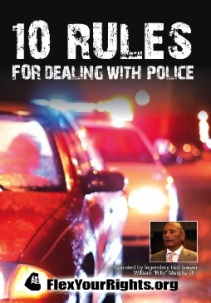
Drug War Chronicle Video Review: "10 Rules for Dealing With Police," from Flex Your Rights
In 2008, the latest year tallied in the FBI's Uniform Crime Report, more than 14,000,000 people were arrested in the United States, and uncounted millions more were subject to "stop and frisk" searches either on the streets or after being stopped for an alleged traffic violations. Of all those arrests in 2008, more than 1.7 million were for drug offenses, and about half of those were for marijuana offenses. For both pot busts in particular and drug arrests in general, nearly 90% of those arrested were for simple possession.
"10 Rules" will help the both the entirely innocent and those guilty of nothing more of possessing drugs in violation of our contemptible drug laws reduce the harm of their run-ins with police. Not that it encourages the violation of any laws -- it doesn't -- but it does clearly, concisely, and effectively explain what people can do to exercise their constitutional rights while keeping their cool, in the process protecting themselves from police who may not have their best interests in mind.
Those stops and those arrests mentioned above, of course, were not random or evenly distributed among the population. If you're young, or non-white, or an identifiable member of some sub-culture fairly or unfairly associated with drug use, you are much more likely to be stopped, hassled, and perhaps arrested. The writers of "10 Rules," Scott Morgan and Steve Silverman of Flex Your Rights understand that.
Building on the foundation of their 2003 video, "Busted: A Citizen's Guide to Surviving Police Encounters," which featured mainly young, white people involved in police encounters, Morgan and Silverman have expanded their target audience. In three of the four scenarios used in the video -- a traffic stop and search, a street stop-and-frisk search, and a knock-and-talk home search -- the protagonists are a young black man, a young Latino man, and a black grandmother, respectively. In only one scene, two young men apparently doing a dope deal on the street, are the citizen protagonists white.
That's not to say that "10 Rules" is intended only for the communities most targeted by police, just that the writers understand just who is being targeted by police. The lessons and wisdom of "10 Rules" are universally relevant in the United States, and all of us can benefit from knowing what our rights are and how to exercise them effectively. "10 Rules" does precisely that, and it does so in a street-smart way that understands cops sometimes don't want to play by the rules.
"10 Rules" build upon the earlier "Busted" in more than one sense. While "10 Rules" is expanding the terrain covered by "Busted," it has taken the cinematic quality to the next level, too. While "Busted" was made using a beta cam, this flick is shot in High Definition video, and that makes for some great production values, which are evident from the opening scene. "10 Rules" was shot on a bigger budget that "Busted," it has more actors (including some drug reform faces you might recognize), and more professional actors, and it has more of the feel of a movie than most video documentaries.
And it has legendary defense attorney William "Billy" Murphy, who plays the role of socratic interlocuter in the video. (You may remember him from appearances on HBO's "The Wire.") Appearing in a courtroom-like setting before a multi-ethnic group of very interested questioners, the pony-tailed lawyer begins with a basic discussion of the rights granted us by the US Constitution, especially the Fourth, Fifth, and Sixth amendments dealing with the right to be free of unwarranted searches, the right to stay silent, and the right to legal counsel. His performance, folksy, yet forceful; scholarly, yet, street-savvy, sparkles throughout; his natural charisma shines through.
From there, we alternate between Williams and his audience and the scenarios mentioned above. We see the young black man, Darren, get pulled over in traffic, produce a bit of bad attitude, and suffer mightily for his efforts. He gets handcuffed, manhandled, and consents to a search of his vehicle, after which the cop leaves his belongings strewn in the wet road and gives him a traffic ticket.
Then it's back to the courtroom, where Darren, angry and feeling disrespected, tells his tale. Murphy is sympathetic, but explains that Darren broke rule #1.
"Rule #1, always be calm and collected," the veteran attorney intones. "A police encounter is absolutely the worst time and place to vent your frustrations about getting stopped by the police. As soon as you opened your mouth, you failed the attitude test. Don't ever talk back, don't raise your voice, don't use profanity. Being hostile to police is stupid and dangerous."
Such advice may be frustrating, but it's smart, and it's street-smart. Murphy noted that things could have turned out even worse, as the video showed in an alternate take on the scene with Darren twitching on the ground after getting tasered for his efforts. He also threw in some good advice about pulling over immediately, turning off the car, keeping your hands on the wheel, and turning on an interior light just to reduce police officers' nervousness level.
Murphy uses the same scenario with Darren to get through rule #2 ("You always have the right to remain silent"), rule #3 ("You have the right to refuse searches), rule #4 ("Don't get fooled" -- the police can and will lie to you or tell you you'll get off easier if you do what they ask), and rule #5 ("Ask if you are free to go"). This time, the cop still has a bad attitude and Darren still gets a ticket, but he doesn't counterproductively antagonize the cop, he doesn't get rousted and handcuffed, he doesn't allow the cop to search his vehicle, he doesn't get intimated by the officers' threat to bring in a drug dog that will tear up his car, and he does ask if he's free to go. He is.
Which brings us to a discussion of probable cause and and rule #6: "Don't expose yourself" and give police probable cause to search you. The video shows a car with bumper stickers saying "Got Weed?" "Bad Cop, No Donut," and "My other gun is a Tech-9" -- probably not a smart idea unless you really enjoy getting pulled over and hassled. More generally, "don't expose yourself" means that if you are carrying items you really don't want the police to see (and arrest you for), don't leave them lying around in plain sight. That's instant probable cause.
I'm not going to tell you the rest of the rules because I want you to see the video for yourself. But I will tell you about the heart-rending scene where the black grandmother lets police search her home in the name of public safety -- there have been some gang gun crimes, they explain pleasantly -- and ends up getting busted for her granddaughter's pot stash, arrested, and is now facing eviction from her public housing. Under Murphy's guidance, we rewind and replay the scene, with grandma politely but firmly exercising her rights, keeping the cops out of her home, and not going to jail or threatened with losing her home.
In a time when police are more aggressive than ever, "10 Rules" is an absolutely necessary corrective, full of folksy -- but accurate -- information. "10 Rules" is the kind of basic primer on your rights that every citizen needs to know, it's well-thought out and well-written, and it not only is it full of critically important information, it's entertaining.
Go watch it and learn how to flex your rights. Better yet, watch it together with your friends, your family, or your classmates, then practice putting the rules into effect. Sometimes it's as simple as saying a simple phrase -- "Officer, am I free to go?" Do some role-playing, practice saying the magic words, and "10 Rules" can help you survive any police encounter in better shape than otherwise. When you're done, watch it and practice again -- familiarity is the best help when facing an intimidating police officer staring down at you.
We all owe a debt of gratitude to people who feel strongly enough about the rule of law in this country to help others learn how the law protects them and how to protect themselves within the law. A big thank you to the guys at Flex Your Rights is in order. And they would be the first to tell you the best way to thank them is to learn and apply the "10 Rules."
 |
|
 |