Drug Testing

Wanna Beat a Drug Test? Switch From Pot to Oxycodone

Yesterday, I wrote about false positive drug test results, noting that many schools aren't required to confirm positive results and quoting a top expert who believes that more expensive follow-up testing is often not being conducted. Obviously, the potential for innocent students to be accused and stigmatized is profoundly disturbing. Still, the issue of false negatives raises interesting issues as well. From The New Scientist:
Of 710 drug tests performed, 85 gave incorrect results, either because the urine sample was too dilute to interpret properly, or because the test picked up prescription medicines. Meanwhile, routine tests failed to detect the painkiller oxycodone in nearly two-thirds of cases.
So the synthetic opioids driving America's growing problem with prescription abuse among young people are remarkably difficult to detect through the exact urine testing programs ONDCP is pitching as a solution to the problem of youth drug abuse.

As marijuana remains the easiest drug to detect, is it any wonder that kids are turning to dangerous synthetic opioids that are undetectable 2/3 thirds of the time? We've always understood that more dangerous drugs leave the body faster, but oxycodone usually fails to show up even when it's still in your system.

Thus the ONDCP's argument that drug testing 'identifies use before it becomes a huge problem' is fundamentally incompatible with what these tests actually do. Given the ease with which one can avoid detection of all drugs other than marijuana, only students with severe addiction problems are likely to be identified. And if their problem is oxycodone, they'll often evade detection altogether.

So student drug testing is more likely to increase prescription drug abuse than prevent it. But before we accuse ONDCP of having its head up its ass yet again, check out their awesome life-saving guide on how to dispose of valuable unused prescriptions by mixing them with kitty litter.

If only more people disposed of their drugs instead of snorting them, we'd be out of the dark forest of hopelessness and instead skipping merrily through the lush meadows of healthiness and well-being. Surely, there's nothing more euphoric than being completely sober, even if it requires frequent urine inspections to keep you that way.

Punk Rocker's Drug Test a False Positive -- But Charges Still Pending

Dr. Bronner's sent out this follow-up press release earlier today: FOR IMMEDIATE RELEASE CONTACT: Adam Eidinger April 17, 2007
Breaking News! Orange County Crime Lab Test Shows Dr. Bronner's Soap Clean of GHB or Any Other Drug Germs' Drummer Don Bolles Wrongly Imprisoned; Police Field Drug Test Kits Faulty
ESCONDIDO, CA – The Bronner family, makers of the popular organic Dr. Bronner's Magic Soaps, has learned that the confirmation drug-testing at the Orange County crime lab of soap taken from Don Bolles does not contain GHB (Gamma Hydroxy Butyrate). The crime lab's confirmation tests use the GC-MS method which is much more accurate than the field drug test kits used by the Newport Beach Police, which on April 4th produced a false-positive for GHB for Dr. Bronner's peppermint soap. Based on this flawed faulty field test, Newport Beach police threw Don Bolles, drummer for the legendary punk band The Germs, in jail for three and half days over Easter weekend. Media reports that Dr. Bronner's soaps test positive for THC are also false. Bruce Margolin, attorney for Jimmy Michael Giorsetti who goes by the stage name Don Bolles, was told Friday by the Orange County DA that Mr. Bolles' soap tested negative for drugs. "Mr. Bolles' charges of felony drug possession charges have been proven false," said David Bronner, President of Dr. Bronner's Magic Soaps. "It's shocking that the DA's office is sitting on the lab results on the soap and hasn't dropped the charges already. Mr. Bolles has always been innocent in this case, but as long as these charges are pending he may not get a passport to travel out of the country to perform and is in major legal jeopardy," said Bronner who appeared in court last Friday to support Mr. Bolles. The next court appearance for Mr. Bolles is May 18, 2007. "Don and our soaps shouldn't have to wait a month to clear this up," says Bronner. "Our customers need to know now this whole soap opera is a mistake by police who tormented an innocent 50 year old man with jail. We purchased the same NarcoPouch® 928 GHB field test made by ODV, Inc. that was used by the police, and ran tests on our soaps. We confirmed that the test is useless when used on soap since every test came back positive. We also tested other common brands of soap including Johnson & Johnson's popular Neutrogena brand, as well as Colgate-Palmolive's popular Tom's of Maine brand, which gave the same false-positive tests as well. What kind of justice system allows police to use field drug tests that deprive citizens of their God-given liberty, that test positive for something as common as soap? What kind of policies and regulations are in place on police drug-testing practices and products, such that a US citizen can be tossed in the slammer over Easter weekend for possession of soap? Police departments nationwide should immediately stop using the ODV, Inc. field test for GHB as it is not accurate when used on soaps and who knows what other common household products." ODV, Inc is a subsidiary of Armor Holdings, Inc. Mr. Bolles was arrested following a search of his vintage 1968 Dodge A-108 van by the Newport Beach police. During the search they found an 8 oz bottle of peppermint Dr. Bronner's soap which is made with organic coconut, olive, hemp, peppermint and jojoba oils. The police ignored repeated pleas by Mr. Bolles that the liquid was nothing more than soap. "I've used only Dr. Bronner's soap for 35 years," says Mr. Bolles. "I use it for everything - bathing, washing my hair, washing my clothes - it goes everywhere I go. I'm scheduled to go to Europe to tour with The Germs this summer, but these felony charges could keep me from traveling out of the country." To arrange an interview with Don Bolles or David Bronner please contact Adam Eidinger.

The drug war is everywhere, even in my mailbox...

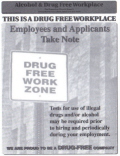
Today our new federal and DC labor law posters showed up in the mail -- there are a lot of different posting requirements, and it's easier to just order a set, as opposed to figuring everything you need and taping it all together on the wall -- plus we have three organizations in the office and we can split the bill. None of that is very interesting for a drug policy blog, in and of itself. But stuffed inside the poster tube was a flyer advertising some additional posters they have for sale, including a "THIS IS A DRUG FREE WORKPLACE" poster. The poster, if we displayed it, would proclaim DRCNet to be a "DRUG FREE WORK ZONE" and explain that "Tests for use of illegal drugs and/or alcohol may be required prior to hiring and periodically during your employment." The blurb accompanying the poster graphic reads as follows:
DRUG FREE WORKPLACE All employers should provide a Drug-Free Workplace program including a written policy statement. If an employee receives a positive confirmed drug test for illegal use of drugs or alcohol, or refuses to submit to drug or alcohol test, then the burden of proof is shifted to the employee. Substance abusing workers are:
  • Five times more likely to file a worker's compensation claim;
  • 3.6 times more likely to be involved in on-the-job accidents; and
  • Late for work three times as often.
  • Absenteeism: Substance abusers are 2.5 times more likely to be absent 8 or more days a year.
  • Lost Productivity: Substance abusers are one-third less productive.
This "data," if you can call it that, is problematic in a number of ways. First, there is no differentiation of use from abuse, no explanation of what exactly is meant by abuse, no clarity as to whether the numbers refer only to illegal drugs or if they also include alcohol. If they do include alcohol, is there some distinction between casual use and heavier use that can affect work performance? Presumably the alcohol tests they mention would not have the same kinds of standards as illegal drug tests, since there is no legal or prevailing cultural standard calling for teetotalism (abstention from alcohol use). It is really hard to say exactly what they are saying. What we do know, however, is that drug testing isn't worth the money or the collateral costs. According to the 1994 National Academy of Sciences report "Under the Influence: Drugs and the American Work Force" (as summarized by the ACLU):
  • Research results indicate that drug use does not pose significant productivity or safety problems in the work force. In 1994, the National Academy of Sciences published results from a three year research effort compiling research resulting from all major studies of drug testing program effectiveness. The report concluded, "the data... do not provide clear evidence of the deleterious effects of drugs other than alcohol on safety and other job performance indicators."
  • Though frequently inaccurate and ineffective, drug testing is extremely expensive. Texas Intruments reports that their drug testing program costs $100 per employee. Drug testing products and services are a multi-billion dollar industry. But the incidence of drug use in the workforce is very low. The federal government reported in 1990 that only 0.5% of tested employees tested positive. The same year, the government spent $11.7 million on its drug testing program. That works out to $77,000 per identified drug user.
  • The NAS looked for and was unable to find evidence of drug testing programs' deterrent effects. Studies which appear to show a decrease in positive test rates since the implementation of drug testing programs usually don't adjust for the expansion of such programs' testing groups to include not only for-cause drug tests but also suspicionless drug tests. That is, as drug-testing programs have expanded, they have tested more and more people who aren't suspected of drug use, improving their numbers and subjecting thousands of non-users to invasive testing procedures.
Needless to say, at DRCNet we consider our staff's personal choices about substances to be their personal choices, and we have no intention of instituting such a program -- our people know that if they show up to work sober, get their work done and don't create risk for the organization by carrying contraband into the office, they'll be okay. Isn't that the way it should be, anywhere? This company is called The Labor Law Poster Service, located in Lansing, Michigan. I don't think we'll be ordering from them again. If there are any employers out there reading this who can point us to another such outfit, one that has the labor law posters we need but does not attempt to profit from the drug testing scam, please drop me a line before next year. Otherwise, we may just have to find all the different forms we need separately and cobble them together here ourselves. The drug war is everywhere...

Parents Say The Darndest Things

Here's ONDCP's Bertha Madras from an online debate over student drug testing:

Newsweek: Is there a risk that kids who test positive for drugs will be stigmatized?

Madras: The thing that I have heard is that everyone knows who's using drugs; there are no surprises amongst the kids. Kids know who are the users, their friends know, so when a kid is not engaged in sports for one game, nobody is surprised. I've been a parent all my life, and I knew which one of the kids I didn't want my kids near.

This level of incoherence is an ONDCP specialty. Leaving aside the matter of whether Madras already had kids when she was born, there's still a lot of good stuff here.

Madras claims to know which kids use drugs, which basically undermines her whole point throughout the debate. If this information is widely available, who needs a urine collection program? Why waste precious educational resources to confirm what super-mom Bertha Madras already knows?

Obviously, she delights in stigma rather than refuting it. She admits to having a very negative impression of certain kids, and encourages her children to avoid them rather than offer support. Her statement is an endorsement of stigma and an unambiguous admission that singling out students is part of her agenda.

What a coward. Bertha Madras is as yellow as the urine she wants to collect from innocent children.

Pee For Recreation, Not For Education

ONDCP's abhorrent traveling drug testing show made its first stop of the year in Charleston, SC this week. As usual, the push to implement student drug testing in schools around the country was met with serious opposition from drug policy reformers.

Still, no matter how logical and scientific our arguments may be, there are always those who fail to recognize what's at stake. From The Charleston Post and Courier:

Senior Antwan Edwards plays four sports at North Charleston High and is captain of the football and wrestling teams. Random testing would be a good way to keep some students from using drugs, he said.

It also would prepare students for life after high school by starting those tests now, he said.

If life after high school means having your urine collected by agents of the state and inspected for molecular evidence of unapproved conduct, who wants to grow up? The idea of drug testing as a form of socialization reeks of dystopian fascism. But you can't blame Antwan Edwards, who was probably off giving urine samples when the 4th Amendment was being taught.

"If you don't have anything to hide, why not take the test?" he said.

Oh, there are so many answers to this question. In Antwan Edwards' case, I'd worry that a false positive drug test could be exactly what it takes to ruin his otherwise promising future. And there are plenty of easy ways to get a false positive. They don't happen a lot, but when they do, no one believes you except your mom.

Some students don't care about their privacy, or having newer books instead of urine collection programs, or being presumed innocent, or the fact that their peers may switch to more-dangerous less-detectible drugs, or the evidence that these programs don't work.

Sadly, some students don’t care about these things. But they should care about false positives. They should be terrified. The companies that manufacture these tests claim that there are no false positives, so imagine trying to convince them that there's been a mistake.

If you don't have anything to gain, why take the test?

What's up with these "pain contracts"?

Spurred by the federal government's crackdown on prescription drug abuse, doctors around the country are resorting to "pain contracts" with patients in an attempt to protect themselves from charges they are Dr. Feelgoods. Such contracts typically require the patient to agree that "lost, stolen, or misplaced" drugs are not to be replaced and that the patient agree to be drug tested. Patients who refuse to sign such an agreement or who test positive for non-prescribed drugs--i.e. marijuana--are likely to be cut off.