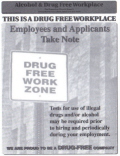
The drug war is everywhere, even in my mailbox...
 |
|
DRUG FREE WORKPLACE All employers should provide a Drug-Free Workplace program including a written policy statement. If an employee receives a positive confirmed drug test for illegal use of drugs or alcohol, or refuses to submit to drug or alcohol test, then the burden of proof is shifted to the employee. Substance abusing workers are:This "data," if you can call it that, is problematic in a number of ways. First, there is no differentiation of use from abuse, no explanation of what exactly is meant by abuse, no clarity as to whether the numbers refer only to illegal drugs or if they also include alcohol. If they do include alcohol, is there some distinction between casual use and heavier use that can affect work performance? Presumably the alcohol tests they mention would not have the same kinds of standards as illegal drug tests, since there is no legal or prevailing cultural standard calling for teetotalism (abstention from alcohol use). It is really hard to say exactly what they are saying. What we do know, however, is that drug testing isn't worth the money or the collateral costs. According to the 1994 National Academy of Sciences report "Under the Influence: Drugs and the American Work Force" (as summarized by the ACLU):
- Five times more likely to file a worker's compensation claim;
- 3.6 times more likely to be involved in on-the-job accidents; and
- Late for work three times as often.
- Absenteeism: Substance abusers are 2.5 times more likely to be absent 8 or more days a year.
- Lost Productivity: Substance abusers are one-third less productive.
Needless to say, at DRCNet we consider our staff's personal choices about substances to be their personal choices, and we have no intention of instituting such a program -- our people know that if they show up to work sober, get their work done and don't create risk for the organization by carrying contraband into the office, they'll be okay. Isn't that the way it should be, anywhere? This company is called The Labor Law Poster Service, located in Lansing, Michigan. I don't think we'll be ordering from them again. If there are any employers out there reading this who can point us to another such outfit, one that has the labor law posters we need but does not attempt to profit from the drug testing scam, please drop me a line before next year. Otherwise, we may just have to find all the different forms we need separately and cobble them together here ourselves. The drug war is everywhere...
- Research results indicate that drug use does not pose significant productivity or safety problems in the work force. In 1994, the National Academy of Sciences published results from a three year research effort compiling research resulting from all major studies of drug testing program effectiveness. The report concluded, "the data... do not provide clear evidence of the deleterious effects of drugs other than alcohol on safety and other job performance indicators."
- Though frequently inaccurate and ineffective, drug testing is extremely expensive. Texas Intruments reports that their drug testing program costs $100 per employee. Drug testing products and services are a multi-billion dollar industry. But the incidence of drug use in the workforce is very low. The federal government reported in 1990 that only 0.5% of tested employees tested positive. The same year, the government spent $11.7 million on its drug testing program. That works out to $77,000 per identified drug user.
- The NAS looked for and was unable to find evidence of drug testing programs' deterrent effects. Studies which appear to show a decrease in positive test rates since the implementation of drug testing programs usually don't adjust for the expansion of such programs' testing groups to include not only for-cause drug tests but also suspicionless drug tests. That is, as drug-testing programs have expanded, they have tested more and more people who aren't suspected of drug use, improving their numbers and subjecting thousands of non-users to invasive testing procedures.
Treating Drug Addiction With Addictive Drugs
Jacob Sullum at Reason is incredulous over a new Vancouver program that administers maintenance doses to stimulant addicts:
As long as legalization is out of the picture, taxpayers must choose between subsidizing the addictions of sometimes unsympathetic characters, or subsidizing by default the black market profiteers who would otherwise provide for them.
Anyone who canât come to terms with this will love Joe Biden's hilariously unworkable plan to eradicate drugs from the earth with biological weapons.
The government drives [stimulants] into the black market and then allows the select few who are sufficiently f#@ked up to get oral stimulants at taxpayers' expense. Meanwhile, doctors commonly prescribe stimulants to people who have trouble focusing and paying attention, a condition that used to be self-treated but nowadays is recognized as a disease requiring professional diagnosis. If you take these drugs without that diagnosis, you also have a diseaseâdrug dependenceâthat one day, if we're lucky, may be treated by giving you the drugs.The whole thing is mind-numbingly absurd. Try as we might to rein them in, drug policies continue to boldly defy the boundaries of logic at every turn. Still, Sullum's assessment of government sponsored maintenance programs gives me pause.
This strikes me as exactly the wrong way to achieve drug policy reform, guaranteed to alienate people who might be willing to let others use drugs but don't want to pick up the tab for it. The message should be freedom coupled with responsibility, not government-subsidized drug addiction.I'm not saying he's wrong, but I sure hope he is. Though ideal, the freedom/responsibility model isn't exactly resonating either. To whatever extent such programs are bad because they piss off taxpayers, one hopes they'll earn their keep by mitigating the destructive conditions that necessitate counterintuitive ideas like stimulant maintenance in the first place. Demonstrating that such programs actually save money while reducing harm should eventually placate reasonable skeptics.
As long as legalization is out of the picture, taxpayers must choose between subsidizing the addictions of sometimes unsympathetic characters, or subsidizing by default the black market profiteers who would otherwise provide for them.
Anyone who canât come to terms with this will love Joe Biden's hilariously unworkable plan to eradicate drugs from the earth with biological weapons.
Medical Marijuana: Flint Becomes Fifth Michigan City to Okay It
In a Tuesday election, voters in Flint, Michigan, approved the medical use of marijuana by a very comfortable margin.
Collision Course: Bolivia's "Coca, Si; Cocaine, No" Policy Runs Afoul of the International Drug Control Board and, Probably, the United States
With the release of its annual report this week, the International Narcotics Control Board has set its sights on Bolivia and that country's pro-coca policies. The US is also preparing to make a decision on whether to decertify Bolivia as not cooperating in American drug war goals. The Bolivians don't seem to care.