Some Good News from Kansas

Some good news, from our friends at the Drug Policy Forum of Kansas: March 19, 2007 The Kansas House Judiciary Committee today killed SB 14, the drug offender registry bill. This legislation would have required persons convicted of sale of illegal drugs with 1000 yards of a school, or of manufacturing methamphetamine, to register on the KBI offender web site every 6 months for the rest of their life. The bill passed the KS Senate 39-0 in January. Testifying in opposition to SB 14 was DPFKS executive director Laura Green, along with KS Families Against Mandatory Minimums director Peter Ninemire, Jennifer Roth of the Kansas Association of Criminal Defense Lawyers and the parents of a currently incarcerated meth offender. Read the testimony on our website. Testifying for the bill was KBI lobbyist Kyle Smith. Kudos to the 19 committee member for recognizing this bill as another waste of taxpayer money in the failed war on drugs! In February, DPFKS contacted the 105 sheriff departments in KS to alert them to the cost to their department to administer this law. In his testimony to the committee on March 14, KBI lobbyist Smith revealed that the sheriffs were 'grumbling' about the cost to implement the bill. He suggested the committee remove the drug sales offenders and leave the bill with only persons convicted of manufacture of a controlled substance as the registrants. This was a bill in search of a problem. There is no evidence that someone who goes to prison for manufacturing meth will start another lab and be a danger to society. There has never been one case in Kansas where this has occurred. Unfortunately, this bill is part of a national get-tough-on-crime agenda. Tennessee, Minnesota, and Illinois have passed similar bills. Montana, Georgia, Maine, Oklahoma, Oregon, Washington State and West Virginia are considering similar legislation.

Hurwitz Prosecutor Caught Up in US Attorneys Controversy

good riddance, let us hope
We have not previously commented here about the US Attorneys firing controversy (or scandal, depending on how one looks at it) -- mostly because drug policy has not come up in it -- partly because we assume that both the people who got canned and the people replacing them are all all likely to be serious SOBs from our point of view. For example, it was one of the firees, San Diego's Carol Lam, who prosecuted medical marijuana provider Steve McWilliams, an act that ended in McWilliams' suicide. Readers who have followed the pain issue will doubtless be interested to know that the guy who prosecuted pain physician Dr. Hurwitz, Paul McNulty, and who was responsible for the infamous withdrawal by the DEA during that prosecution of the pain FAQ it had worked together on with doctors and other experts, is in serious hot water. McNulty was the US Attorney for eastern Virginia at the time, but was subsequently promoted to the #2 spot at DOJ. According to his official bio he played a key role in abolishing parole in Virginia in 1994. McNulty's name has come up on and off within the firings matter since early on, but until this evening it seemed like he might survive it and quite possibly become the next Attorney General. But things have shifted again in this fast-changing story. According to the Politico, in a story filed at 9:06 EST:
Republican sources also disclosed that it is now a virtual certainty that Deputy Attorney General Paul J. McNulty, whose incomplete and inaccurate congressional testimony about the prosecutors helped precipitate the crisis, will also resign shortly. Officials were debating whether Gonzales and McNulty should depart at the same time or whether McNulty should go a day or two after Gonzales.
Let's hope the reporting about McNulty at least is on target. Whatever the cause for his career's abrupt ending, it will be a good thing. McNulty's actions in the Hurwitz case caused incalculable damage to the cause of pain management with opioids for patients who need it -- effectively he caused large numbers of pain patients to be tortured through denial of medication or under-use of it. Having met Dr. Hurwitz a number of times, and counting a number of his former patients friends, I could be biased about that -- though his conviction has since been overturned due to the trial flaws that prosecutors and the judge created. But I think McNulty's instigation of the withdrawal of the FAQ demonstrates objectively that he is willing to attack the rule of law itself if it suits his purposes. No tears shed for this guy's career, none deserved -- good riddance to at least one really, really cruel, unethical and dishonest prosecutor.

Pictures from the "Bong Hits 4 Jesus" Free Speech Supreme Court Demonstration and Press Conference

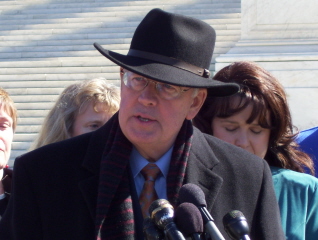
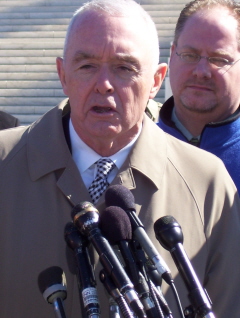
UPDATE: Drug War Chronicle feature report now available here online. DRCNet associate director David Guard attended the "Bong Hits 4 Jesus" free speech demonstration outside the Supreme Court today, and took pictures for the benefit of those of us who couldn't make it there ourselves. Here are some of the highlights: Students demonstrating at the courthouse: Ken Starr, counsel for the bad guys: Former US drug czar Barry McCaffrey (also there for the bad guys): More demonstration and press conference pictures (click the "read full post" or title link in this post to see the rest if you don't already see them):
The Truth About Marijuana Use in the UK

As Phil notes below, there's a new wave of reefer madness taking hold in England. The Independent's reporting is hysterical in both senses of the word, so much so that the ONDCP blog wasted no time in picking up the story.

We're told that marijuana addiction among teenagers has skyrocketed, that marijuana is 25 times stronger than it was generation ago, and that marijuana just might cause schizophrenia. And the underlying implication of all this is that the effort to legalize marijuana, culminating in the UK's 2004 reclassification decriminalizing simple possession, has somehow caused all of these horrible problems.

Interestingly, The Independent's multiple articles yesterday reached their conclusions without mentioning usage rates. Here's why: marijuana use in the UK is going down. From The Observer in October, 2006:
According to a report by the Central Narcotics Office, after more than a decade of rapid growth, seizures of cannabis resin in Europe dropped by a fifth last year, to 831 tonnes.
…

The apparent trend is reinforced by British figures which show that the popularity of cannabis in the UK has plummeted, with 600,000 fewer people smoking or eating marijuana than three years ago.
The failure to address this relevant, yet contradictory fact is a hallmark of alarmist pseudo-scientific drug war reporting. Instead we get this:
Today record numbers of young people are in treatment programmes for skunk [high-grade marijuana] abuse and hospital admissions due to the drug are at their highest ever.
We know that rumors of more potent pot are both wildly exaggerated and largely irrelevant since users adjust their doses to achieve the desired effect regardless of potency. We also know that potency has increased notably (3-4 times, not 25) and that increased potency has much to do with prohibition, which creates a financial incentive for growers to maximize their risk/reward ratio since punishment is determined by weight rather than THC content.

So if it isn't the potency, then what's driving the spike in marijuana treatment in the UK? I think the answer is that reduced stigma and a new policy of not arresting casual users have resulted in more people seeking help. It makes vastly more sense than arguing that marijuana suddenly turned into crack laced with heroin the moment they decriminalized it.

I can't prove my theory anymore than addiction "experts" can prove that marijuana had almost no THC in the '60's. But it makes intuitive sense. Wouldn't you expect more people to seek treatment once the risk of arrest is removed?

After decriminalizing marijuana, the British are seeing lower usage rates and more people seeking treatment. Let's talk about that.

The Independent on Sunday Reverses Itself on Decrim, Warns of Killer Skunk, Reefer Madness

A decade ago, the British newspaper the Independent on Sunday made headlines itself when it came out strongly for the decriminalization of marijuana. Now, sad to say, it appears that the venerable newspaper has succumbed to Reefer Madness. In a front page editorial and series of related articles yesterday, the Independent reversed course:
Yes, our front page today is calculated to grab your attention. We do not really believe that The Independent on Sunday was wrong at the time, 10 years ago, when we called for cannabis to be decriminalized. As Rosie Boycott, who was the editor who ran the campaign, argues, the drug that she sought to decriminalize then was rather different from that which is available on the streets now. Indeed, this newspaper's campaign was less avant-garde than it seemed. Only four years later, The Daily Telegraph went farther, calling for cannabis to be legalized for a trial period. We were leading a consensus, which even this Government - often guilty of gesture-authoritarianism - could not resist, downgrading cannabis from class B to class C. At the same time, however, two things were happening. One was the shift towards more powerful forms of the drug, known as skunk. The other was the emerging evidence of the psychological harm caused to a minority of users, especially teenage boys and particularly associated with skunk. We report today that the number of cannabis users on drug treatment programs has risen 13-fold since our campaign was launched, and that nearly half of the 22,000 currently on such programs are under the age of 18. Of course, part of the explanation for this increase is that the provision of treatment is better than it was 10 years ago. But there is no question, as Robin Murray, one of the leading experts in this field, argues on these pages, that cannabis use is associated with growing mental health problems.
Ouch. This is really a shame, and it's even more shameful because the Independent on Sunday appears to have fallen prey to propaganda that could have come straight from the mouth of the American drug czar. This is not your father's marijuana, the newspaper argues with a straight face, this is the KILLER SKUNK! As one of the related articles puts it, "skunk - a form of cannabis so powerful that experts are warning it can be 25 times more powerful than the cannabis used by previous generations." What!? As far as I know, the most high-powered strains of marijuana are capable of THC yields of around 25% to 30%, with what is commonly known as "kind bud" having a yield of 10% to 15%. (These figures may be a bit off, but not much). Marijuana with 1% THC is about the equivalent of ditch weed. For the Independent's claims to be accurate, all those people smoking pot in Swinging London in the 1960s must have been smoking ditch weed and deceived into thinking they were getting high, while everyone in London now must be smoking the most exclusive buds in the world. This "25 times" figure is just plain bogus, and I don’t understand how the Independent fell for it. We've already debunked the American drug czar's version of this. Now are we going to have to do remedial work across the pond? Besides, skunk is but one variety of high-potency weed. What about AK-47 and White Widow? Singling out skunk as the culprit seems to be to be based on ignorance more than anything. I am also struck by the increasingly shrill claims of links between marijuana and madness. These seem to be especially prevalent in the United Kingdom and Australia. (While the UK frets about skunk, the Australians have their own idiosyncratic and equally scientifically indefensible bogeyman: HYDROPONIC! As if the growing medium used to produce marijuana were the determinant of its nature.) I'm not prepared to debunk the Independent on these claims today, but I do wonder about at least two things: Why isn’t this stuff driving us crazy over here, or, at least, why isn’t John Walters raising holy hell about the link between marijuana and madness? And if marijuana use has increased dramatically in the UK in past decades and if potency has indeed increased (which I don't doubt), then where is the accompanying spike in reported schizophrenia cases? I think I'm going to have to do a feature article on this important and disappointing turn of events. I'll use that to look more closely at the claims about marijuana and mental illness. I am starting to get worried, though; I've been smoking that stuff for 35 years, and now madness could be right around the corner. Who knew?

ABA Spring Conference: Overcoming Legal Barriers to Reentry

This conference will bring together policy-makers, government officials, business leaders, and community advocacy groups from across the country to explore ways in which they can together encourage successful offender reentry within their respective jurisdictions.

26th Annual ISIL World Conference

At this event we will help celebrate the 400th anniversary of the founding of English America at Jamestown, and also celebrate America's revolutionary heritage. But our U.S. and international speakers will also discuss innovative measures and strategies to solve some of today's serious problems. These are always exciting and memorable events, and this is a rare opportunity to enjoy an ISIL conference in the States (the first since 1990) and make new freedom-loving friends from here and abroad.