Five Architects of the Drug War -- and the Result of Their Work
Alex Coolman's Drug Law Blog has published a list -- with pictures -- of "5 Bumbling Architects of America's War on Drugs": Hamilton Wright, Richmond Pearson Hobson, Harry Anslinger, William Randolph Hearst, and Richard Nixon. It's a good historical review of how duplicitous and random the pathway to prison and the current drug war really was. In order to believe that current US (and world) drug policy makes sense, it is necessary to assume that a sensible drug policy occurred by accident.
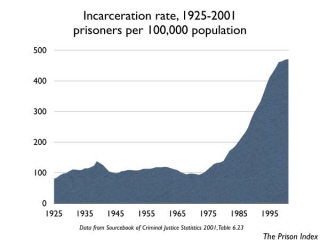
The most important picture is the one at the end, showing the result of our architects' efforts:
San Francisco Orders Medical Marijuana Dispensaries to Sell Fatter Bags
Regulation of medical marijuana distribution can have some interesting side effects. The following email, sent to a dispensary operator by an employee of the San Francisco Department of Health, shows that the city is requiring clubs to be more careful in their measurements:
This is the kind of regulation the marijuana industry actually needs. Hopefully someday, when the DEA shows up at your dispensary, it wonât be to confiscate your proceeds and product, it will be to warn you: "It's come to our attention that you're selling skimpy sacksâ¦"
Dear MCD Applicant;In other words, San Francisco is ordering dispensaries to give patients more bud for their buck. The extra 3rd of a gram per ounce isnât going to put any providers out of business, but it's amusing to see the city intervene on behalf of medical marijuana consumers.
It has come to my attention that some MCD's [medical cannabis dispensaries] are using the incorrect equivalent conversion between grams and ounces. You must use 28.35 grams/ounce, not 28 grams/ounce for all cannabis sold by weight. The law behind this is in the State Business and Professions Code, which is typically enforced by Weights and Measures (State Dept of Agriculture). As they currently are not addressing weights and measures issues regarding cannabis clubs, the City's MCD Inspection Program will enforce this requirement.
Please feel free to share this with any club operator (I do not have email
for most operators).
Thank you for your cooperation.
This is the kind of regulation the marijuana industry actually needs. Hopefully someday, when the DEA shows up at your dispensary, it wonât be to confiscate your proceeds and product, it will be to warn you: "It's come to our attention that you're selling skimpy sacksâ¦"
New Resource on Judges' Views on Federal Sentencing -- Basically, They Hate It
Law professor David Zlotnick has released a new resource on judicial views on the federal sentencing system, available on his web site at the Roger Williams School of Law (link below). Briefly, judges don't like it. A few of the comments Zlotnick collected -- from the additional comments section -- provide some flavor of what it is to be found there:
Judge Morris S. Arnold Eighth Circuit Court of Appeals Appointed by George H.W. Bush, 1992 "You may say that I said that many of our drug laws are scandalously draconian and the sentences are often savage. You may also quote me as saying the war on drugs has done considerable damage to the Fourth Amendment and that something is very wrong indeed when a person gets a longer sentence for marijuana than for espionage." Senior Judge Andrew W. Bogue District of South Dakota Appointed by Richard Nixon, 1970 Prior Legal Experience: State's Attorney, Turner County, South Dakota, 1952-1954 "I will say this on the sentencing guidelines: I detest them. The sentencing guidelines divest courts of their role in imposing just and appropriate sentences to fit the crime and the defendant, with due consideration to all the attendant circumstances. They deprive judges of their discretion which is the touchstone of justice. Were the sentencing guidelines merely suggestive, they might very well serve as an important and helpful model which could assist judges in a difficult task. However, in their present form, as I said, they are detestable." Judge Richard A. Gadbois, Jr. (deceased) Central District of California Appointed by Ronald Reagan, 1982 "The law stinks. I donât know a judge that thinks otherwise."Following are some introductory comments from Zlotnick, via Doug Berman's Sentencing Law and Policy blog:
I am pleased to announce that the website for my federal sentencing project can be now be accessed at this link. The underlying research for this project was funded by a Soros Senior Justice Fellowship grant and was conducted over the past four and a half years. The heart of the work is contained in forty comprehensive case studies of federal cases in which Republican appointees complained that the sentences required by law were excessive. These profiles are the most comprehensively documented cases studies of federal sentencings available on the Internet. The site also includes a draft of my forthcoming article in the Colorado Law Review, "The Future of Federal Sentencing Policy: Learning Lessons from Republican Appointees in the Guidelines Era." This article contains a blueprint for sentencing reform legislation that might resonate with this cohort of federal judges in the post-Booker era. The launch of the website this summer is intended to allow my work to be used by sentencing reformers in the upcoming debate in Congress over the Sentencing Commission's proposed changes to the crack cocaine penalties. By showing that Republican appointees share many of the same concerns as academics and criminal defense attorneys, I hope to explode the myth of the liberal federal judiciary and pave the way for meaningful and bipartisan sentencing reform.
Last Tuesday's Senate Judiciary Committee hearing
This hearing on Justice Dept. oversight turned out to be rather encouraging for sentencing reform. Sen. Jeff Sessions asked AG Gonzales about the Department's position on ending the crack/cocaine sentencing disparity. He said he would be happy to conference about it. When pressed he said he didn't think it should be changed. He then proceeded to make John Walters proud. Sen. Leahy was having none of it. He said we know where cocaine is. It's in the boardrooms, on the yachts and etc. He went on to state that cocaine users are more likely to be able to better defend themselves on charges. Gonzales couldn't say anything more. Seeing an Alabama Republican pose this question, and Leahy back him up was wonderful. The wheels certainly grind slowly, but they DO grind. I don't know where this will lead, but seeing it discussed by two prominent members on the committee even for a minute shows the prohibitionists propaganda fog is slowly lifting.
Taking it to the Drug Warriors--Is It Time for Direct Action?
You know, a guy gets tired fighting for decades for the right to do something which should be our right anyway. Yeah, I know the litany: We've got to play the game...if you don't like the law, change it...the political process is slow...we can't be impatient...we have to educate politicians and cultivate law enforcement....blah blah blah.
Well, in the face of the no-progress Hinchey-Rohrabacher vote and the continuing defiance of the will of California voters by the DEA, not to mention all the other drug war horrors, I'm prepared to once again make inciteful (if not insightful) calls for direct action against these downpressors.
1. Let's take the DEA's war on medical marijuana patients and providers to the DEA. Let's shut 'em down in California. Blockade their offices, and not for symbolic civil disobedience purposes, but for the actual purpose of disrupting their activities.
2. Let's really take it to the DEA. These black-suited, paramilitary-style goons presumably have homes in the area. I'd like to see protestors on the sidewalk in front of their houses. Ooh, but you say it's not polite or uncouth to do that sort of thing! Well, I frankly find DEA goons kicking down doors and arresting harmless people who didn't do anything to anybody pretty impolite and uncouth. Maybe they'll enjoy explaining to their neighbors (two out of three of whom voted for Prop 215) how they earn a living. These thugs need to pay a price for what they do, and I personally don't care if it offends the sensibilities of some of our more delicate members. And I don't buy their "I'm only following orders" excuse, either. It didn't fly at Nuremburg, and it shouldn't fly now. It's time for public shaming and shunning.
3. And maybe we should be focusing on a mass march aimed at national DEA headquarters one of these months. Again, the purpose would be practical--not symbolic--to shut the monster down. This is an agency that needs to be abolished, and until we can accomplish that, the least we can do it make it impossible for it to function properly.
3. More broadly, let's attack the snitch system that underpins the drug war. Last week, we did a newsbrief on the couple in Philadelphia indicted for posting flyers outing a snitch. They copied information from the Who's A Rat? web site, which is protected by the First Amendment. The folks in Philadelphia are charged with intimidating witnesses--by making public information about what they are doing--and I hope they fight that case all the way. Snitches have no right to have their exploits go unsung. In solidarity with the Philadelphia folks, and everyone who has suffered from drug war snitchery, I propose that DRCNet enter into a collaboration with Who's a Rat? by posting the information about one undercover officer (they list more than 400) or one snitch (they list over 4000) online each week. Personally, I would rather go after the narcs than the snitches, most of whom are victims themselves. ("You're gonna go to prison for 30 years and get raped by hardened cons if you don't give up the names..."). Snitches may be victims of circumstance (and a weak values system), but narcs do this horrid work for a living, either because they believe in or they like it. I want to see their names and mugs plastered across the internet. I don't suppose my boss will agree with me on this one, although I'd like to hear why not.
5. Police on a drug raid in Belfast this week were met by a rock-throwing mob. Mindful of the incitement statutes, I have no comment.
Whaddya think, folks? I'm really, really tired of waiting for lamebrain politicians to protect me from these thugs. I guess I'm going to have to do it myself. With your help.
More "responsible" members of our movement generally shy away from tactics like these. Let them be responsible. I want to fight back.