Editorial: A Matter of Basic Fairness in the Marc Emery Case
The case of Canada's famed marijuana advocate Marc Emery raises issues of basic fairness and illuminates the darkness in today's criminal justice system.
Update: Marc Emery
The article in the paper was so small I almost missed it. I guess no-one's particularly proud of this one. Mr. Emery not only got to serve his time in Canada, he managed to get his co-accused off the hook as well.
Press Coverage of the Drug War is So Flawed it Actually Encourages People to Sell Marijuana
I wrote yesterday about an absurd report in The Philadelphia Inquirer which valued marijuana at over $100 per joint. As I pointed out, boastful law-enforcement sources frequently collaborate with slothful reporters to produce wildly inaccurate news coverage of the drug war.
Obviously, it is just unacceptable to have major news sources reporting frivolous and false information. The laugh-out-loud craziness of implying that a joint costs $100 just shouldnât have made it to print, and we can all gaze at this spectacle and shake our heads as we recognize that the incompetence which made this report possible is perfectly typical. It explains volumes about the media's neglectful role in permitting drug war indoctrination to permeate our collective consciousness each day. It is 2007, and we shouldn't even be reading celebratory drug bust stories anymore, because each new one is a mere exhibit of the failure of those that came before it.
But, beyond all of that, it stands to reason that such coverage has a remarkable potential to entice individuals to enter the drug trade in the first place. The theoretical deterrent value of reporting on major drug busts and the fate of the perpetrators is surely undermined when profit margins are overstated so dramatically.
If one believes The Philadelphia Inquirer that 16 pounds of high-grade marijuana can be sold for $812,000, and one subsequently stumbles across an opportunity to acquire that amount for the (more likely) price of $50,000-80,000, they might be intrigued. By routinely exaggerating the street value of illegal drugs, the press renders itself an inadvertent advertising campaign for the lucrative business of black market drug distribution.
I've heard, but cannot confirm, that the Canadian press has sought to scale back this exact behavior after a revelation that constantly reporting on multi-million dollar marijuana seizures was having the effect of convincing people that it's easy to make a million dollars growing pot. I have no idea whether this is accurate, but it's certainly amusing to consider the possibility that all of this reckless drug war reporting is simply emboldening prospective marijuana entrepreneurs.
One wonders, therefore, how many more of these drug bust press conferences our intrepid journalists are willing to snooze their way through before becoming overcome with déjà vu and finding themselves compelled by the distant call of journalistic integrity to do anything other than cut and paste the predictable pontifications of the proud pot police into the morning paper.
Obviously, it is just unacceptable to have major news sources reporting frivolous and false information. The laugh-out-loud craziness of implying that a joint costs $100 just shouldnât have made it to print, and we can all gaze at this spectacle and shake our heads as we recognize that the incompetence which made this report possible is perfectly typical. It explains volumes about the media's neglectful role in permitting drug war indoctrination to permeate our collective consciousness each day. It is 2007, and we shouldn't even be reading celebratory drug bust stories anymore, because each new one is a mere exhibit of the failure of those that came before it.
But, beyond all of that, it stands to reason that such coverage has a remarkable potential to entice individuals to enter the drug trade in the first place. The theoretical deterrent value of reporting on major drug busts and the fate of the perpetrators is surely undermined when profit margins are overstated so dramatically.
If one believes The Philadelphia Inquirer that 16 pounds of high-grade marijuana can be sold for $812,000, and one subsequently stumbles across an opportunity to acquire that amount for the (more likely) price of $50,000-80,000, they might be intrigued. By routinely exaggerating the street value of illegal drugs, the press renders itself an inadvertent advertising campaign for the lucrative business of black market drug distribution.
I've heard, but cannot confirm, that the Canadian press has sought to scale back this exact behavior after a revelation that constantly reporting on multi-million dollar marijuana seizures was having the effect of convincing people that it's easy to make a million dollars growing pot. I have no idea whether this is accurate, but it's certainly amusing to consider the possibility that all of this reckless drug war reporting is simply emboldening prospective marijuana entrepreneurs.
One wonders, therefore, how many more of these drug bust press conferences our intrepid journalists are willing to snooze their way through before becoming overcome with déjà vu and finding themselves compelled by the distant call of journalistic integrity to do anything other than cut and paste the predictable pontifications of the proud pot police into the morning paper.
Prince of Pot Pleads Out
Marc Emery, the self-styled Prince of Pot has accepted a plea bargain which would see him serve five years in a Canadian prison. It's difficult to gauge how much influence the numerous petitions and letter campaigns had in the justice system offering this deal.
Banning Cylindrical Objects Won't Stop People from Smoking Crack
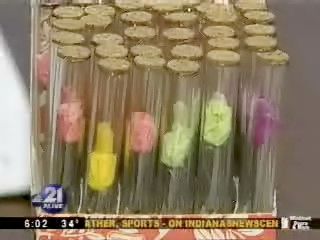
You know those little roses that come in glass tubes? You can buy them at gas stations for a buck or two and then use them however you see fit. And, as luck would have it, some folks like to put crack in them and smoke it. It should therefore come as no surprise to find people calling for a ban on these so-called "love roses."
â¦Reverend Michael Latham, the leader of the local NAACP Chapter, says these "love roses" are littering our streets and damaging our community.
Rev. Michael Latham: "Take it out. Don't sell it. And, understand it's being used to for smoking crack cocaine. I think Fort Wayne has a real serious crack problem."
Latham is calling for a boycott of at least three gas stations in Fort Wayne after calling the owners to complain. [Indianasnewscenter.com]
 |
|
Inevitably, when the citizens of Ft. Wayne, Indiana endeavor to misdirect their concerns over the local drug problem, they've got a powerful ally in their congressman, drug war hall-of-shamer Mark Souder.
Mark Souder/Congressman, 3rd District: "I support a boycott. That's voluntary consumer decision."
Did Mark Souder just use the term "voluntary consumer decision"? Lucky me, I'd have bet anyone anything that we'd never hear those words leave his lips given his career-long commitment to jailing certain consumers for the voluntary decisions they make. Souder then proceeds to celebrate his sudden affinity for consumer choice by proposing a new law banning small containers:
Co-Chair of the House Drug Policy Caucus, Souder thinks Latham's plan is a good one. The Congressman hopes to go one step further in the near future with a law banning hidden drug compartments, like these.
Mark Souder/Congressman, 3rd District: "I believe when something is used solely for illegal purposes, it should be illegal."
Even if "love roses" were literally never used for anything other than smoking crack, their prohibition would still accomplish nothing absent the simultaneous prohibition of other popular crack accessories such as soda cans, cigarettes, and radio antennas. But I also don't see why these pretty little roses couldn't sometimes be used just to brighten someone's day.
Remind me to send Mark Souder a dozen "love roses" for Valentine's Day.
Philadelphia Police Say Marijuana Costs $100 Per Joint
Exaggerating the value of drug seizures is an age-old tactic in the drug war. Fuzzy math can turn a routine bust into a career-making front page news story, so it's no surprise that narcotics officers frequently miscalculate the value of their scores. But when a major paper like The Philadelphia Inquirer inadvertently values marijuana at $100 per joint, you know things have gotten out of hand:
Today, police laid out 16 pounds of the stuff they said they confiscated from a high-level dealer who supplied the suburbsâ¦
Police put the value of the marijuana at $812,000. On Tuesday, as the probe continued, investigators seized 12 pounds of hallucinogenic mushrooms worth $614,000 and more than $439,000 in cash, police said. [Philadelphia Inquirer]
Really?!? Let's do the math. $812,000 / 16 pounds / 16 ounces / 28.3 grams = $112.08 per gram. That's a hearty marijuana joint for $112. The same formula finds them valuing the mushrooms at a whopping, and oddly similar, $113 per gram.
Just look at High Times Magazine's Market Quotes for marijuana to see that the highest street prices come nowhere close to these wildly false numbers. A gram of the very best pot can fetch $25-30, usually less. It is literally as though they calculated the value of the seizure and added a zero at the end (actually that's currently my best guess as to what happened here).
This is what we get when reporters simply pass along claims from police regarding drugs. Law-enforcement's lack of expertise on certain drug-related matters, combined with their incentive to exaggerate their own achievements, creates an obvious imperative that the press seek to substantiate such claims before offering them to the public.
This announcement from The Philadelphia Inquirer that marijuana costs $100 per joint is just a perfect example of the media's ongoing failure to provide responsible coverage of the war on drugs.
[Thanks, Irina]