SWAT SHOT
Last night I happened to be channel surfing and came across what I thought was an embedded videographer doing a story on a forced entry of a Al Qaeda stronghold in Iraq. Typical army stuff, helmets, masks, flak jackets, squad level weapons, guys shuffling along in a camouflaged conga line, and everything available to blow away anyone that objected.
Now That We've Forgiven Barack Obama's Drug Use, Can We Forgive Everyone Else Too?
Note: I posted this a few weeks ago, but withdrew it so I could use some of the language in a Op-ed which was rejected by The Washington Post (probably for being too awesome). I repost it today in response to Obama's recent rejection of marijuana decriminalization.
One of the most fascinating developments of the '08 presidential primaries has been the rising taboo against criticizing the candidates for their youthful experimentation with drugs. We've come a long way since "I didn't inhale," but is this really an evolving discourse surrounding drug use in American life or merely a truce between the privileged press and political classes?
It began with the resignation of Hillary Clinton's New Hampshire campaign co-chair following barbed remarks about Barack Obama's past drug use. Now, a comment by BET founder and Clinton supporter Robert L. Johnson is drawing similar condemnations:
Johnson said the Clintons have been "deeply and emotionally involved in black issues â when Barack Obama was doin' something in the neighborhood that I won't say what he was doin,' but he said it in his book."
The Clinton campaign later put out statement in which Johnson claimed he was referring not to drug use but to community organizing.
The Obama campaign Monday said that story does not wash. "His tortured explanation doesnât hold up against his original statement," campaign press secretary Bill Burton said in a statement. [Politico]
Clearly, conventional wisdom now holds that voters don't think past drug use rises to the level of relevance in a presidential campaign. To even mention such a thing is considered so rude and toxic that doing so reflects more poorly on the messenger than the target. And this is the Most Important Job in the World we're interviewing for.
What we're witnessing here is notable to be sure. But is this really a signal that our society is maturing in its attitude about drug use, or just another example of the class-based prejudice that ignores drug experimentation among the educated and upwardly-mobile, while police continue to flatten poor communities with their massive drug war hammers?
As rare and encouraging as it is find the media directing its guile towards the accuser and not the user, we still live in a society that collects urine from millions of blue-collar Americans as a method of assessing their job qualifications. We still live in a society that revokes aid for higher education from students with drug convictions, a society that revokes low-income housing and food stamps from poor people for engaging in the exact same behavior whose mere mention is now off-limits even in the no-holds-barred realm of presidential politics. And, unbelievably, we live in society where felony disenfranchisement is so widespread it can change the outcome of these same elections in which the criminal histories of the candidates are never to be discussed.
Now that our pundits and politicians have elected to shield one another from the consequences of their own indulgence, will they bestow the blessings of this grand enlightenment on the rest of us? Perhaps, but not until the people hold these high offices hostage and demand equal justice from the hypocrites who quibble over the contents of their autobiographies while fathers of four wait for their records to be expunged so they can apply at Home Depot.
Protest Against Police Violence is Monitored From Above by Police Snipers
Concerned citizens in Lima, Ohio continue to search for answers six weeks after their local SWAT team killed an innocent woman and shot her baby during a drug raid. Though the police department has yet to explain the shooting, their behavior certainly speaks volumes about the Us vs. Everyone mentality that made this tragic event possible.
Via The Agitator, snipers from the Lima SWAT team were perched on the rooftop as citizens gathered to discuss the violent excesses of the Lima SWAT team. Apparently, they think you pose a threat if you protest the threat that they pose:
This is the same SWAT team that had to remove an image from its website shortly after the shooting, which depicted a SWAT officer firing a machine gun straight at you when you opened the site. The graphic made anyone visiting the site feel like a potential target, which was exactly the wrong message to send after killing an innocent mother of six and shooting her baby.
Yet, the decision to post SWAT snipers atop the local high school during a town hall meeting discussing SWAT violence is even more hideous. An act so ironic and inappropriate is an unambiguous statement of contempt towards a confused and grieving community. If the Lima Police Department were even remotely concerned about the widespread public animosity they'd already caused, they would not behave this way. And if they had a plausible explanation for killing an innocent woman and shooting her baby, we'd have heard it by now.
Ladies and gentlemen, allow me to introduce you to the War on Drugs. You might have heard of it before, but you really don't understand what it is until you've witnessed the spectacle of hundreds of African Americans marching hand in hand against indiscriminate police violence. If you've formed an opinion about drug prohibition without realizing that innocent mothers and babies are getting shot, then please take this opportunity to reassess the situation.
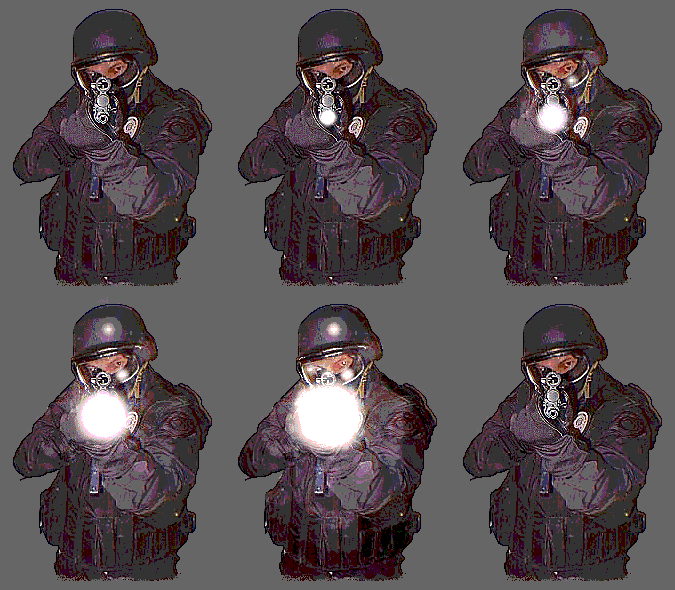
animated graphic from Lima Swat Team web site -- they took it down after killing Tarika Wilson
Via The Agitator, snipers from the Lima SWAT team were perched on the rooftop as citizens gathered to discuss the violent excesses of the Lima SWAT team. Apparently, they think you pose a threat if you protest the threat that they pose:
As residents arrived in the parking lot at the school, several noticed movement on the roof of the buildings. The Lima SWAT team was in position looking down on the gathering speakers. âHere we come in good faith, and they have snipers on the roofs of our school! We came in peace, and they are ready to gun us down like dogs!â Willie Manley vowed to ask them face to face. âHow can we trust you, when you canât trust us?âBy what sort of twisted logic was it decided that these peaceful protesters might have to be put down? The whole thing just smacks of intimidation.
The mood seemed to changed as people continued to walk into the school many taking a final glance at the rooftops in disbelief, shaking their heads and commenting to friends. [The Sojourner's Truth]
This is the same SWAT team that had to remove an image from its website shortly after the shooting, which depicted a SWAT officer firing a machine gun straight at you when you opened the site. The graphic made anyone visiting the site feel like a potential target, which was exactly the wrong message to send after killing an innocent mother of six and shooting her baby.
Yet, the decision to post SWAT snipers atop the local high school during a town hall meeting discussing SWAT violence is even more hideous. An act so ironic and inappropriate is an unambiguous statement of contempt towards a confused and grieving community. If the Lima Police Department were even remotely concerned about the widespread public animosity they'd already caused, they would not behave this way. And if they had a plausible explanation for killing an innocent woman and shooting her baby, we'd have heard it by now.
Ladies and gentlemen, allow me to introduce you to the War on Drugs. You might have heard of it before, but you really don't understand what it is until you've witnessed the spectacle of hundreds of African Americans marching hand in hand against indiscriminate police violence. If you've formed an opinion about drug prohibition without realizing that innocent mothers and babies are getting shot, then please take this opportunity to reassess the situation.
animated graphic from Lima Swat Team web site -- they took it down after killing Tarika Wilson
Where Should Public Health End and Criminal Justice Begin
Today,Feb,13'08 a conference held at the UBC campus at Robson square asked that question and the answer was ; only as a last resort and countering violence exclusively. Harm reduction was the order of the day and a lack of both money and political will were cited as reasons for the pathetic response to the need for treatment that is both feasible and of a duration that would give success a chance.
TRUTH IN STRANGE PLACES AWARD
Our Truth In Strange Places Award goes this month to the new US Attorney for Northern California, Joseph Russoniello, who said, in regard to cracking down on medical marijuana,
âWe could spend a lifetime closing dispensaries and doing other kinds of drugs, enforcement actions, bringing cases and prosecuting people, shoveling sand against the tide. It would be terribly unproductive and probably not an efficient use of precious federal resources,â
Cops don't necessarily need a drug offense to be complete jerks.
This is one of the most disturbing events in today's news.
Here in Florida, of course.
http://www.tampabays10.com/news/local/article.aspx?storyid=73902
Welcome to the police state.
Come on vacation