Shooting Down Innocent People in Airplanes Wonât Win the Drug War
When the average person forms an opinion regarding the efficacy of our drug policy, are they taking into account the totality of brutal unforeseen disasters that regularly occur in the course of our international anti-drug crusade? Alas, the reality of the actual drug war (not the one the drug czar talks about) is considerably uglier than many among us realize.
Thatâs why this Wall Street Journal piece from Mary Anastasia OâGrady stands out as an example of what drug war reporting in the mainstream press ought to look like.
Yet, as OâGrady explains, this was in fact the perfectly predictable consequence of an out-of-control drug interdiction program that basically shot planes out of the sky with no investigation and no oversight. The problem isnât just that they killed innocent people, but that they created and maintained a policy that they must have known would produce that result. Itâs the perfect exhibit in the total disregard for innocent human life that is central to the drug war itself.
To her credit, OâGrady is willing to make the connection between violence and prohibition:
In other words, we get nothing in exchange for the death and destruction weâve subsidized and sustained for all these years. Nothing, that is, except a bunch of dead innocents, a smoldering civil war below our border, a world-record prison population, and a shameless political culture that still swears this is the only way to deal with drugs.
Thatâs why this Wall Street Journal piece from Mary Anastasia OâGrady stands out as an example of what drug war reporting in the mainstream press ought to look like.
Innocents Die in the Drug War
Of all the casualties claimed by the U.S. "war on drugs" in Latin America, perhaps none so fully captures its senselessness and injustice as the 2001 CIA-directed killing of Christian missionary Veronica Bowers and her daughter Charity in Peru. Â
â¦
On that day the Bowers family was flying in a single-engine plane over the Amazon toward their home in Iquitos. Mrs. Bowers was holding the infant on her lap when a bullet fired by the Peruvian Air Force, under direction of the CIA, hit the aircraft, traveled through her back and into Charity's skull. The plane crash-landed on the Amazon River. Mr. Bowers, his young son and the pilot survived. Neither the plane nor its passengers were found to be involved in any way in the drug business and initial reports said that the mistaken attack was a tragic one-time error.
Yet, as OâGrady explains, this was in fact the perfectly predictable consequence of an out-of-control drug interdiction program that basically shot planes out of the sky with no investigation and no oversight. The problem isnât just that they killed innocent people, but that they created and maintained a policy that they must have known would produce that result. Itâs the perfect exhibit in the total disregard for innocent human life that is central to the drug war itself.
To her credit, OâGrady is willing to make the connection between violence and prohibition:
Consider the fact that Mr. Clinton's justification for the Airbridge Denial Program was that drug trafficking was a threat to Peruvian national security. Of course it was: Prohibition naturally produces powerful criminal networks that undermine the rule of law.
â¦
Since then, U.S. interdiction has put the pressure on Colombia and the problem is now resurging in Peru. The latest reports are that Mexican cartels are teaming up with remnants of the Shining Path terror network to rebuild the business, proving once again the futility of the supply-side attack as a way of minimizing drug use in the U.S.
In other words, we get nothing in exchange for the death and destruction weâve subsidized and sustained for all these years. Nothing, that is, except a bunch of dead innocents, a smoldering civil war below our border, a world-record prison population, and a shameless political culture that still swears this is the only way to deal with drugs.
Day One at the U.N. Drug Treatment Meeting -- Slightly More Interesting Than Predicted
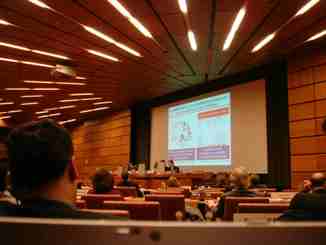
More than 200 people from around the globe have shown up for the first day of this drug treatment meeting at the United Nations Office on Drugs and Crime (UNODC) in Vienna. (If you're just tuning it, it may be helpful to read my first post, from yesterday, where I set the stage for what's to come.) Tantalizingly titled "Technical Seminar on Drug Addiction Prevention and Treatment: from Research to Practice," the tag line at the bottom of the conference program awkwardly hawks "NOTHING LESS than a qualified, systematic, science-based approach such as that used to treat other health conditions" â a fair enough goal. I tell you, the crowd was on tenterhooks for the event to begin.
In truth it was the most subdued, dead crowd ever gathered. Perhaps the most exciting event of the day was kangaroo hotpot on the canteen menu. To be clear, I have less interest in the science on show than on the subtexts of the dialogue and what is said and not said â all with an eye on the Commission on Narcotic Drugs (CND) meeting occurring next March. At that convening, countries will gather to review the last decade of UN-approved international drug policy, set forth at the first United Nations General Assembly Special Session (UNGASS) on Drugs in 1998, and issue a new UN Political Declaration. I suspect that the goings on at this prior conference may offer hints of what's to come.
Antonio Maria Costa, the Executive Director of the UNODC, was in fine fettle opening the event. True to his pompous, unapologetic manner he was disrespectfully late, but his opening remarks were good. He wants the CND/UNGASS process to put increased money into demand reduction in order to put health at the center of the equation and reduce drug related crime. Consequently, Costa called for the rebalancing of drug control (by putting a greater emphasis on health), expressed concern that too little is spent on treating drug addiction, and acknowledged that law enforcement should not be used as an alternative to treatment. Costa also rejects the over-incarceration of drug users (he's been consistent about this).
I'd like to think that Costa's comment re: over incarceration was an unsubtle dig at the US, where 1 in 31 US citizens live under the auspices of the criminal justice system. However, I suspect he's directing his remarks at the world below the equator or at Central Asia. In so many words, he admonished member states for not protecting their drug users and respecting their human rights.
The day went downhill from then on in, as the conference morphed into a showcase for the disconnect between the science around drugs and addiction and the current reality re: which research-based policy recommendations are ever actually applied or funded or prioritized by governmental bodies. Consider the presentation of the keynote speaker, Dr. Nora Volkow, who heads the United States' National Institutes on Drug Abuse. I like Volkow. She cares about people who use drugs, and exudes compassion and even fire when she defends them. Before her presentation, we had a conversation about the federal ban on the funding of syringe exchange, and she expressed real excitement about working for Barack Obama.
Certainly Dr. Volkow's presentation on the science of addiction was well done, and it affirmed much of what has been said for years by those of us who are involved in harm reduction. She ran through her Positron Emission Tomography (PET) Scan studies (they show the effect of drugs on the brain) and noted that there is hope of our someday being able to know in advance who is vulnerable to problematic drug use. In stating that abstinence is 'magical thinking' and addiction has a smorgasbord of serious medical consequences, including hiv/hcv, cancer, and mental illness, associated with it, she laid out a fine argument for embracing harm reduction without connecting the dots of course. She noted that people are people are at risk due to environmental factors.
But looking at the blues, reds and yellows in the dissected brains on show, one would be hard pressed not to consider the color of the person who possessed this brain to begin with and then the hard, cold facts re: the skin color of who actually gets locked up for long periods of time in the US for having what Dr. Volkow was describes as a brain disease. The drug war in the US has disproportionately affected people and communities of color. Looking at the science of addiction doesn't dispel the effects of institutionalized racism. Nor does it reunite families, deliver education, or prevent HIV transmission. Scientific discovery is only the first step; it won't do us much good unless and until it's translated into real world policies and services. Hopefully that's Dr. Nora Volkow's dream under Obama (and Obama's dream as President): to put the theories that come out of what she and her colleagues are learning in the lab into practice.
Most of the rest of the presentations were equally predictable. Drug treatment works. Drug prevention is cost effective. Drug treatment is cost effective. Addiction is a brain disease. Methadone works. Buprenorphine works. And that's all to the good. But will any of the policy recommendations that come out of this research ever actually be applied or funded or prioritized by governmental bodies? Anywhere?
Vladimir Poznyak, from the Department of Mental Health and Substance Abuse at the World Health Organization (WHO), was the first person to bring up harm reduction. Clearly there is some tension between WHO and this UNODC meeting. Given the consistent commitment WHO has expressed for harm reduction, Poznyak pointedly highlighted needle exchange and harm reduction as HIV prevention in a WHO technical manual during his talk.
But for my money the Man of the Day was Ingo Michels from the Ministry of Health in Germany. Michels' presentation, which detailed Germany's comprehensive drug treatment system and included information on safer injection sites, heroin prescription, and drug user organizations, clearly rejected the extent to which harm reduction had remained hidden and unspoken during the first day. It was also the first indication that harm reduction is more than just a means of HIV prevention.
Your intrepid reporter then got the first question in. Prattling on in my usual fashion that is never succinct and always more about making a point rather than asking a simple question, and bearing in mind what I said in yesterday's post about the way in which US governmental representatives at these UN meetings always suppress the extent of harm reduction and needle exchange programs in the US and their success, I went at it. I detailed out the number of needle exchange programs in the US; noted out that the larger programs are federally funded (except for needles); and pointed out that they represent a continuum of care for drug users, act as a safety net for drug users who are "out of treatment," and make referrals to drug treatment. In short, I argued that the UN is cornering itself by limiting harm reduction programs as just an HIV intervention.
Well, that set Michels off. He slammed the US representatives for blocking the UNGASS process and said he hoped the Obama Presidency would mean that there would be a new UNGASS delegation at this March's meeting. (Being fairly new to this process, I think he probably overstepped his bounds. Excellent stuff.) Surprisingly, the conservative panel facilitator, Gilberto Gerra, Chief of Health and Human Development Section of UNODC, also animatedly joined the discussion by saying that UNODC believes that harm reduction should be part of the "comprehensive package."
I'll be damned.
More battle to be joined tomorrow.
Allan Clear is executive director of the Harm Reduction Coalition.
 |
 |
|
|
|
When it Comes to Marijuana Laws, Obamaâs Website Should be Called Same.gov
Did anyone notice how the marijuana legalization question was ranked #1 on Obamaâs Change.gov site, but he answered the question 4th? Not only did Obamaâs team fail to explain the "no" answer, but they didnât even honor the 1st place popularity rank the question earned when it drew the most votes from the public.
Thereâs nothing surprising about any of this, but it is indeed perfectly emblematic of the profound lack of seriousness with which this issue is treated in our political culture. The marijuana question was answered second to last and received the shortest response of all the questions. Itâs just not something our political leadership wants to talk about. There is scarcely anything less important to them than this and theyâd really appreciate it if we stopped asking about it.
But we wonât stop. Certainly not now. Perhaps we appreciate the symbolism behind Obamaâs Change.gov campaign even more than its authors do. Yes, we surged at the opportunity to push forward ideas long relegated arbitrarily to the political fringe. We seized upon this new venue for unfiltered political dialogue, an entirely unclaimed territory in which we had yet to be told we were unwelcome. We clutched it in our collective fist, squeezed it with all our might, and recoiled in disgust when it squirted us in the eye.
Sure, we got burned, but we saw it coming. They didnât see us coming. They never could have imagined that this experiment with online democracy would find us standing at the front of the line. They shook their heads, sighed and joked that this is what you get when you let the frickinâ internet dictate political priorities.
Well, itâs fine with me if they think that, because theyâre the ones kissing the internetâs ass in the first place. Will they now retreat to the editorial pages and go back to letting the pundits tell them what the people want?
Thereâs nothing surprising about any of this, but it is indeed perfectly emblematic of the profound lack of seriousness with which this issue is treated in our political culture. The marijuana question was answered second to last and received the shortest response of all the questions. Itâs just not something our political leadership wants to talk about. There is scarcely anything less important to them than this and theyâd really appreciate it if we stopped asking about it.
But we wonât stop. Certainly not now. Perhaps we appreciate the symbolism behind Obamaâs Change.gov campaign even more than its authors do. Yes, we surged at the opportunity to push forward ideas long relegated arbitrarily to the political fringe. We seized upon this new venue for unfiltered political dialogue, an entirely unclaimed territory in which we had yet to be told we were unwelcome. We clutched it in our collective fist, squeezed it with all our might, and recoiled in disgust when it squirted us in the eye.
Sure, we got burned, but we saw it coming. They didnât see us coming. They never could have imagined that this experiment with online democracy would find us standing at the front of the line. They shook their heads, sighed and joked that this is what you get when you let the frickinâ internet dictate political priorities.
Well, itâs fine with me if they think that, because theyâre the ones kissing the internetâs ass in the first place. Will they now retreat to the editorial pages and go back to letting the pundits tell them what the people want?
High School Seniors Are Using Lots of LSD This Year
Jacob Sullum pokes numerous holes in the drug czarâs recent claims of dramatic drug war progress. This in particular jumped out at me:
Be careful out there, kids! Thanks to the total failure of the war on drugs, you are up to your asses in acid and meth, but seriously, do not mix them. It will suck. Youâll get arrested (and probably tasered, too).
See, contrary to the drug czarâs wild accusations, those of us who want to end the drug war have no interest in seeing young people make poor choices. And the fact that Americaâs high schools are overflowing with acid and speed ought to help illustrate why closing the black market is actually a perfectly rational approach to keeping powerful drugs away from our kids.
â¦if Walters wants to take credit for every drop in drug use that occurs on his watch, he'll have to take the blame for the enormous increases in past-month LSD use among high school seniors and past-month methamphetamine use among sophomores, both of which nearly doubled between 2007 and 2008 (hitting a whopping 1.1 percent and 0.7 percent, respectively).
Be careful out there, kids! Thanks to the total failure of the war on drugs, you are up to your asses in acid and meth, but seriously, do not mix them. It will suck. Youâll get arrested (and probably tasered, too).
See, contrary to the drug czarâs wild accusations, those of us who want to end the drug war have no interest in seeing young people make poor choices. And the fact that Americaâs high schools are overflowing with acid and speed ought to help illustrate why closing the black market is actually a perfectly rational approach to keeping powerful drugs away from our kids.
More on the Ryan Frederick Case
Radley Balko has new details in the case of Ryan Frederick, the Virginia man who was charged with murder for killing a police officer who he mistook for a burglar during a questionable drug raid.
The story just gets more complicated all the time, but if one thing remains clear, itâs that the entire case against Frederick is a sham. The loss of life is regrettable indeed, but it is the result of shoddy drug war policing, not premeditated cop-killing by Frederick.
The story just gets more complicated all the time, but if one thing remains clear, itâs that the entire case against Frederick is a sham. The loss of life is regrettable indeed, but it is the result of shoddy drug war policing, not premeditated cop-killing by Frederick.