Obama Creates New "Border Czar" Position, Cartel Leaders Laugh in Unison
In case America's fixation with "czars" hadn't already become enough of a national embarrassment:
Sounds like fun. And when it fails spectacularly, what then? Perhaps we'll appoint a Czar Czar to coordinate the efforts of our various Czars and make sure their collaborations are fruitful. I guarantee you there are a disturbingly high number of people working in our government who would not think that is stupid.
Would you watch a reality show where the Czars all live in a house together and perform feats of prowess in exchange for prizes while Joe Rogan makes fun of them? What would that show be called?
EL PASO, Texas (AP) â A former Justice Department official who led a 1990s crackdown on illegal border crossings was named to the new U.S. post of "border czar" Wednesday to oversee efforts to end drug-cartel violence along the U.S.-Mexico border and to slow the tide of illegal immigration.
â¦
The Obama administration has promised to target border violence and work with Mexican authorities to curb drug and arms trafficking. Hundreds of federal agents, along with high-tech surveillance gear and drug-sniffing dogs, are being deployed to the Southwest.
Sounds like fun. And when it fails spectacularly, what then? Perhaps we'll appoint a Czar Czar to coordinate the efforts of our various Czars and make sure their collaborations are fruitful. I guarantee you there are a disturbingly high number of people working in our government who would not think that is stupid.
Would you watch a reality show where the Czars all live in a house together and perform feats of prowess in exchange for prizes while Joe Rogan makes fun of them? What would that show be called?
We'll Pay You $14 billion to Legalize Marijuana
Our friends at NORML paid a visit to the Treasury Department today:
Is anyone still confused about why marijuana reform is an economics issue? Mr. President?
Anyway, assuming the desperate folks at the treasury didn't attempt to cash it, let me be the first to offer a home for that large novelty check which would surely just take up space around the NORML office. It will make a sweet conversation piece. Give me that giant check, you hippies.
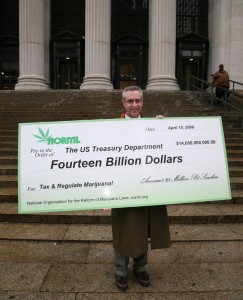
Allen St. Pierre, photo from The Hill Blog
Earlier this morning, the organization presented a mock check to the U.S Treasury Department in the sum of $14 billion dollars. The check total represents the combined savings and tax revenues that would be generated by regulating the sale and production of cannabis like alcohol.
"We represent the millions of otherwise law-abiding cannabis consumers who are ready, willing, vocal and able to contribute needed tax revenue to Americaâs struggling economy," NORML Executive Director Allen St. Pierre said at a press conference at the steps of the general post office in New York City. "All we ask in exchange for our $14 billion is that our government respects our decision to use marijuana privately and responsibly." [The Hill]
Is anyone still confused about why marijuana reform is an economics issue? Mr. President?
Anyway, assuming the desperate folks at the treasury didn't attempt to cash it, let me be the first to offer a home for that large novelty check which would surely just take up space around the NORML office. It will make a sweet conversation piece. Give me that giant check, you hippies.
Allen St. Pierre, photo from The Hill Blog
Errata: 4/3/09 Danger of Drug Enforcement Story
Correction to 4/3/09 danger of drug enforcement story, and accompanying discussion.