
Latest

In The Trenches

The LEAP Report: January/February 2009

January/February 2009

This issue…

  • Did you Know…?
  • Join LEAP's Rapid Response Team
  • LEAP Speakers: Education, Advocacy, Action
  • State by State
  • Make the LEAP

Did You Know…?

Did you know that LEAP's official YouTube channel was the #1 most-subscribed non-profit featured on YouTube for the month of January?  Halfway through the month, we're ranked #3 for February… so if haven't already visited LEAP on YouTube, please check out the videos we've posted and make sure to click "subscribe" so you can be notified whenever we upload a new video.   

Elsewhere on the web, LEAP speaker Norm Stamper has become a featured blogger for The Huffington Post.  On February 6, Norm's article 'One Cop To Another: Don't Arrest Phelps for Bong Photo' was the #1 most-viewed article on the entire HuffPost site.  In addition to the attention his blog has received, many media outlets are anxious to speak with Norm and hear his insight into President Obama's likely choice for drug czar, Gil Kerlikowske, who was Norm's immediate successor as Seattle's chief of police.  And make sure to stay up late tonight (or set your DVR) to catch Norm on the Fox News Channel's "Red Eye."  The show airs at 3 AM EST, Friday morning, Feb. 20.

By making a contribution, you can help LEAP gain visibility and make this a #1 issue in your community.

Join LEAP's Rapid Response Team

One thing that LEAP prides itself on is our ability to inspire and engage citizen volunteers; our cops can't do everything themselves!  That's why LEAP is launching an all-new Rapid Response Team of people who will make themselves available to receive e-mail alerts every few days asking for a few minutes of time to help advance reform.  For example, we may ask you to help build our movement for change by submitting comments on high-profile newspaper websites and blog posts, calling in to popular radio shows that are discussing the drug war, or voting in online polls asking about reform. 

If you would like to join the Rapid Response Team, please click here.  The list will be totally separate from our normal newsletter and action alert list, and you can remove yourself at any time if you feel you're getting too many e-mails.

LEAP Speakers: Education, Advocacy, Action

Contributed by Barbara Humphrey, Speakers Bureau Assistant

From rotaries to college campuses, Lions clubs to the halls of Congress, LEAP speakers are spreading the drug policy reform message, and it is making a difference.    An important role of the Speakers Bureau staff is to capture feedback from LEAP speaking engagements, allowing us to measure the impact of our efforts.  In addition to finding out how many people attended presentations, we also strive to go beyond the numbers to determine the impact of the presentation on those present and to solicit ideas for how to improve the effectiveness of these presentations.  The following are examples of the kind of feedback provided to LEAP following speaker presentations. 

In January, veteran speaker Dean Becker addressed a Texas Lion's Club audience of 130+, including three sitting judges, municipal law enforcement officers, and a State elected representative.    What an incredible opportunity to affect change!  

One of LEAP's newer speakers, Neill Franklin, spoke to supporters of the Tuerk House, a Timonium, Maryland drug/alcohol center, in early February.  The host was appreciative that Neill was able to generate a lively discussion following his presentation, a good indication of how well the talk was received.   The next day, Neill spoke to 20 faculty members and students at the University of Maryland College of Law.  The students were so impressed with the presentation that they have suggested a school-wide forum on the subject, while the faculty host described Neill as "awesome." 

In California, Judge James Gray spoke to more than 30 students at UCLA in February.  The school's host described the presentation as inspiring, and she was aware of a number of students whose minds had changed that night as a result of Judge Gray's talk. 

LEAP's Executive Director, Jack Cole, is also one of LEAP's most effective speakers.   Jack made a presentation to a group of 30 Rotarians in Massachusetts recently.  The club's host commented that "Jack made a real hit!  His presentation was great and I'm sure a lot were converted."  

The feedback from LEAP speaking engagements point to the important impact these speakers are making in the communities where they live and visit.  They inspire us all to keep booking, keep talking, and keep following up.

State By State

El Paso, Texas was at the forefront of the drug war debate in January. When El Paso's city council unanimously voted to call for an open debate on ending drug prohibition, the mayor vetoed the resolution.  The city council responded by calling for an override of the veto, and LEAP speaker Terry Nelson attended the meeting to give testimony before the council.  Unfortunately, the mayor's veto was upheld; four of the eight council members who originally supported the resolution reversed their votes under significant federal pressure that threatened state and federal funding.  If you haven't already done so, please visit www.DrugWarDebate.com to ask YOUR state and federal representatives to support a blue ribbon commission reviewing the efficacy of drug prohibition. 


Make The LEAP

As drug prohibition-related issues like the Michael Phelps drug investigation, the imminent nomination of a new drug czar, and the El Paso City Council's efforts continue to make the news, LEAP's voice needs to be heard now more than ever.  LEAP is committed to keeping the debate on war on drugs at the forefront until the day drug prohibition ends.  Please support LEAP's efforts by making a tax-deductible contribution to ensure that our mission of education on the failures of drug prohibition can reach its fullest potential.
Event
Event
In The Trenches

Press Advisory: Citizens Affected by World Drug Policies Question the UN

[Courtesy of ENCOD] From 11 to 13 March, the High Level Segment of the UN Commision on Narcotic Drugs will take place in Vienna, with the purpose of establishing new guidelines for international drug policies. The Summit will take place a year after the results of a ten year strategy adopted by the UN General Assembly Special Session (UNGASS) on Drugs in New York in 1998 should have been evaluated. The goal of that strategy was to eliminate or significantly reduce illicit drug supply and demand by 2008. The sad truth is that there has been no evaluation worthy of that name. The UN Office on Drug Control (UNODC) has written its own story, falsely claiming to have achieved control of the world drug problem. On the other hand, UNODC now acknowledges the serious harmful effects of drug prohibition. We welcome this important recognition, but we deplore the fact that it is immediately made worthless by unfounded predictions of less damaging results. A more serious evaluation does exist, however, which was ordered by the European Commission, and conducted by a respected group of experts with more distance to the UN and national drug policies. Until the moment this statement is written this report is not open for public scrutiny. It seems evident that, to have a meaningful impact on the deliberations and outcome of the CND, this "counterevaluation" should be made public before and not after the actual start of the CND. We condemn the way publication of this important advice has been held up. This will further reduce the relevance of the outcome of this year’s CND. Ten years have passed and the supply of cannabis, cocaine and heroin has increased. More people use illicit drugs than ever. The illegal environment in which drugs are produced, distributed and consumed has generated corruption, violent conflicts, criminal profits and dangers to public health. Independent analysts estimate the cost of drug prohibition in terms of expenses for police and justice operations at 70 billion euro year. There is no evidence whatsoever that these operations have had any positive impact on drugs-related crime. At the same time these policies have ruined the lives of hundreds of millions of people in the entire world, who have become a victim of executions, military repression, eradication of crops, environmental damage, incarceration and torture, violation of economic, social and cultural rights, marginalisation and stigmatization committed by authorities in the name of the war on drugs. Meanwhile, the UN drug control bureaucracy continues to reject any possible alternative to the policies of repression and prohibition. Also this year, the International Narcotics Control Board (consisting of 13 so-called drug experts in charge of monitoring the entire world drug situation) criticizes countries for applying non repressive harm reduction strategies such as needle exchange, decriminalization of cannabis use or even defending cultural traditions such as the use of the coca leaf in Bolivia, where this leaf has been a part of culture since thousands of years. How long will we have to see the UN dictating instructions to carry out policies that are deemed to fail? When will common sense take over the debate on drugs? This question is brought forward to the Ministerial Summit in Vienna by a coalition of citizens from the entire world. They will represent both producers of illicit plants, consumers of drugs and other citizens who are directly affected by drug policies. Among others they will maintain that the creation of legal markets for beneficial products that can be made of the coca leaf, cannabis and opium, for consumers in the entire world, could create opportunities for developing a sustainable future for populations in marginalised areas such as Afghanistan, Morocco or the Andean Region. They will maintain that non-repressive drug policies, such as cannabis policy in the Netherlands or heroin policy in Switzerland, have better results than repressive drug policies. The popularity of cannabis in the Netherlands, where it is legally available, is lower than in many other European countries or the United States, where it is totally prohibited. Mr. Costa has no idea how to explain this. He simply wants to continue the war on cannabis even when the evidence on cannabis use in the Netherlands falsifies the theory of prohibition. Representing citizens from all over the world they will insist that taking the drugs market out of the hands of criminal organisations will save and improve the lives of millions of people around the planet. Each day that the United Nations postpone this decision, they make themselves responsible for policies that do not benefit anyone, except the criminal organizations that dedicate themselves to drugs trafficking, as well as the bureaucracies working in the so-called drug control business, among others those who build prisons. It is time to initiate new strategies in international drug policy. Current strategies cause more problems than solutions. Non-repressive strategies are needed to deal with the drug issue, strategies that do not criminalise producers nor consumers, that are aimed at reducing risks related to drugs within a legal framework in which human rights are respected. We invite the representatives of the media to a press conference with the members of the delegation to the UN Summit on Friday 13 March, 11.00 hs onwards, in cafe Landtmann, Vienna. Speakers will be: If conditions allow: Chakib Alkhayari, president of the Human Rights Association for the people of the Rif (North Morocco). Representatives of coca producers from Bolivia. Jude Byrne and Matthew Southwell, members of INPUD, the International Network of People who Use Drugs. Fredrick Polak, European Coalition for Just and Effective Drug Policies (ENCOD) , who since one year is trying to start an open conversation with the UNODC Executive Director, Antonio Maria Costa on the evidence that drug prohibition has no impact on drug use levels. Adriana Rodriguez Salazar, independent researcher from Colombia, specialised in the impact of the war on drugs on society and environment in Colombia. Terry Nelson, of Law Enforcement Against Prohibition, United States, an association of mainly (ex-) policemen and judges opposed to the war on drugs.
Blog

Kellogg's Stock Takes Big Hit After Phelps Bong Controversy


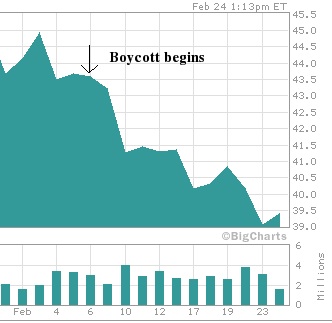
I'm no expert on the stock market, but this doesn’t look good for Kellogg's:

Kellogg Co. Stock -- February 2009:


As the chart shows, the company's stock took an immediate dive following its decision to drop Michael Phelps over the infamous bong hit photo. What began as a coordinated boycott by drug reform organizations quickly escalated into a full-blown media frenzy as major news outlets picked up the story. Pot-friendly websites like Digg.com began directing massive traffic to news coverage that was critical of Kellogg's anti-marijuana posturing, thereby increasing the campaign's visibility among likely supporters.

The cumulative impact of all this negative publicity is helpfully illustrated by The Vanno Reputation Index, which monitors the public image of leading corporations:
Out of the 5,600 company reputations Vanno monitors, Kellogg ranked ninth before it booted Phelps. Now it's ranked 83. Not even an industry-wide peanut scare inflicted as much damage on the food company's reputation. [Business Insider]

In the current economic climate, it would be silly to think we're solely responsible for Kellogg's falling stock. Still, the Vanno data clearly shows that we've dealt a substantial blow to the company's reputation at the worst possible time. Whether or not we actually had a considerable impact on Kellogg's bottom line is beside the point. What matters is that we sent an unprecedented message to corporate America that reefer madness is bad for business.

For far too long now, the drug war has been sustained by a corporate culture that embraces anti-drug propaganda at every turn. Just as our press and politicians have struggled to come to terms with evolving public attitudes about drugs and drug policy, corporate America has remained enslaved by the tired mindset that a healthy public image is best secured through hardline anti-drug posturing.

The Phelps saga may soon be regarded as the moment when all of that changed, the unforeseeable, yet inevitable moment when the invisible hand of America's marijuana culture finally became a fist.

Update: Many have pointed out, and I agree, that Kellogg's falling stock is much better explained by the economy than the boycott. I thought I did a sufficient job of drawing this distinction in the post, but I can understand how the title and tone of the overall post might lead some to conclude otherwise. So for the record: the point of the post is not that the marijuana reform community crashed Kellogg's stock. I don't believe that to be true. The point is that our message gains much better traction at a moment like this. The last thing Kellogg's wants is a highly publicized boycott in the middle of an economic crisis.

I've been skeptical of previous boycott proposals that have circulated among reformers in the past, but this effort has been a massive success. In terms of media coverage and the subsequent slaughter of Kellogg's corporate reputation ranking, we couldn't have asked for a more visible impact than we've managed to achieve.

Just because Kellogg's hasn't formally surrendered to us somehow doesn't mean we didn't kick their ass. I'm sure they are utterly stunned by the backlash they received, and that's what matters.

Blog

Cops Going to Prison for Botched Drug Raid That Killed Elderly Woman

Justice was finally served in the case of Kathryn Johnston, as three officers were sentenced to prison today for their role in the botched drug raid that took her life.

These officers crossed the often all-too-thin line that separates drug cops from common criminals, and they will pay for what they did, as well they should. We can only hope that today's outcome serves as a reminder to others in uniform who've forgotten what it means to protect and serve. Alas, this comment from the judge suggests that Atlanta's problems with rogue cops are far from solved:

A federal judge who sent three fallen cops to prison for a notorious drug raid that left an elderly woman dead said Tuesday that Atlanta Police Department performance quotas unduly influenced the officers’ behavior.

"It is my fervent hope the Atlanta Police Department will take to heart what has happened here," U.S. District Judge Julie Carnes said. At the close of an emotional two-day hearing, Carnes sentenced former officers Gregg Junnier, Jason R. Smith and Arthur Bruce Tesler to between 5 and 10 years in prison.

At the hearing, Tesler’s lawyer provided examples of other Atlanta police officers breaking the rules or violating the law and said a disturbing culture of misconduct pervades the force. [Atlanta Journal Constitution]

Thus, even in its finest hour, our justice system remains crippled by the enemy within. There is nothing unique about Atlanta's police culture that brought this tragedy to life. Everywhere the drug war is fought, you will find police who have become indifferent to the very laws they've sworn to uphold.
Chronicle
Chronicle
Chronicle
Chronicle

Reseña de la Crónica: "Dope Menace: The Sensational World of Drug Paperbacks, 1900-1975", de Stephen J. Gertz (2008, Feral House Press, 219 págs., US$ 24,95, en rústica)

"<em>Dope Menace</em>" [La amenaza de la droga] es un viaje visualmente despampanante y muy bien informado al cierne de la obsesión de EE.UU. en mediados del Siglo XX por los libros baratos en rústica, especialmente por los que contaban con la temática de la droga. Si está interesado en drogas y cultura popular, debe echarle una ojeada a esto.