Police/Suspect Altercations

RSS Feed for this category

Mexican Army Seizes 15 Tons of Methamphetamine

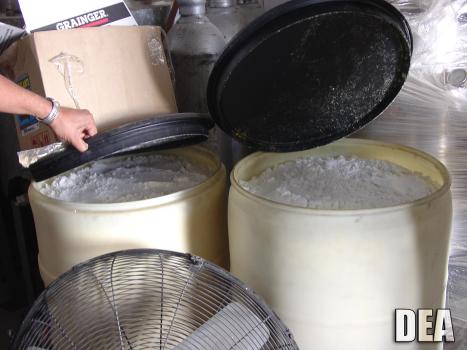
Mexican army troops seized an astounding 15 tons of pure methamphetamine in the western state of Jalisco, the Mexican military announced Wednesday night. That's an amount equal to half of all the meth seized worldwide in 2009 and would have supplied some 13 million individual doses worth over $4 billion on the street in the US.

clandestine Mexican meth lab in Jalisco (SEDENA)
The army said it had received several anonymous tips, leading it to the enormous stash on a small ranch in the municipality of Tlojomulco de Zuniga, near Guadalajara, Mexico's second largest city. Soldiers found no one on the ranch and made no arrests, although it appeared 12 to 15 people had been working there. 

The army called the seizure "historic," and it appears to be the largest meth bust in Mexican history by far. The previous record bust by the army came in June 2010, when soldiers seized 3.4 tons of pure meth in the central state of Queretaro. During that bust, soldiers also seized hundreds of tons of precursor chemicals.

Meth manufacture is a big business for Mexico's drug cartels. The US National Drug Intelligence Center estimates that 80% of the meth in the US comes from Mexico. After a downward blip five years ago, the supply of meth has been on the increase, and so have seizures. On the US-Mexico border, meth seizures jumped 87% between 2007 and 2009, according to the 2011 UN World Drug Report.

Experts interviewed by the Associated Press reeled at the size of the seizure.

"Seizures of this size... could mean one of two things," said Antonio Mazzitelli, the regional representative of the UN Office of Drugs and Crime. "On one hand, it may be a product that hasn't been able to be sold, and like any business, when the market is depressed, stockpiles build up," he said. "Or such large-scale production could suggest an expansion, an attempt by some Mexican groups, the most business-oriented I would say, to move into Latin American and Asian markets."

"I have never seen quantity in that range," said Steve Preisler, an industrial chemist who adopted the nom de plume Uncle Fester to author the book "Secrets of Methamphetamine Manufacture" and who is seen by some as the father of modern meth-making. But, he added: "The amounts of precursors they were importing would produce multi-tons of product."

Guadalajara is Sinaloa cartel territory, and an unnamed "senior US law enforcement official in Mexico" told the AP this week's bust was "probably Sinaloa."

The Mexican army in the area might want to watch its back for the next few days because the cartels are known to seek reprisals. Earlier this week, in fact, cartel gunmen in Coahuila attacked an army patrol hours after soldiers seized eight tons of marijuana, leaving two or three dead.

Mexico

Bronx Narc Kills Unarmed Teen

A NYPD narcotics officer shot and killed a Bronx 18-year-old Thursday as the teen was allegedly trying to flush drugs down a toilet in his own home. Ramarley Graham becomes the eighth person to die in US drug law enforcement operations so far this year, and it appears to have been over a small amount of marijuana.

Police told the Wall Street Journal the undercover narcs had already arrested two other men they watched allegedly selling drugs Thursday afternoon when they approached Graham. He ran to his home nearby, followed by police, and into a second-floor bathroom, where he was possibly trying to flush drugs, police said.

When an unidentified officer confronted him in the bathroom, Graham spun around, and, according to police, there was a struggle, and the officer then shot him in the chest. It wasn't clear what caused the officer to fire. Graham was pronounced dead at a local hospital. A small amount of pot was floating in the toilet bowl.

An earlier report from PIX-11 TV, however, had police telling local media Graham "made a motion near his waist leading them to believe he was armed" when he was still on the street. He wasn't, police have conceded.

Police were quick to tell local media about Graham's arrest record, which included busts for burglary, robbery, dealing marijuana, and other offenses. But they didn't say how those cases had been resolved or whether they were even aware of his identity when they shot him.

After the shooting, PIX-11 TV reported that "Graham's parents were at the White Plains Road intersection visibly agitated and a crowd of approximately 80 people were openly hostile towards police, berating officers lined up along the crime scene tape."

Graham's mother, Constance Malcolm, 39, told the Wall Street Journal, a neighbor had called her at work to tell her her son had been killed. Malcolm said her mother and her six-year-old son were also in the apartment during the shooting.

"The cops told me they were chasing him. He had weed, and that's it," Ms. Malcolm said. "Nobody deserves to be shot like that in their own house."

Bronx, NY
United States

Sword-Wielding Man Killed in California Drug Raid

Los Angeles County sheriff's deputies executing a narcotics search warrant in Lancaster Wednesday night shot and killed an a 68-year-old man when he allegedly emerged from a bedroom holding a four-foot sword. The as yet unidentified man becomes the seventh person to die in US domestic drug law enforcement operations so far this year.

According to police, the man raised the sword toward a deputy and was then shot several times. It's not clear how many deputies fired. None were injured.

The man was taken to a local hospital, where he died. His name has not been released pending notification of relatives.

Three other people in the house were detained for questioning.

Police released no information about the results of their narcotics search, nor have they specified the technique they used in gaining entry to the residence.

Lancaster, CA
United States

Mexico Drug War Update

by Bernd Debusmann Jr.

Mexican drug trafficking organizations make billions each year smuggling drugs into the United States, profiting enormously from the prohibitionist drug policies of the US government. Since Mexican president Felipe Calderon took office in December 2006 and called the armed forces into the fight against the so-called cartels, prohibition-related violence has killed more than 50,000 people, including more than 15,000 in 2010 and another 15,000 last year. The increasing militarization of the drug war and the arrests or killings of dozens of high-profile drug traffickers have failed to stem the flow of drugs -- or the violence -- whatsoever. The Merida initiative, which provides $1.4 billion over three years for the US to assist the Mexican government with training, equipment and intelligence, has so far failed to make a difference. Here are a few of the latest developments in Mexico's drug war:

Thursday, January 26

In Ciudad Juarez, a man was shot and killed inside a restaurant in front of dozens of customers. Several people who were with the victim ran from the scene.

Friday, January 27

In Nuevo Laredo, four gunmen and a soldier were killed during a fire fight. The incident began when gunmen traveling in six vehicles opened fire on an army patrol. Five soldiers were wounded and taken to a local hospital.

In Ciudad Juarez, at least ten people were murdered in several incidents. Ten more would be killed on Saturday.

Saturday, January 28

In Torreon, five people were gunned down by a group of men wielding assault rifles. Four other individuals were wounded in the incident.

In Monterrey, three bodies were found dead along with a message from a criminal organization.

Monday, January 30

In Sinaloa, the commander of army forces in the state said that marijuana and poppy growers have been severely hampered by drought and that his forces are detecting fewer grow sites than in previous years. Another army spokesman said that the drought did not mean a drop-off in overall cartel production.

In Nuevo Leon, police announced the capture of a suspected Zeta who allegedly confessed to killing 75 people, at least 36 of whom were taken from passenger buses. Enrique Elizondo Flores, "El Arabe," was arrested on January 20 but authorities say they delayed the announcement to give them time to verify his claims. Over 90 people were killed in three bus attacks thought to have been carried out by the Zetas in January and March 2011.

In Ciudad Juarez, at least seven people were killed.  In one incident, three gunmen were killed in a fire fight after attacking the police. At least eight municipal police officers have been killed in January in attacks that have been blamed on the New Juarez Cartel. In other incidents, a couple was murdered in an industrial park, a man was shot dead on a bus, and a body was found in a car after having been kidnapped on Sunday.

In Guasave, Sinaloa, three soldiers were killed during a fire fight with armed men. According to reports, an army patrol was chasing several vehicles with armed men who resisted. Several gunmen were also reported killed but the bodies were taken away. A pickup truck and several weapons were left abandoned at the scene. After the shooting, a tense standoff took place between soldiers and municipal police forces, who had ignored distress calls from the soldiers involved in the shooting.

In Monterrey, seven suspected Zetas were arrested on kidnapping and other charges. Two victims were rescued from their safe house.

Tuesday, January 31

In Mexico City, a top official confirmed that an army general and 29 of his troops are on trial for crimes they committed while operating in the Ojinaga, Chihuahua border area in 2008 and 2009. General Manuel Moreno and his underlings are accused of committing at least 10 killings and reselling seized narcotics, as well as stealing property during raids. They were originally charged in August 2009.

Off the coast of California, a motorboat laden with over a ton of marijuana was intercepted by authorities. Three Mexican nationals were arrested.

In Mexico City, Mexican prosecutors announced that three former Tamaulipas governors are being investigated. Authorities have declined to say why exactly the men are being investigated, however.

[Editor's Note: We are no longer going to keep a running tally of the death toll; the figures are too unreliable. The latest figures below were released by the Mexican government in January.]

Total Body Count for 2007 (approx.): 4,300

Total Body Count for 2008 (approx.): 5,400

Total Body Count for 2009 (approx.): 9,600
 
Total Body Count for 2010 (official): 15,273

Partial Body Count for 2011 (official): 12,093*

Total Body Count (official): 47,705*

* Official figures through September 30, 2011. Unofficial estimates put the entire year's death toll at around 16,000, meaning more than 50,000 people had been killed by the end of 2011.

Mexico

Michigan Deputy Kills Drug Suspect Dragging Him With Car

A Wayne County sheriff's deputy shot and killed a drug suspect whose car was dragging him down the street Monday evening. The man, who is yet unidentified, becomes the sixth person to die in US domestic drug law enforcement operations so far this year.

According to local media citing police sources, Wayne County sheriff's deputies witnessed a suspected drug buy and moved in to make an arrest. The suspect appeared to be cooperating until a tow truck arrived, when he then bolted back into his car and tried to drive away. A deputy grabbed onto the car and was dragged down the street. He opened fire when the suspect refused to heed his commands to stop.

"The suspect jumped back into the car, took off. One of my deputies was next to the car. He attempted to stop him from taking the car, grabbed a hold of him and he was dragging him down the street," said Wayne County Sheriff Benny Napoleon. "He was being dragged down the street," Napoleon explained. "After several orders to stop, the deputy fired twice."

The suspect died at the scene, the sheriff said. The deputy, a veteran undercover narcotics officer, was hospitalized in serious condition, but is expected to recover.

The sheriff said the dead man appeared to be cooperating until he suddenly dashed for freedom.

"The process was almost over, and I guess something about seeing the car go on the tow truck must have really set him off and he decided he didn't want his car towed," Napoleon said.

Detroit, MI
United States

Mexico Drug War Update

by Bernd Debusmann Jr.

Mexican drug trafficking organizations make billions each year smuggling drugs into the United States, profiting enormously from the prohibitionist drug policies of the US government. Since Mexican president Felipe Calderon took office in December 2006 and called the armed forces into the fight against the so-called cartels, prohibition-related violence has killed more than 50,000 people, including more than 15,000 in 2010 and another 15,000 last year. The increasing militarization of the drug war and the arrests or killings of dozens of high-profile drug traffickers have failed to stem the flow of drugs -- or the violence -- whatsoever. The Merida initiative, which provides $1.4 billion over three years for the US to assist the Mexican government with training, equipment and intelligence, has so far failed to make a difference. Here are a few of the latest developments in Mexico's drug war:

Friday, January 20

In Durango, a high-ranking aide to Sinaloa Cartel leader Joaquin "El Chapo" Guzman was shot and killed by an army special operations unit. Luis Alberto Cabrera Sarabia, "the Engineer," is thought to have been responsible for cartel operations in Durango and parts of Chihuahua. One gunman was killed in the operation and eleven were taken into custody. Four soldiers were wounded during the gun battle.

Saturday, January 21

In Ciudad Juarez, a police officer was shot and killed on his way to work. A police spokesman said the officers were in a private vehicle when they were cut off by another car and several men opened fire.

In Sonora, a high-ranking Sinaloa Cartel figure was captured near the city of Cananea. Fidel Mancinas Franco is thought to have been in charge of cartel operations in Nogales, Agua Prieta, Naco and Cananea. He is also wanted in the United States in connection with the deaths of 11 migrants in 2009.

Sunday, January 22

In Atoyac de Alvarrez, Guerrero, eight men were killed at a funeral for a man shot days earlier. The men were attacked by men wielding automatic weapons.

In Acapulco, three bodies were found in an empty lot. Another individual was found decapitated in a car and a fifth died during an exchange of fire with the police.

Monday, January 23

In Veracruz, Mexican marines took over the duties of the local transit police. The move is designed to root out corrupt elements of the force, which, like the Veracruz municipal police, is thought to have been thoroughly infiltrated by organized crime groups.

In Ciudad Juarez, at least eight people were murdered. In one incident, four men were shot and killed when gunmen stormed a house in the south of the city. Earlier in the day, a naked body bound in duct tape was thrown from a moving car, along with a note from a criminal group.

In Saltillo, Coahuila, four gunmen were killed by the army. A local university was temporarily locked down during the incident.

Also in Saltillo, army and police forces conducted operations inside several penal facilities looking for drugs, weapons and other suspicious items.

Tuesday, January 24

Near Mexico City, five police officers were ambushed and killed as they made a traffic stop in Ixtapaluca. The officers had stopped a vehicle when a taxi and a minivan pulled up and they were shot at by gunmen with assault rifles. Police suspect the incident was an attempt to free people who had been taken into police custody.

Across Ciudad Juarez, banners threatening the municipal police were hung at various locations. Some of the notes also mention police Chief Julian Leyzoala by name. The banners were taken down and police stations in the city were put on high alert.

Two officers were shot and killed as they traveled in a private Ford Mustang in the city. At least five municipal police officers have been killed so far in 2012.

[Editor's Note: We are no longer going to keep a running tally of the death toll; the figures are too unreliable. The latest figures below were released by the Mexican government in January.]

Total Body Count for 2007 (approx.): 4,300

Total Body Count for 2008 (approx.): 5,400

Total Body Count for 2009 (approx.): 9,600
 
Total Body Count for 2010 (official): 15,273

Partial Body Count for 2011 (official): 12,093*

Total Body Count (official): 47,705*

* Official figures through September 30, 2011. Unofficial estimates put the entire year's death toll at around 16,000, meaning more than 50,000 people have been killed by the end of 2011.

Mexico

Mexico Drug War Update

by Bernd Debusmann Jr.

Mexican drug trafficking organizations make billions each year smuggling drugs into the United States, profiting enormously from the prohibitionist drug policies of the US government. Since Mexican president Felipe Calderon took office in December 2006 and called the armed forces into the fight against the so-called cartels, prohibition-related violence has killed more than 45,000 people, including more than 15,000 in 2010 and approximately 12,000 last year. The increasing militarization of the drug war and the arrests or killings of dozens of high-profile drug traffickers have failed to stem the flow of drugs -- or the violence -- whatsoever. The Merida initiative, which provides $1.4 billion over three years for the US to assist the Mexican government with training, equipment and intelligence, has so far failed to make a difference. Here are a few of the latest developments in Mexico's drug war:

Thursday, January 12

In Nuevo Leon, military personnel captured a high-ranking Zeta boss. Jesus Sarabia Luis Ramos, "El Pepito," was considered by authorities to be the fourth most important leader in the organization. He was known to operate in Coahuila, Nuevo Leon and Tamaulipas.

Sunday, January 15

In Culiacan, a Canadian national was gunned down. Salih Adabulazizz Sahbaz, 35, was apparently of Iranian or Iraqi origin and was carrying a large amount of cash on his person when he was murdered. The motive remains unknown. He is the third Canadian known to have been killed in Mexico so far this year.

Monday, January 16

In Cuernavaca, seven gunmen were killed in a fire fight with federal police. One officer was wounded in the clash. The gunmen were traveling in three stolen vehicles when police intercepted them.

In Zacapetec, Morelos, the local police chief was shot and killed by three men on motorcycles while he was at a gas station. He survived the initial shooting but later died in a local hospital.

Tuesday, January 17

In Little Rock, Arkansas, authorities indicted 22 individuals on trafficking charges for being part in a meth operation with links to Mexican cartels. Seventeen of those are now in custody. Police also seized 13.3 pounds of "ice" meth and seven vehicles, five weapons and $163,590.

In Ciudad Juarez, gunmen stormed a home and killed four individuals inside. Three of the dead were found in a bathroom where they had attempted to hide. Local media reported that at least some of the men had been released from prison six months ago.

In Nayarit, police arrested a local cartel boss. Benigno Ibarra Valle, 30, "El Guero Pelocho," was the head of the "Pelochos," a local branch of the Sinaloa Cartel. He is suspected in the deaths of at least five police officers in recent weeks. Nine other individuals were also taken into custody.

In Lazaro Cardenas, authorities seized 194 tons of meth precursor chemicals on a ship from China. The containers were all headed for Guatemala or Nicaragua.

[Editor's Note: We are no longer going to keep a running tally of the death toll; the figures are too unreliable. The latest figures below were released by the Mexican government in January.]

Total Body Count for 2007 (approx.): 4,300

Total Body Count for 2008 (approx.): 5,400

Total Body Count for 2009 (approx.): 9,600
 
Total Body Count for 2010 (official): 15,273

Partial Body Count for 2011 (official): 12,093*

Total Body Count (official): 47,705*

* Official figures through September 30, 2011. Unofficial estimates put the entire year's death toll at around 16,000, meaning more than 50,000 people have been killed.

Mexico

Two More US Drug War Deaths This Week

Two men were shot and killed in separate incidents by police enforcing drug laws this week. California resident Angel Molina and Little Rock, Arkansas resident Angelo Clark become the 3rd and 4th persons to die in US domestic drug law enforcement operations so far this year.

Police told local media in Shafter, California, that Shafter police went to a residence during a drug investigation Monday night and when they arrived, they encountered two people in the driveway. Police said they were searching the two men when they found a gun on Molina, 37. Police said Molina then tried to grab the gun, and Officer Joseph Hayes shot him in the chest.

He was taken to the Kern Medical Center, but died less than an hour later. The district attorney's office is investigating the incident. Officer Hayes is on administrative leave.

In Little Rock, police told local media a SWAT team was serving a pre-dawn search warrant at an alleged drug house when they were confronted by Clark, who they said was holding an AK-47 directed at officers. He was shot by police and died at the scene.

Police said they had been investigating the residence since early December and undercover narcotics detectives had bought crack cocaine from Clark, 31, who lived there. But there was no mention of crack being seized at the home. Instead police reported finding a small marijuana growing operation, pot plants, scales and other drug paraphernalia, a loaded AK-47 clip, and a .40 caliber hand gun.

The unnamed SWAT officer who pulled the trigger is now on administrative leave. The Little Rock Police Department is conducting separate detective division and internal affairs investigations.

Mexico Drug War Update

by Bernd Debusmann Jr.

Mexican drug trafficking organizations make billions each year smuggling drugs into the United States, profiting enormously from the prohibitionist drug policies of the US government. Since Mexican president Felipe Calderon took office in December 2006 and called the armed forces into the fight against the so-called cartels, prohibition-related violence has killed more than 45,000 people, including more than 15,000 in 2010 and approximately 12,000 last year. The increasing militarization of the drug war and the arrests or killings of dozens of high-profile drug traffickers have failed to stem the flow of drugs -- or the violence -- whatsoever. The Merida initiative, which provides $1.4 billion over three years for the US to assist the Mexican government with training, equipment and intelligence, has so far failed to make a difference. Here are a few of the latest developments in Mexico's drug war:

Wednesday, January 4

In Altamira Prison in Tamaulipas, a clash between groups of rival inmates left 31 dead. Another 13 were wounded in the incident, which began when a group of men stormed a wing of the prison which they were forbidden from entering. Local media reported that the fighting was between members of the Gulf Cartel and the Zetas, but that has not been confirmed. Later on, twenty prisoners were detained for their part in the fight.

Thursday, January 5

In Michoacan, five bodies were found abandoned in a burning SUV. Authorities believe the five men were all cartel gunmen killed during intense gun battles between rival local criminal organizations.

In Tijuana, a Sinaloa Cartel figure was arrested. Omar Cabrera Bengoecha, "R-12," is alleged to be a former municipal police officer who worked for a faction of the Tijuana Cartel that broke away from the Arellano-Felix Organization and allied with El Chapo Guzman’s Sinaloa Cartel. In 2008, Cabrera Bengoecha was dismissed from the police force for his involvement in illicit narcotics transport.

Saturday, January 7

In Nuevo Leon, authorities announced the arrest of four men for participating in a kidnapping cell. One of the men was suspended professional goalkeeper Omar "El Gato" Ortiz. It is alleged that the gang -- which is tied to the Gulf Cartel -- participated in at least 20 kidnappings.

Monday, January 9

In Michoacan, 13 bodies were discovered dumped at a gas station near the town of Zitacuaro. At least two of the dead were minors. All the dead individuals were male and most had been shot in the head and tortured. A message left at the scene led authorities to believe the killings are in relation to the ongoing struggle between La Familia Michoaca and an offshoot group known as the Knights Templar.

In Ciudad Juarez, at least seven people were murdered in two multiple homicides. In one incident, a woman and three men were taken from their home by five heavily armed gunmen and executed. According to reports, the suspects wore black uniforms and said they were federal police officers. While the five men searched the home for drugs, at least ten other gunmen stood watch outside.

Tuesday, January 10

In Nuevo Leon, an army patrol killed four gunmen during an engagement near the municipality of Cerralvo, about 50 miles from the Texas border. A woman was seriously wounded in the fighting, but it is unclear if she was a kidnapping victim or lived at the rural location. Several weapons and vehicles were captured.

In Washington, the Treasury Department said in a statement that they were placing two Mexicans and a Colombian national on Specially Designated Narcotics Traffickers list for their involvement with Joaquin "El Chapo" Guzman, whom they called the world's most powerful drug trafficker.

In Ciudad Juarez, one municipal police officer was killed and five others wounded after being attacked by a group of gunmen. Five civilians were also wounded in the attack.

In Ciudad Victoria, Tamaulipas, authorities disarmed a car bomb left outside a state police facility.

Wednesday, January 11

In Mexico City, two bodies were found in a burning SUV left outside a high-end shopping mall in the city's Sante Fe area. A note left at the scene was signed by a local organization known as the "Hand with Eyes." Both victims had been decapitated.

[Editor's Note: Our 2011 estimated death toll is 12,150, pending the release of official figures. Our new 2012 death toll is also an estimate.]

Total Body Count for 2007 (approx.): 4,300

Total Body Count for 2008 (approx.): 5,400

Total Body Count for 2009 (approx.): 9,600

Total Body Count for 2010 (official): 15,273

Total Body Count for 2011 (approx.): 12,150

Total Body Count for 2012: (approx.) 100

TOTAL: > 46,000

Mexico

Time to Rethink Drug Raids, Police Trainers Say

With a 15% increase in shooting deaths of law enforcement officers last year, and with this year kicking off with an Ogden, Utah, drug raid that left one officer dead and five more wounded, some police trainers are saying it is time for police to rethink their tactics, USA Today reported Wednesday.

Time for an attitude adjustment? (Image: Barton County Sheriff's Office, Kansas)
Some 68 law enforcers were killed by gunfire last year, 10 of them while serving search warrants or on multi-agency raids. While only three of them died doing work directly related to drug law enforcement -- two US Marshals were shot and killed in separate raids trying to arrest drug fugitives and one Florida police officer was killed trying to search suspicious persons for drugs -- the bloody Ogden raid has focused attention on drug raids.

In that raid, aimed at Matthew Stewart, an Army veteran with no criminal record who was supposedly "self-medicating" with marijuana he grew himself, a local drug task force forced its way into his home only to be met with ferocious gunfire. When the bullets stopped flying, Ogden Officer Jared Francom was dead and five of his comrades and Stewart were wounded. Prosecutors said this week they would seek the death penalty for him.

But that won't bring back Officer Francom, and police need to reevaluate their tactics, said Pat McCarthy, who advises police agencies across the country.

"The days of knocking down doors in drug cases should be over. Given what's going on now, you have to consider other options," McCarthy told USA Today. "Police should focus on trying to lure suspects out into the open or just "wait them out," he said. "It's time to change our thinking, Cops are exposing themselves to increasing danger many times over, and it's just not necessary."

That sentiment was echoed by Harvey Hedden, executive director of the International Law Enforcement Trainers and Educators Association. Its members need to "look at everything" to avoid putting themselves in danger.

"Police work can be 99% boredom and 1% panic," Hedden said. "Routine can be the most dangerous of all. We need to go back to the basics."

The Justice Department will host a meeting later this month with researchers and law enforcement officials to review tactics and training in the wake of the officers' deaths.

Of course, it's not just police who died in drug raids. The Chronicle's tally of domestic drug war deaths last year includes 13 civilians who were killed by police in drug raids on residences.

Drug War Issues

Criminal JusticeAsset Forfeiture, Collateral Sanctions (College Aid, Drug Taxes, Housing, Welfare), Court Rulings, Drug Courts, Due Process, Felony Disenfranchisement, Incarceration, Policing (2011 Drug War Killings, 2012 Drug War Killings, Arrests, Eradication, Informants, Interdiction, Lowest Priority Policies, Police Corruption, Police Raids, Profiling, Search and Seizure, SWAT/Paramilitarization, Task Forces, Undercover Work), Probation or Parole, Prosecution, Reentry/Rehabilitation, Sentencing (Alternatives to Incarceration, Clemency and Pardon, Crack/Powder Cocaine Disparity, Death Penalty, Decriminalization, Drug Free Zones, Mandatory Minimums, Rockefeller Drug Laws, Sentencing Guidelines)CultureArt, Celebrities, Counter-Culture, Music, Poetry/Literature, Television, TheaterDrug UseParaphernalia, ViolenceIntersecting IssuesCollateral Sanctions (College Aid, Drug Taxes, Housing, Welfare), Violence, Border, Budgets/Taxes/Economics, Business, Civil Rights, Driving, Economics, Education (College Aid), Environment, Families, Free Speech, Gun Policy, Human Rights, Immigration, Militarization, Money Laundering, Pregnancy, Privacy (Search and Seizure, Drug Testing), Race, Religion, Sports, Women's IssuesMarijuana PolicyGateway Theory, Hemp, Marijuana -- Personal Use, Marijuana Industry, Medical MarijuanaMedicineMedical Marijuana, Science of Drugs, Under-treatment of PainPublic HealthAddiction, Addiction Treatment (Science of Drugs), Drug Education, Drug Prevention, Drug-Related AIDS/HIV or Hepatitis C, Harm Reduction (Methadone & Other Opiate Maintenance, Needle Exchange, Overdose Prevention, Safe Injection Sites)Source and Transit CountriesAndean Drug War, Coca, Hashish, Mexican Drug War, Opium ProductionSpecific DrugsAlcohol, Ayahuasca, Cocaine (Crack Cocaine), Ecstasy, Heroin, Ibogaine, ketamine, Khat, Marijuana (Gateway Theory, Marijuana -- Personal Use, Medical Marijuana, Hashish), Methamphetamine, Nicotine, Prescription Opiates (Fentanyl, Oxycontin), Psychedelics (LSD, Mescaline, Peyote, Salvia Divinorum), Synthetic Drugs (Mephedrone, Synthetic Cannabinoids)YouthGrade School, Post-Secondary School, Raves, Secondary School