
Drug War Daily Digest, October 23, 2026
Drug Policy
[image:5 align:left caption:true]
US Mission Attacks Ben Saul Over Counterdrug Operations. In an October 22 statement responding to UN Special Rapporteur Ben Saul's report on counterterrorism and drug enforcement, which directly criticized recent US policies, US Ambassador to the United Nations Mike Waltz attacked the rapporteur. He accused Saul of bias, called him "terrorist-sympathizing," and defended the Trump administration's aggressive drug enforcement policies in the Americas, which have included repeated military attacks on alleged drug-trafficking vessels. Saul's October 22 statement put the toll at at least 239 people in 71 attacks on civilian vessels and called for accountability for what he characterized as unlawful killings. Waltz also attempted to smear Saul because China provided part of the funding for his position and criticized Saul for his earlier criticism of counterterrorism operations. The statement was a response to Saul's call for accountability over those strikes.
TalkingDrugs has posted a highlights compilation of Saul's press conference on Instagram.
Extrajudicial Killings
Philippines Gives Dela Rosa One Week to Surrender, Offers P50 Million Reward. Rappler reported today that Philippine Interior Secretary Jonvic Remulla has given Senator Ronald "Bato" dela Rosa one week to surrender and announced a P50 million reward for information leading to his capture. Dela Rosa was the first national police chief in the administration of former president Rodrigo Duterte and faces an arrest warrant from the International Criminal Court (ICC) for his alleged role in drug war killings under Duterte. The court issued the warrant under seal in November 2025 and made it public on May 11. Dela Rosa has been in hiding since May. A police task force led by Lieutenant General Wilson Joseph Lopez has been assigned to find and arrest him.
Also on October 23, GMA News reported that Dela Rosa's attorneys have challenged the legal basis for the reward. They argued that the reward rules require a Philippine court warrant and questioned the proposed use of intelligence funds.
Marijuana Policy
Booker Challenges DEA Restrictions on Cannabis Workers with Past Drug Convictions. In an interview with Marijuana Moment published today, Sen. Cory Booker (D-NJ) criticized the Drug Enforcement Administration for jeopardizing medical marijuana businesses' registration applications because they employ people with past drug convictions. Booker was responding to earlier Marijuana Moment reporting about a Mississippi dispensary, Wildflower, whose owner, Nicole Huff, was told in correspondence from a DEA official that existing DEA registration rules restrict access to controlled substances for employees with drug-related felony convictions. She had two affected workers and was told she could fire them, withdraw her application, seek a waiver and lose expedited processing, or contest the matter before an agency judge. Huff said DEA later told her the workers could move temporarily to jobs without access to marijuana while a waiver is being considered, but gave no timetable. She said creating administrative jobs would be financially impractical for many businesses. Booker called that policy "ridiculous" and "really problematic", arguing that people harmed by drug prohibition should be able to work in the legal industry.
Illinois Explains New Hemp Product Requirements Ahead of November 12 Change. The Illinois News Joint reported October 21 that state agricultural officials have released guidance on the state's new hemp law. Under that law, as of November 12, products containing more than 0.4 mg per container of total THC, including THCA and other cannabinoids with THC-like effects covered by the law, must be sold through the state's cannabis regulatory system and comply with its licensing and sales requirements. Products at or below the limit that meet the other hemp requirements may continue to be sold outside the cannabis dispensary system. The hemp category excludes synthesized cannabinoids, products containing alcohol, tobacco or nicotine, and products intended for smoking or vaping. The state requirements take effect November 12, separately from the federal deadline discussed below.
Limited Participation Leaves Federal CBD Patient Program in Doubt. Citing the Centers for Medicare & Medicaid Services (CMS), MJBizDaily reported October 21 that participation in the initiative allowing care organizations in Medicare's ACO REACH model to offer hemp-derived CBD products remains low. So far, only six of 74 organizations have been approved. CMS did not say how many are actually distributing products. Under the initiative, participating organizations can pay up to $500 per eligible patient per year for products. The initiative doesn't establish general Medicare coverage of CBD. Some suppliers told MJBizDaily that restrictions on hemp cannabinoid products now set to take effect December 11, after a congressional delay, have discouraged groups from participating.
International
Thai Prime Minister Seeks Tighter Cannabis Enforcement and Penalties. Citing a government statement after a narcotics control board meeting, the Malaysian National News Agency, Bernama, reported that Thai Prime Minister Anutin Charnvirakul called for stronger cannabis controls and tougher penalties on Thursday. He ordered agencies to inspect licensed businesses, crack down on licensing violations, and intensify customs checks to block unauthorized exports. The meeting discussed proposed amendments to the Narcotics Act concerning cannabis and changes to possession offenses, including small quantities, alongside treatment and rehabilitation. Bernama also noted that the cabinet approved a draft Cannabis and Hemp Act on September 22 to restrict cannabis to medical use. These were proposals and enforcement directions, not an announcement that new penalties had taken effect.
Ontario Proposes New Cannabis Enforcement Powers for Provincial Regulator. The Ontario provincial government announced October 19 that it intends to give regulators the power to inspect unauthorized marijuana retailers, impose administrative financial penalties, and seize products and equipment. The plan would give those powers to the Alcohol and Gaming Commission of Ontario and would cover both unlicensed shops and online sellers. Estimating that unlicensed sellers account for about 30 percent of the market, officials said the measures were designed to protect consumers and the province's 1,800 legal marijuana sellers. The plan requires approval by the Legislative Assembly of Ontario.
UN Organized Crime Conference Adopts Resolution Targeting Drug Trafficking Facilitators. The UN Office on Drugs and Crime reported today that governments that are parties to the UN Convention against Transnational Organized Crime adopted a resolution calling for more international cooperation against drug trafficking and entities that facilitate the trade, including recruiters, money launderers, corrupt officials, and suppliers of logistical or technical support. They met for the treaty's thirteenth conference of parties and negotiated for five days on a series of resolutions, including this one. Other resolutions addressed environmental crime, firearms, and cultural property. UNODC said some resolutions required votes rather than reaching consensus, but did not say if that was the case with the drug trafficking resolution.
International Society for the Study of Drug Policy to Meet in Medellín in June 2027. The International Society for the Study of Drug Policy (ISSDP) will hold its 2027 conference in Medellín, Colombia, June 22-26, hosted by Universidad EAFIT. The gathering will bring together researchers, policymakers, and practitioners to discuss drug policy research. According to ISSDP, this will be the second time the conference has been held in Latin America.
Latin America Strikes
InSight Crime Examines Limits of Ecuador's Militarized Crackdown. In an October 15 analysis, Sean Doherty of InSight Crime finds that Ecuador's military-led crackdown on organized crime has failed to produce a sustained improvement in security. Killings have declined in 2026 after a record year, but Ecuador remains on course for one of its deadliest years. Doherty points to corruption, prison insecurity and gang fragmentation, with arrests of leaders intensifying internal competition. The government's newest strategy acknowledges the social conditions fostering criminality but nonetheless continues to emphasize repression and cooperating with the Trump administration's aggressive anti-drug policies in the hemisphere.
DoD Contractor Posts Then Deletes Announcement About Ecuador Counterdrug Center
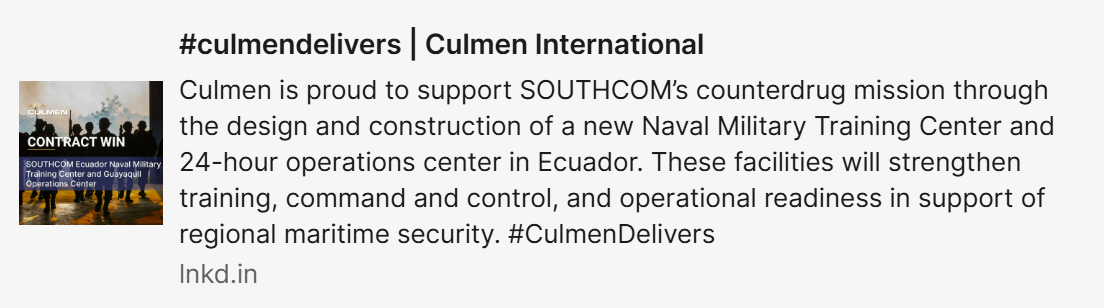
Culmen International, a US contractor based in Alexandria, VA, posted an announcement on LinkedIn and Instagram about a SOUTHCOM counterdrug project to design and construct a naval military training center and a 24-hour operations center in Ecuador. An October 16 post by SA Defensa described the operations center as being in Guayaquil.
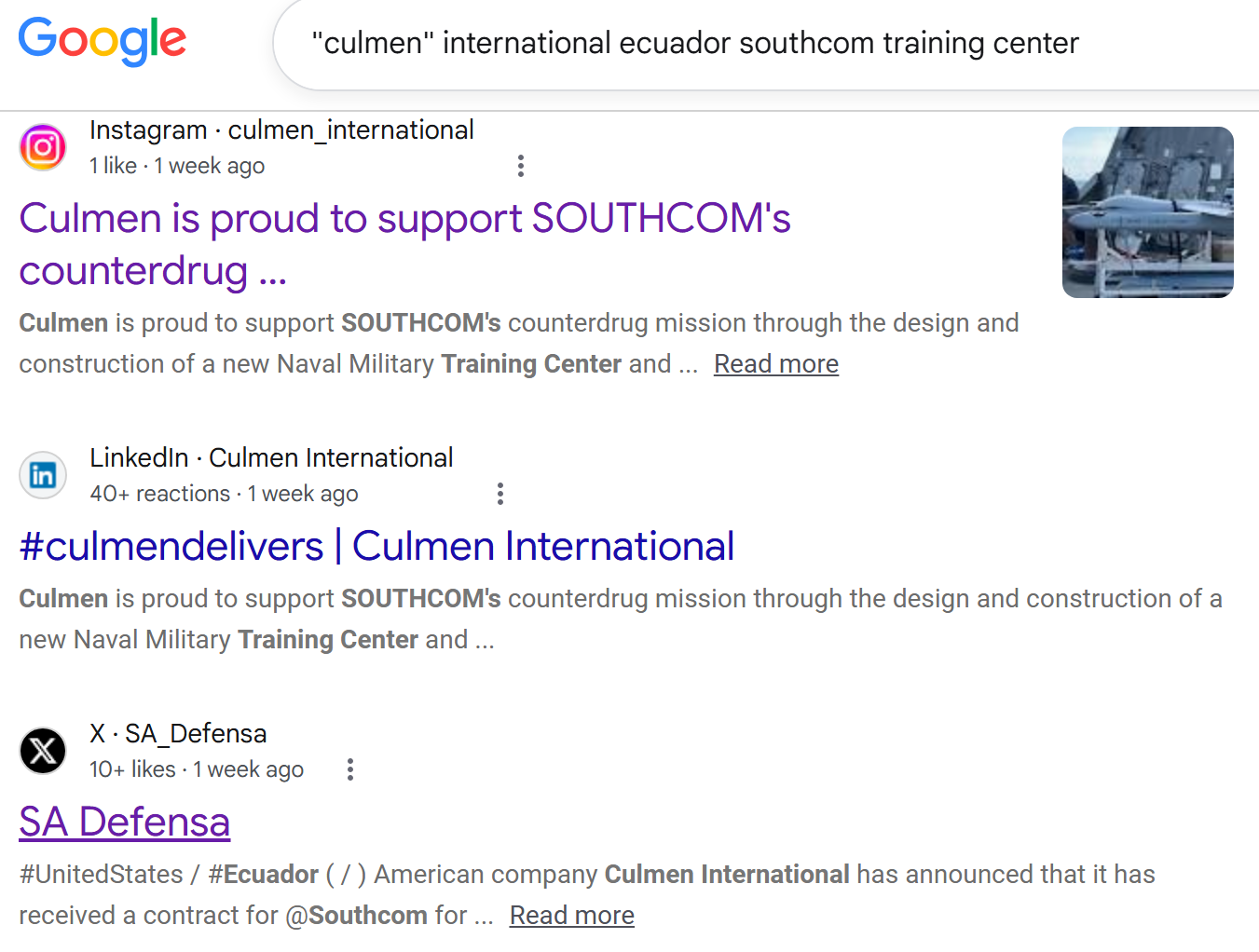
We saw the LinkedIn post on a Signal group, but when we clicked on it, LinkedIn said the post was removed. A Google search turned up listings for the company's two social media posts, as well as the SA Defensa post. The Instagram link on Google also shows the post as unavailable. A look at both social media feeds failed to turn up any copies of the post.
Why the announcements became unavailable, we can only speculate. One possible reason is the government preferred the project to remain off the public's radar, due to political sensitivities regarding US activities in Ecuador. Another is that company management, taking note of the murderous US boat strikes, some of which seem related to Ecuador, and of a strike on a purported drug trafficking headquarters in Ecuador that turned out to be a dairy farm, want to minimize the chances that their involvement with the Trump administration's radical counterdrug programs in Latin America will get scrutinized in future criminal investigations.
Preserved screenshots, captured October 23. Select an image to view it at full size.
Signal link preview Signal preserves the LinkedIn announcement.
| Search listings Google preserves listings for both posts.
| Instagram unavailable The post is no longer available.
| News coverage SA Defensa reports the contract.
|

Psychedelics
VA Selects Ten Sites to Prepare for Possible Psychedelic Treatment Rollout. Psychedelic Alpha reported on Thursday that senior adviser Andrew Gradison said at an October 15 healthcare forum that the Department of Veterans Affairs (VA) has selected ten initial sites to prepare to provide psychedelic therapies if the medicines become commercially available. Gradison did not name the sites. He warned that treating even 1,000 patients in the first year could be problematic because those therapies require substantial staffing and resources. The VA plans to study the initial rollout to guide further implementation. The planned rollout remains contingent on FDA approval and commercial availability of the treatments.
European Clinicians Describe Access and Funding Barriers for Psychedelic Therapies. A report today by Ryan Khan in Psychedelic Alpha examines how European health systems are preparing treatment access before conventional drug approvals. The article focuses on the October 8-9 TAIP conference in Estonia, where clinicians described Norway's publicly funded ketamine treatment model, Germany's limited psilocybin compassionate-use program, and Switzerland's case-by-case permissions. The report also describes preliminary findings from a British ketamine-assisted therapy pilot designed to fit existing NHS services; they should not be treated as randomized trial results. Clinicians cited obstacles including payment for lengthy supervised sessions, staff training, and equitable access. The report says Norway's expansion of ketamine treatment to include acute suicidal crises was approved in August, with implementation protocols still being developed.
Research
Medical Cannabis and Autism, Public Views of Legalization
A new Minnesota Office of Cannabis Management report examines 1,645 people with autism spectrum disorder who bought medical cannabis after entering the program between August 2018 and July 2024. Among participants reporting at least moderate anxiety initially, 34.3% reported a reduction of at least 30% within four months that persisted for another four months. Twenty percent reported an adverse effect, most commonly dry mouth; the report cautions that its questionnaire may miss severe effects. The observational study had no control group and did not account for other treatments, so it cannot establish that cannabis caused the improvements. Behavioral questionnaire results came from only 46 participants, a small and potentially unrepresentative subset. The report was released October 1 and highlighted in the agency's October 19 newsletter.
A University of Massachusetts Amherst/WCVB poll released October 21 found that Massachusetts voters generally view marijuana legalization favorably. Positive assessments reached 70% for tax revenue, 65% for the economy, 56% for local communities and 52% for the criminal justice system. Views of its effects on young people were more divided: 39% positive, 31% negative and 30% neutral. The survey measured voters' perceptions, rather than independently measuring legalization's effects. It was conducted October 5-12.
This work by StoptheDrugWar.org is licensed under Creative Commons Attribution-ShareAlike 4.0 International


Add new comment