Policing

RSS Feed for this category

This Week's Corrupt Cops Stories

A St. Louis cop is headed for federal prison for re-selling seized pot, a Camden cop is heading there, too, for running amok in the drug war, a Miami cop awaits sentencing for transporting what he thought was cocaine, and a Baltimore jail guard gets popped for smuggling weed and psychedelics into the jail. Let's get to it:

In Baltimore, a Baltimore jail guard was arrested last Friday on charges he was smuggling drugs into Central Booking. Guard Michael McCain, 44, was indicted on eight drug counts, including possession with intent to distribute marijuana and 5-methoxy-diisopropyltryptamine, better known as "Foxy Methoxy," a psychedelic.

In Miami, a Miami-Dade police officer was convicted last Wednesday of helping to transport shipments of what he thought was cocaine on behalf of a man he believed was a South Beach club manager, but who instead turned out to be an undercover FBI agent. Officer Daniel Mack was convicted of conspiracy to possess and distribute multiple kilos of cocaine and using a firearm in the commission of a crime. He is looking at 15-to-life when he is sentenced in December. Mack was convicted along with two other men of transporting 19 kilos of what they thought was cocaine from Miami Beach to Aventura. They were paid $25,000 for their efforts. Mack had been suspended without pay pending trial; he will now be fired.

In Camden, New Jersey, a former Camden police officer was sentenced last Wednesday to 20 months in federal prison for stealing money during drug raids, illegally searching homes, planting evidence, and lying in court. He copped to conspiracy and deprivation of civil rights. Kevin Parry, 32, was one of four Camden police officers arrested on corruption charges in 2010. He got a reduced sentence because he testified in the trial of one of the others. Two of the others also pleaded guilty and are now doing time, while a third awaits sentencing. Camden County prosecutors dropped the charges in 210 cases in which the quartet was involved.

In St. Louis, a former St. Louis police officer was sentenced Monday to five years in federal prison for seizing marijuana, then working with his brother to sell it on the streets. Larry Davis, 46, was a supervisory agent for a unit doing drug investigations, and he admitted seizing packages containing marijuana from delivery businesses, then selling the weed. His brother also got federal prison time, but only a year.

Texas Woman Jailed for Outing Narc on Facebook

In a case that would appear to raise First Amendment questions, a Mesquite, Texas, woman has been arrested and charged with a felony after she allegedly posted a photograph of an undercover narcotics officer on Facebook and identified him as a narc. Melissa Walthall, 30, was charged with felony retaliation after Mesquite police deemed her post "a viable threat to the officer's safety."

Do citizens have the right to identify police officers? (earthisland.org)
The photo was copied from the officer's own Facebook page.

Walthall got into trouble after an acquaintance of hers went to the Mesquite Police and told them a photograph of a man labeled "Undercover Mesquite Narcotics" had appeared on her newsfeed. "Anyone know this bitch?" asked the caption below the photo.

Walthall reportedly told police she had seen the photo on a flyer several weeks earlier and had posted it on Facebook because a friend of hers was unhappy with the narc's testimony in a drug trial. Walthall refused to snitch out her friend, but a police computer search led them to a George Pickens.

Pickens told police he and his brother, Bobby Stedham, had begun researching the narc online and found his Facebook page and photograph, then used the photo to make flyers with the intent to display them locally "like garage sale signs."

Stedham now also faces a felony retaliation charge, while Pickens was hit with drugs and weapons charges after police found an ounce of meth and a sawed-off shotgun at his residence.

Law enforcement spokesmen defended the arrests.

"It's a very dangerous situation," said Kevin Lawrence, executive director of the Texas Municipal Police Association. "If you're trying to infiltrate a cartel, a drug ring, a gang, one of the keys is people have to believe you're not an officer. Anything that hints at tying you to law enforcement is very dangerous," he said.

Walthill and Stedham's flyers and Facebook posts did not call for retaliation against the narc, but merely identified him, raising interesting First Amendment questions. It will be interesting to see if they fight the charges, and if they get any help from civil libertarians.

Mesquite, TX
United States

Decriminalize Drug Possession, UK Experts Say

In a report six years in the making, the United Kingdom Drug Policy Commission, a non-governmental advisory body chaired by Dame Edith Runciman, has called for a reboot of British drug policy and for decriminalizing the possession of small amounts of drugs for personal use.

The report, A Fresh Approach to Drugs, found that the UK is wasting much of the $4.8 billion a year it spends fighting illegal drugs, and that the annual cost to the country of hard drug use was about $20 billion. A smarter set of drug policies emphasizing prevention, diversion, and treatment would be a more effective use of public resources, the report found.

Some 42,000 people in the UK are convicted each year of drug possession offenses and another 160,000 given citations for marijuana possession. Arresting, citing, and jailing all those people "amounts to a lot of time and money for police, prosecution, and courts," the report said.

"To address these costs, there is evidence to suggest that the law on the possession of small amounts of controlled drugs, for personal use only, could be changed so that it is no longer a criminal offence. Criminal sanctions could be replaced with simple civil penalties, such as a fine, perhaps a referral to a drug awareness session run by a public health body, or if  there was a demonstrable need, to a drug treatment program. The evidence from other countries that have done this is that it would not necessarily lead to any significant increase in use, while providing opportunities to address some of the harms associated with existing drug laws," the report recommended.

"Given its relatively low level of harm, its wide usage, and international developments, the obvious drug to focus on as a first step is cannabis, which is already subject to lesser sanctions than previously with the use of cannabis warnings. If evaluations indicated that there were no substantial negative consequences, similar incremental measures could be considered, with caution and careful further evaluation, for other drugs," the report said.

But while the commission was ready to embrace decriminalization, it was not ready to go as far as legalizing drug sales.

"We do not believe that there is sufficient evidence at the moment to support the case for removing criminal penalties for the major production or supply offenses of most drugs," it said.

Still, policymakers might want to consider lowering the penalties for growing small numbers of marijuana plants to "undermine the commercialization of production, with the associated involvement of organized crime."

The report also called for a review of harsh sentences for drug offenses, a consistent framework for regulating all psychoactive substances -- from nicotine to heroin -- and for moving the policy prism through which drug policy is enacted from the criminal justice system to the public health system.

But the Home Office, which currently administers drug policy in Britain, wasn't having any of it. Things are going swimmingly already, a Home Office spokesperson said.

"While the government welcomes the UKDPC's contribution to the drugs debate, we remain confident that our ambitious approach to tackling drugs -- outlined in our drugs strategy -- is the right one," the spokesperson said. "Drug usage is at its lowest level since records began. Drug treatment completions are increasing and individuals are now significantly better placed to achieve recovery and live their lives free from drugs. "I want to take this opportunity to thank the UKDPC for its work in this area over the past six years."

United Kingdom

Amnesty Raps Mexico on Human Rights Abuses in Drug War

Mexico must take decisive action to rein in systematic and widespread use of torture, ill-treatment, and other human rights abuses, which have increased dramatically since outgoing President Felipe Calderon unleashed the military to fight the country's so-called cartels nearly six years ago, Amnesty International said in a report released last Thursday.

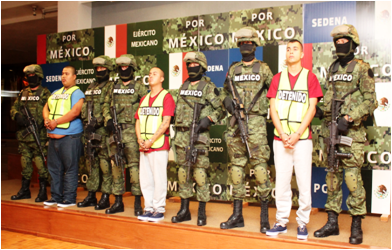
Mexican military displaying detainees (sedena.gob.mx)
The report, Known Abusers, But Victims Ignored: Torture and Ill-Treatment in Mexico, documents the increase of cases of torture and ill-treatment by the police and military forces, the lack of effective investigations and almost total lack of prosecutions, and the juridical weaknesses and lack of political will that allow such abuses to go unpunished and even allow testimony obtained through torture to be used to convict its victims.

An estimated 60,000 people have been killed and another 160,000 displaced in prohibition-related violence in Mexico since Calderon made waging the drug war the centerpiece of his then new administration in December 2006. The cartels are responsible for much of the mayhem, but as the violence intensified, human rights complaints filed with federal authorities have more than quadrupled, from 392 in 2007 to 1669 in 2011. Nearly 5,000 federal complaints have been filed overall, and those are just the cases when someone bothered to go through the formality of a process that too often produces no results.

And, the Amnesty report shows, it is mainly just a formality. According to the report, federal prosecutors prosecuted no torture cases in 2007 or 2008, one in 2009, and filed four more in 2010. Similarly, the number of state level torture prosecutions can be counted in the single digits each year since 2007.

"The Calderón administration has effectively turned a blind eye to the 'torture epidemic' we've been witnessing in Mexico," said Rupert Knox, an Amnesty International Mexico researcher. "The protection of human rights has been ignored or sidelined in favor of the government's strategy of militarized combat of organized crime and drug cartels. Across Mexico criminal suspects often face detention and trial on the basis of evidence obtained under torture and ill-treatment while prosecutors and courts fail to question seriously information or evidence obtained in this manner."

Miriam Isaura López Vargas is a case in point. She was arbitrarily detained in Ensenada, Baja California, on February 2, 2011. During interrogation in a military barracks in Tijuana by a civilian federal prosecutor, members of the army reportedly sexually assaulted her, subjected her to near asphyxiation and stress positions, and threatened her in order to coerce her into signing a confession falsely implicating other detainees in drug trafficking offenses.

"I heard a man scream many times, they kept on asking him, 'Where are the guns, where are the drugs?' A bit later I heard 'Take him away and bring me the next one.' I heard them open a door," Lopez Vargas recounted. "They put a wet cloth over my face, when I tried to breathe. I felt the wet cloth, it became difficult to breathe, I then felt a stream of water up my nose, I tried to get up but couldn't because they had me held down by my shoulders and legs… someone was pressing down on my stomach, they did this repeatedly as they kept on asking the same questions."

A week later, she was transferred to Mexico City and held without being brought before a judge until April 26, 2011, when she was charged with drug offenses. The following month, the case against her collapsed, and she was released by a federal judge. She filed a complaint alleging she was tortured; it has yet to be acted on.

The involvement of the Mexican military in the Lopez Vargas is not unusual. Across Mexico,  military personnel performing policing functions have held thousands of suspects in military barracks before presenting them to prosecutors. In this context, there have been numerous reports of torture and ill-treatment while in military custody.

"Federal authorities have shown an absolute lack of leadership to combat torture and ill-treatment seriously at the state level or federal level," said Knox. "The only way to tackle torture and ill-treatment is by ensuring that all cases are properly investigated and those responsible, brought to justice. In a letter sent to Amnesty International, Mexican President elect Enrique Peña Nieto committed to implement policies and take action to end torture, we urge the authorities to abide by their promises."

Mexico

Louisiana Man Dies in Car Crash Fleeing Drug Bust

A Morgan City, Louisiana, man was killed last Wednesday when he got into a fatal car crash while attempting to flee deputies doing a narcotics investigation. Irvian Singleton, 44, becomes the 50th person to die so far this year in domestic drug law enforcement operations.

According to the Louisiana State Police, Singleton was fleeing from St. Mary Parish deputies who were attempting to stop him for a drug investigation. His car crossed the center line as he fled from pursuing deputies, and he struck another vehicle, which flipped his car over. Singleton, who was not wearing a seat belt, was pronounced dead at the scene. The other driver was hospitalized with non-life threatening injuries.

According to the St. Mary Parish Sheriff's Department
, members of the Narcotics Division suspected Singleton had drugs in the vehicle when he drove away.

"It is believed right now that the suspect did possibly have narcotics in that vehicle," the sheriff's department said. "So, as a result, we actually have a dual investigation that's taking place right now with the state police as well as the sheriff's department."

This Week's Corrupt Cops Stories

Some Michigan narcs were up to no good, a New Mexico probation officer gets caught carrying pounds of weed, a New York City prison guard gets caught peddling pot and placebos (!) to prisoners, and a Florida cop gets caught stealing weed to use as probable cause for a search warrant. Just another week in the drug war. Let's get to it:

In Eastpointe, Michigan, one Eastpointe officer has resigned and another faces a departmental hearing amidst allegations that they mishandled drugs used in investigations and sold seized items on Craigslist. The two as yet unidentified officers were both members of the department's drug enforcement unit. They are accused of using drugs for street buys without properly logging and accounting for them. They are also accused of selling seized items, including chrome wheels and flat-screen TVs on Craigslist, possibly in exchange for drugs. The case has been turned over to the Macomb County Prosecutor’s Office, where a decision on any potential criminal charges is not expected until next week at the earliest.

In Alamogordo, New Mexico, a state juvenile probation officer was arrested September 26 at a US Customs and Border Protection checkpoint with 9.7 pounds of marijuana in his vehicle. Saul Velasco, 37, is charged with possession with intent to distribute marijuana. Velasco was on duty and driving a state vehicle when arrested. There were 10 bundles of weed in his car, for which he allegedly paid $2,500 to a man he met at a restaurant near El Paso, Texas. He was scheduled for a preliminary hiring last Friday, but we have no word on how that went.

In New York City, a Rikers Island prison guard was arrested last Thursday on charged he took bribes and provided marijuana and placebo drugs to inmates. Lashar Williams, 38, a 13-year Department of Corrections veteran, went down after the department heard that he brought $200 worth of weed into the Anna M. Kross Center on Rikers in March. He was then found to have provided one inmate with two suboxone strips for $100 and, on a separate occasion that same month, having provided another inmate with what was supposed to be $700 worth of Oxycontin, but was actually placebos. He has now been indicted on 27 counts, including bribe receiving in the third degree, promoting prison contraband in the first degree, criminal possession and sale of a controlled substance in the fifth degree and receiving reward for official misconduct in the second degree. He has now been suspended with pay.

In Pensacola, Florida, a former Crestview police officer was arrested last Friday for stealing marijuana from a SWAT locker and using it to falsely establish probable cause for a search warrant. Timothy White, 26, falsely claimed the pot came from a local residence and used that claim to secure a search warrant. That warrant was not executed, but White was charged with one count of fabricating evidence and booked into the Okaloosa County Jail.

Two More Drug War Deaths -- Border Patrol Involved in Both

A San Diego housewife and an Arizona Border Patrol agent were both killed in recent separate incidents involving drug law enforcement. Housewife Valeria Tachiquin-Alvarado and Border Patrol agent Nicholas Ivie become the 48th and 49th persons to die in US domestic drug law enforcement operations so far this year.

Tachiquin-Alvarado, a 32-year-old mother of five and a US citizen, was shot and killed September 31 by an as yet unidentified Border Patrol agent as she attempted to leave the scene of a raid, according to Chula Vista police, who are investigating the killing. She was on probation for a 2011 drug conviction at the time.

The fatal encounter began when a group of plain clothes Border Patrol agents went to an apartment to arrest a previously deported felon at an apartment where there had been prior complaints of drug activity. Tachiquin-Alvarado answered the door, was questioned and released, then walked to her car nearby.

Other Border Patrol agents then "contacted" her as she prepared to drive away. She then allegedly pulled away from the curb, striking one of the agents. The agents then told her she was under arrest for vehicular assault and tried to grab her car keys from the ignition. But Tachiquin-Alvarado instead pulled away, striking the first agent again and leaving him perched on the hood of her car.

She drove off at speeds of around 25 mph as the agent yelled at her to stop the car. After driving about 200 yards, Tachiquin-Alvarado began to make a turn, and the agent on her hood drew his gun and fired repeatedly into the windshield, killing her.

Police said they have witnesses to confirm their version, but other witnesses gave a different account.

"I just witnessed the officer walking toward the female's car. She was backing up and then he discharged, his weapon started firing," said Prince Watson, a witness.

Chula Vista police are continuing to investigate and will forward the results to the District Attorney's Office for a ruling on whether the shooting was justified. But Tachiquin-Alvarado's family is not waiting for the investigation to be completed. They held a tearful news conference and candlelight vigil near the scene of the shooting last Monday, and a family attorney has vowed that a civil suit will be filed.

Oh, and the guy the Border Patrol was looking for? They didn't find him.

Then, in the pre-dawn hours last Tuesday, Border Patrol Agent Ivie was shot and killed and a second agent wounded in what federal investigators are now calling a friendly fire incident. According to the FBI, which is investigating the case, Ivie and other agents responded to a tripped sensor that indicated movement in a remote border area "described as a drug-trafficking corridor used by the Sinaloa cartel to smuggle marijuana and other drugs into the US."

Three agents approached the area of the tripped sensor from different directions, perhaps without knowing the others were so close, lost radio contact with each other, then "Ivie got spooked and started to shoot" and "another agent shot back and those bullets killed Ivie," according to an Arizona law enforcement source.

The FBI would only go as far saying there were "strong preliminary indications" that Ivie's death and the wounding of the other agent were "the result of an accidental shooting involving only the agents."

But Arizona law enforcement sources said there was no evidence of illegal border crossers in the area, that the motion sensors sometimes give false indications, and that shell casings on the scene suggested a "blue on blue, friendly-fire event."

This Week's Corrupt Cops Stories

A former Pennsyvlania prosecutor gets caught peddling pot, and a TSA agent and an Alabama cop head to prison for taking bribes from drug dealers. Let's get to it:

In Bellefonte, Pennsylvania, a former Centre County assistant DA was arraigned Tuesday on charges he distributed marijuana. Former Assistant DA Steve Sloane faces seven felony counts after he got caught accepting Fedex packages from California that contained drugs. Sloane has admitted he had been addicted to Oxycontin and also admitted receiving several packages containing hydrocodone pills and marijuana from an old friend in California. Sloane denied selling pot to anyone, but police interviewed several witnesses who said they bought from him. He is currently free on a $100,000 bond.

In Birmingham, Alabama, a former Jasper police officer was sentenced last Wednesday to 15 months in federal prison for accepting a bribe from a drug dealer. Scottie Wilkins, 30, had borrowed money from the dealer, who was on probation, then paid him back by selling him drugs out of the evidence room. He also took a bribe from the dealer to help him out with a probation matter.

In New Haven, Connecticut, a former TSA officer was sentenced Tuesday to six years and four months in federal prison for accepting bribes to allow prescription pain pills to travel unimpeded through airport security. Jonathan Best, 31, had pleaded guilty in April to conspiracy to distribute and to possess with intent to distribute oxycodone. Best admitted accepting cash from a drug dealer to allow oxycodone pills through airport security and agreed last year to travel to Connecticut to help the trafficker launder drug proceeds. Two other former TSA officers, a former New York police officer and an ex-Florida state trooper have also pleaded guilty in the case.

Peru Coca Crop Keeps Getting Bigger

coca leaf statures, Rio Apurimac Valley (stopthedrugwar.org)
Coca cultivation in Peru increased again last year, up 5.2% over 2010, according to the 2011 coca monitoring survey conducted by the United Nations Office on Drugs and Crime and the Peruvian government. That was the sixth straight year of increases in coca cultivation and leaves Peru just behind Colombia when it comes to acres planted.

The survey estimated Peruvian coca planting at 157,000 acres, with government-led eradication efforts destroying only about 25,000 acres, down 14% from the previous year. The UNODC estimated total coca leaf output of 131,3000 tons, up 4.3% over 2010.

Half of the Peruvian crop is planted in the Apurimac, Ene, and Mantaro valley region in the southeast, but the biggest increase in cultivation came in the northern states of Bajo Amazonas, Maranon, and Putumayo, with a regional increase of 40.4%.  Production in those states is on the increase to meet the demand for cocaine and crack cocaine in Europe and Brazil, which is the second leading consumer country after the United States.

"Drug traffickers are becoming more efficient," said Flavio Mirella, the head of the agency's Peruvian office, at a Lima press conference. "Traffickers need less coca leaf to produce more cocaine. Routes of supply are diversifying and producing areas are getting closer to certain routes of exit" toward Brazil and through Bolivia to Brazil and beyond.

Guerrillas of the leftist Shining Path have also been involved in the coca and cocaine trade, and have stepped up attacks on Peruvian police and military this year. President Ollanta Humala has vowed to increase both eradication and the presence of the state in remote, guerrilla-infested coca production areas.

Peru

This Week's Corrupt Cops Stories

It's been a fairly quiet week on the corrupt cop front, but we've still got some Missouri jail guards in trouble, a Houston cop accused of helping to peddle Ecstasy, and a Baltimore cop who did heroin deals in the police station parking lot. Let's get to it:

In Nevada, Missouri, two former Vernon County jailers were charged last Wednesday  with delivery or possession of marijuana at the county jail. Former guards Colby Prough, 39, and James Tumm, 23, face felony marijuana distribution charges, as do one inmate and one civilian.

In Houston, a Harris County sheriff's deputy was arrested last Thursday on charges he assisted others who were selling Ecstasy in the area. Jesus Martinez, 30, now faces federal Ecstasy conspiracy charges and is looking at up to 20 years in prison and a $1 million fine. The five-year veteran was fired last Friday.

In Baltimore, a Baltimore police officer was sentenced last Wednesday to 20 years in federal prison for trafficking in heroin. Daniel Redd, 40, admitted in his plea agreement to meeting with a co-conspirator to score 40 grams of smack while on duty in one incident and to distributing 200 grams of heroin to another co-conspirator in a police station parking lot while on the job and in uniform.

Drug War Issues

Criminal JusticeAsset Forfeiture, Collateral Sanctions (College Aid, Drug Taxes, Housing, Welfare), Court Rulings, Drug Courts, Due Process, Felony Disenfranchisement, Incarceration, Policing (2011 Drug War Killings, 2012 Drug War Killings, 2013 Drug War Killings, Arrests, Eradication, Informants, Interdiction, Lowest Priority Policies, Police Corruption, Police Raids, Profiling, Search and Seizure, SWAT/Paramilitarization, Task Forces, Undercover Work), Probation or Parole, Prosecution, Reentry/Rehabilitation, Sentencing (Alternatives to Incarceration, Clemency and Pardon, Crack/Powder Cocaine Disparity, Death Penalty, Decriminalization, Drug Free Zones, Mandatory Minimums, Rockefeller Drug Laws, Sentencing Guidelines)CultureArt, Celebrities, Counter-Culture, Music, Poetry/Literature, Television, TheaterDrug UseParaphernalia, ViolenceIntersecting IssuesCollateral Sanctions (College Aid, Drug Taxes, Housing, Welfare), Violence, Border, Budgets/Taxes/Economics, Business, Civil Rights, Driving, Economics, Education (College Aid), Employment, Environment, Families, Free Speech, Gun Policy, Human Rights, Immigration, Militarization, Money Laundering, Pregnancy, Privacy (Search and Seizure, Drug Testing), Race, Religion, Science, Sports, Women's IssuesMarijuana PolicyGateway Theory, Hemp, Marijuana -- Personal Use, Marijuana Industry, Medical MarijuanaMedicineMedical Marijuana, Science of Drugs, Under-treatment of PainPublic HealthAddiction, Addiction Treatment (Science of Drugs), Drug Education, Drug Prevention, Drug-Related AIDS/HIV or Hepatitis C, Harm Reduction (Methadone & Other Opiate Maintenance, Needle Exchange, Overdose Prevention, Safe Injection Sites)Source and Transit CountriesAndean Drug War, Coca, Hashish, Mexican Drug War, Opium ProductionSpecific DrugsAlcohol, Ayahuasca, Cocaine (Crack Cocaine), Ecstasy, Heroin, Ibogaine, ketamine, Khat, Marijuana (Gateway Theory, Marijuana -- Personal Use, Medical Marijuana, Hashish), Methamphetamine, Nicotine, Prescription Opiates (Fentanyl, Oxycontin), Psychedelics (LSD, Mescaline, Peyote, Salvia Divinorum), Synthetic Drugs (Mephedrone, Synthetic Cannabinoids)YouthGrade School, Post-Secondary School, Raves, Secondary School